

E1C12 09/14/2010
13:54:14 Page 549
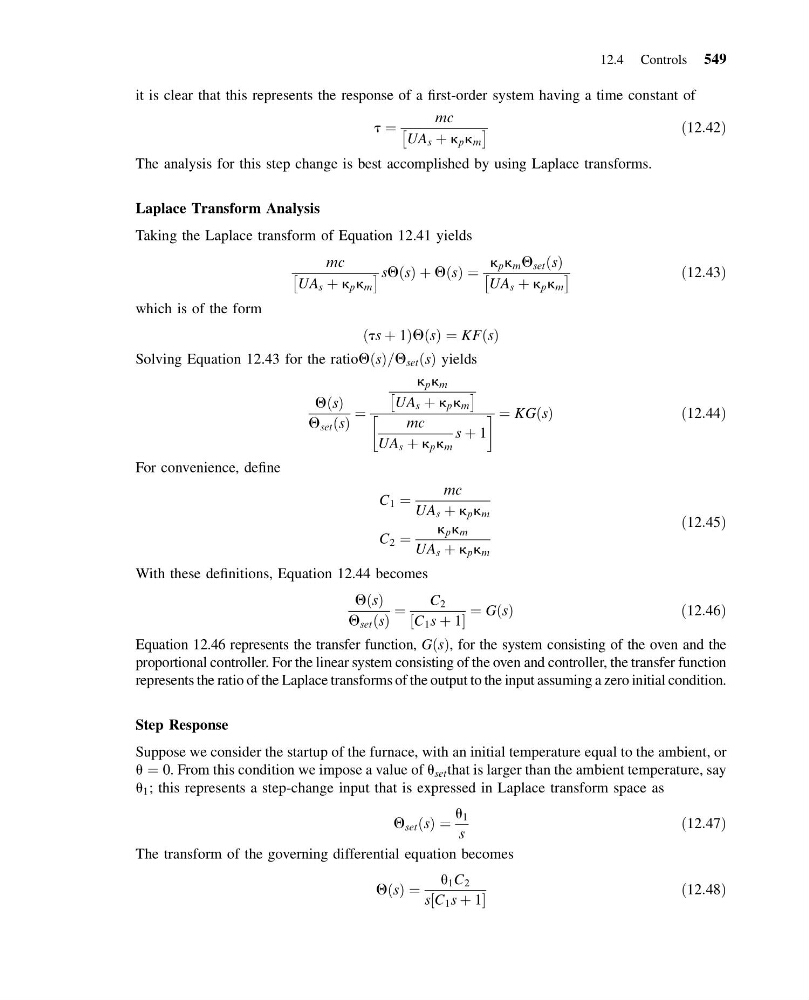
it is clear that this represents the response of a first-order system having a time constant of
t ¼
mc
UA s þ k p k m
Â
Ã
ð12:42Þ
The analysis for this step change is best accomplished by using Laplace transforms.
Laplace Transform Analysis
Taking the Laplace transform of Equation 12.41 yields
mc
UA s þ k p k m
Â
à sQ s
ð Þ þ Q s
ð Þ ¼
k p k m Q set s
ð Þ
UA s þ k p k m
Â
Ã
ð12:43Þ
which is of the form
ðts þ 1ÞQ s
ð Þ ¼ KFðsÞ
Solving Equation 12.43 for the ratioQ s
ð Þ=Q set s
ð Þ yields
Q s
ð Þ
Q set s
ð Þ
¼
k p k m
UA s þ k p k m
Â
Ã
mc
UA s þ k p k m
s þ 1
! ¼ KGðsÞ
ð 12:44Þ
For convenience, define
C 1 ¼
mc
UA s þ k p k m
C 2 ¼
k p k m
UA s þ k p k m
ð12:45Þ
With these definitions, Equation 12.44 becomes
Q s
ð Þ
Q set s
ð Þ
¼
C 2
C 1 s þ 1
½
¼ GðsÞ
ð 12:46Þ
Equation 12.46 represents the transfer function, GðsÞ, for the system consisting of the oven and the
proportional controller. For the linear system consisting of the oven and controller, the transfer function
represents the ratio of the Laplace transforms of the output to the input assuming a zero initial condition.
Step Response
Suppose we consider the startup of the furnace, with an initial temperature equal to the ambient, or
u ¼ 0. From this condition we impose a value of u set that is larger than the ambient temperature, say
u 1 ; this represents a step-change input that is expressed in Laplace transform space as
Q set s
ð Þ ¼
u 1
s
ð12:47Þ
The transform of the governing differential equation becomes
Q s
ð Þ ¼
u 1 C 2
s C 1 s þ 1
½
ð12:48Þ
12.4 Controls 549
13:54:14 Page 549
it is clear that this represents the response of a first-order system having a time constant of
t ¼
mc
UA s þ k p k m
Â
Ã
ð12:42Þ
The analysis for this step change is best accomplished by using Laplace transforms.
Laplace Transform Analysis
Taking the Laplace transform of Equation 12.41 yields
mc
UA s þ k p k m
Â
à sQ s
ð Þ þ Q s
ð Þ ¼
k p k m Q set s
ð Þ
UA s þ k p k m
Â
Ã
ð12:43Þ
which is of the form
ðts þ 1ÞQ s
ð Þ ¼ KFðsÞ
Solving Equation 12.43 for the ratioQ s
ð Þ=Q set s
ð Þ yields
Q s
ð Þ
Q set s
ð Þ
¼
k p k m
UA s þ k p k m
Â
Ã
mc
UA s þ k p k m
s þ 1
! ¼ KGðsÞ
ð 12:44Þ
For convenience, define
C 1 ¼
mc
UA s þ k p k m
C 2 ¼
k p k m
UA s þ k p k m
ð12:45Þ
With these definitions, Equation 12.44 becomes
Q s
ð Þ
Q set s
ð Þ
¼
C 2
C 1 s þ 1
½
¼ GðsÞ
ð 12:46Þ
Equation 12.46 represents the transfer function, GðsÞ, for the system consisting of the oven and the
proportional controller. For the linear system consisting of the oven and controller, the transfer function
represents the ratio of the Laplace transforms of the output to the input assuming a zero initial condition.
Step Response
Suppose we consider the startup of the furnace, with an initial temperature equal to the ambient, or
u ¼ 0. From this condition we impose a value of u set that is larger than the ambient temperature, say
u 1 ; this represents a step-change input that is expressed in Laplace transform space as
Q set s
ð Þ ¼
u 1
s
ð12:47Þ
The transform of the governing differential equation becomes
Q s
ð Þ ¼
u 1 C 2
s C 1 s þ 1
½
ð12:48Þ
12.4 Controls 549