

E1C12 09/14/2010
13:54:13 Page 542
in Figure 12.42. A key element here is that there is the possibility of a disturbance that would
influence the rate of change of the inside temperature. Suppose a delivery arrives and the door
remains open for a period of time. The thermostat must then respond to this disturbance and attempt
to maintain the inside temperature at the set point.
Essentially all practical implementations of on–off control systems require a dead band that
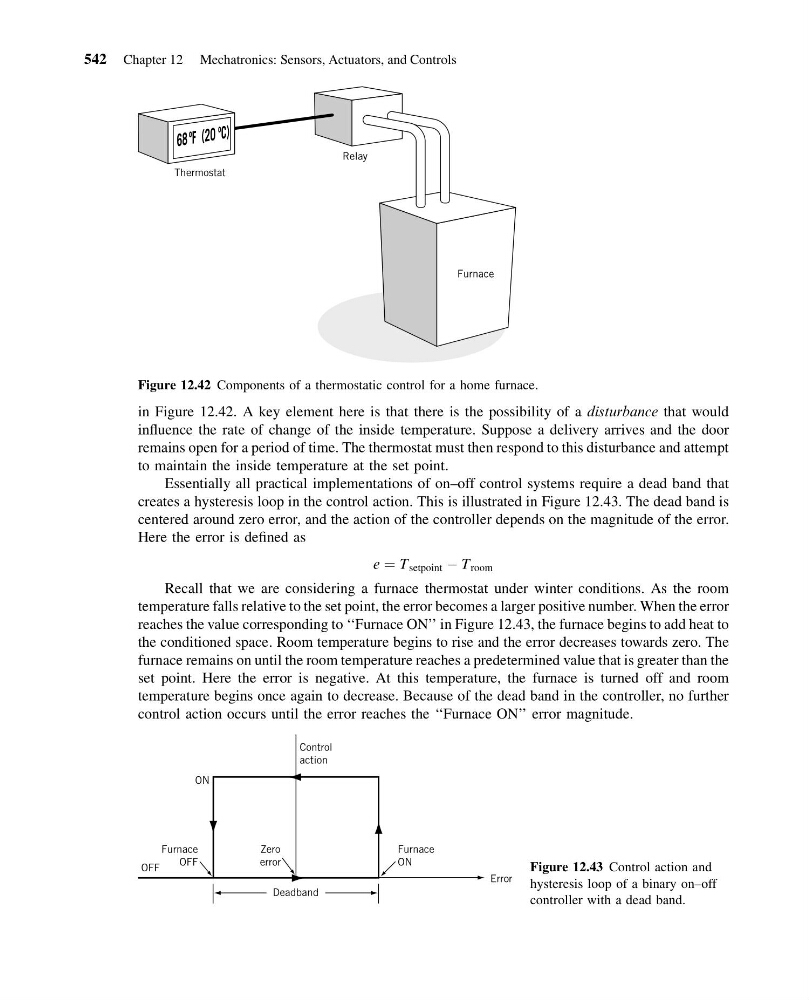
creates a hysteresis loop in the control action. This is illustrated in Figure 12.43. The dead band is
centered around zero error, and the action of the controller depends on the magnitude of the error.
Here the error is defined as
e ¼ T setpoint À T room
Recall that we are considering a furnace thermostat under winter conditions. As the room
temperature falls relative to the set point, the error becomes a larger positive number. When the error
reaches the value corresponding to ‘‘Furnace ON’’ in Figure 12.43, the furnace begins to add heat to
the conditioned space. Room temperature begins to rise and the error decreases towards zero. The
furnace remains on until the room temperature reaches a predetermined value that is greater than the
set point. Here the error is negative. At this temperature, the furnace is turned off and room
temperature begins once again to decrease. Because of the dead band in the controller, no further
control action occurs until the error reaches the ‘‘Furnace ON’’ error magnitude.
Thermostat
Relay
68 ºF (20 ºC)
Furnace
Figure 12.42 Components of a thermostatic control for a home furnace.
Deadband
Furnace
ON
Furnace
OFF
Control
action
Zero
error
ON
OFF
Error
Figure 12.43 Control action and
hysteresis loop of a binary on–off
controller with a dead band.
542 Chapter 12 Mechatronics: Sensors, Actuators, and Controls
13:54:13 Page 542
in Figure 12.42. A key element here is that there is the possibility of a disturbance that would
influence the rate of change of the inside temperature. Suppose a delivery arrives and the door
remains open for a period of time. The thermostat must then respond to this disturbance and attempt
to maintain the inside temperature at the set point.
Essentially all practical implementations of on–off control systems require a dead band that
creates a hysteresis loop in the control action. This is illustrated in Figure 12.43. The dead band is
centered around zero error, and the action of the controller depends on the magnitude of the error.
Here the error is defined as
e ¼ T setpoint À T room
Recall that we are considering a furnace thermostat under winter conditions. As the room
temperature falls relative to the set point, the error becomes a larger positive number. When the error
reaches the value corresponding to ‘‘Furnace ON’’ in Figure 12.43, the furnace begins to add heat to
the conditioned space. Room temperature begins to rise and the error decreases towards zero. The
furnace remains on until the room temperature reaches a predetermined value that is greater than the
set point. Here the error is negative. At this temperature, the furnace is turned off and room
temperature begins once again to decrease. Because of the dead band in the controller, no further
control action occurs until the error reaches the ‘‘Furnace ON’’ error magnitude.
Thermostat
Relay
68 ºF (20 ºC)
Furnace
Figure 12.42 Components of a thermostatic control for a home furnace.
Deadband
Furnace
ON
Furnace
OFF
Control
action
Zero
error
ON
OFF
Error
Figure 12.43 Control action and
hysteresis loop of a binary on–off
controller with a dead band.
542 Chapter 12 Mechatronics: Sensors, Actuators, and Controls