

E1C12 09/14/2010
13:54:13 Page 539
into this category. A three-way valve has three port connections: supply (P), exhaust (T), and service
(A). The service port may be switched between the supply and the exhaust. A four-way has four
connections: supply (P), exhaust (T), and two service ports (A and B). The valve connects either P to
A and B to T, or P to B and A to T. In general, an N-way valve has N-ports with N number of flow
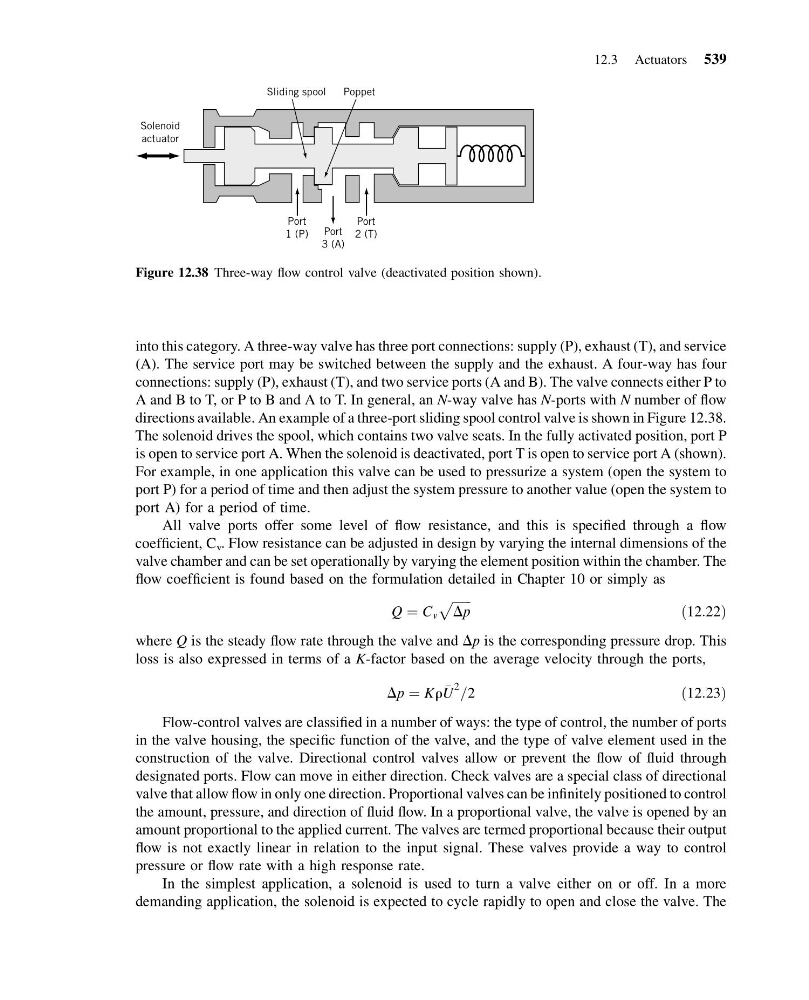
directions available. An example of a three-port sliding spool control valve is shown in Figure 12.38.
The solenoid drives the spool, which contains two valve seats. In the fully activated position, port P
is open to service port A. When the solenoid is deactivated, port T is open to service port A (shown).
For example, in one application this valve can be used to pressurize a system (open the system to
port P) for a period of time and then adjust the system pressure to another value (open the system to
port A) for a period of time.
All valve ports offer some level of flow resistance, and this is specified through a flow
coefficient, C v . Flow resistance can be adjusted in design by varying the internal dimensions of the
valve chamber and can be set operationally by varying the element position within the chamber. The
flow coefficient is found based on the formulation detailed in Chapter 10 or simply as
Q ¼ C v
ffiffiffiffiffiffi
Dp
p
ð12:22Þ
where Q is the steady flow rate through the valve and Dp is the corresponding pressure drop. This
loss is also expressed in terms of a K-factor based on the average velocity through the ports,
Dp ¼ Kr
U
2 =2
ð12:23Þ
Flow-control valves are classified in a number of ways: the type of control, the number of ports
in the valve housing, the specific function of the valve, and the type of valve element used in the
construction of the valve. Directional control valves allow or prevent the flow of fluid through
designated ports. Flow can move in either direction. Check valves are a special class of directional
valve that allow flow in only one direction. Proportional valves can be infinitely positioned to control
the amount, pressure, and direction of fluid flow. In a proportional valve, the valve is opened by an
amount proportional to the applied current. The valves are termed proportional because their output
flow is not exactly linear in relation to the input signal. These valves provide a way to control
pressure or flow rate with a high response rate.
In the simplest application, a solenoid is used to turn a valve either on or off. In a more
demanding application, the solenoid is expected to cycle rapidly to open and close the valve. The
Port
3 (A)
Poppet
Sliding spool
Solenoid
actuator
Port
1 (P)
Port
2 (T)
Figure 12.38 Three-way flow control valve (deactivated position shown).
12.3 Actuators 539
13:54:13 Page 539
into this category. A three-way valve has three port connections: supply (P), exhaust (T), and service
(A). The service port may be switched between the supply and the exhaust. A four-way has four
connections: supply (P), exhaust (T), and two service ports (A and B). The valve connects either P to
A and B to T, or P to B and A to T. In general, an N-way valve has N-ports with N number of flow
directions available. An example of a three-port sliding spool control valve is shown in Figure 12.38.
The solenoid drives the spool, which contains two valve seats. In the fully activated position, port P
is open to service port A. When the solenoid is deactivated, port T is open to service port A (shown).
For example, in one application this valve can be used to pressurize a system (open the system to
port P) for a period of time and then adjust the system pressure to another value (open the system to
port A) for a period of time.
All valve ports offer some level of flow resistance, and this is specified through a flow
coefficient, C v . Flow resistance can be adjusted in design by varying the internal dimensions of the
valve chamber and can be set operationally by varying the element position within the chamber. The
flow coefficient is found based on the formulation detailed in Chapter 10 or simply as
Q ¼ C v
ffiffiffiffiffiffi
Dp
p
ð12:22Þ
where Q is the steady flow rate through the valve and Dp is the corresponding pressure drop. This
loss is also expressed in terms of a K-factor based on the average velocity through the ports,
Dp ¼ Kr
U
2 =2
ð12:23Þ
Flow-control valves are classified in a number of ways: the type of control, the number of ports
in the valve housing, the specific function of the valve, and the type of valve element used in the
construction of the valve. Directional control valves allow or prevent the flow of fluid through
designated ports. Flow can move in either direction. Check valves are a special class of directional
valve that allow flow in only one direction. Proportional valves can be infinitely positioned to control
the amount, pressure, and direction of fluid flow. In a proportional valve, the valve is opened by an
amount proportional to the applied current. The valves are termed proportional because their output
flow is not exactly linear in relation to the input signal. These valves provide a way to control
pressure or flow rate with a high response rate.
In the simplest application, a solenoid is used to turn a valve either on or off. In a more
demanding application, the solenoid is expected to cycle rapidly to open and close the valve. The
Port
3 (A)
Poppet
Sliding spool
Solenoid
actuator
Port
1 (P)
Port
2 (T)
Figure 12.38 Three-way flow control valve (deactivated position shown).
12.3 Actuators 539