

E1C12 09/14/2010
13:54:9 Page 513
For vibration measurements, it is desirable to measure the amplitude of the displacements
associated with the vibrations; thus, the desired behavior of the seismic instrument would be to have
an output that gives a direct indication of y hs . For this to occur, the seismic mass should remain
stationary in an absolute frame of reference, and the housing and output transducer should move
with the vibrating object. To determine the conditions under which this behavior would occur, the
amplitude of y r at steady state can be examined. The ratio of the maximum amplitude of the output
divided by the equivalent static output is y r
ð Þ max =A. For vibration measurements, this ratio should
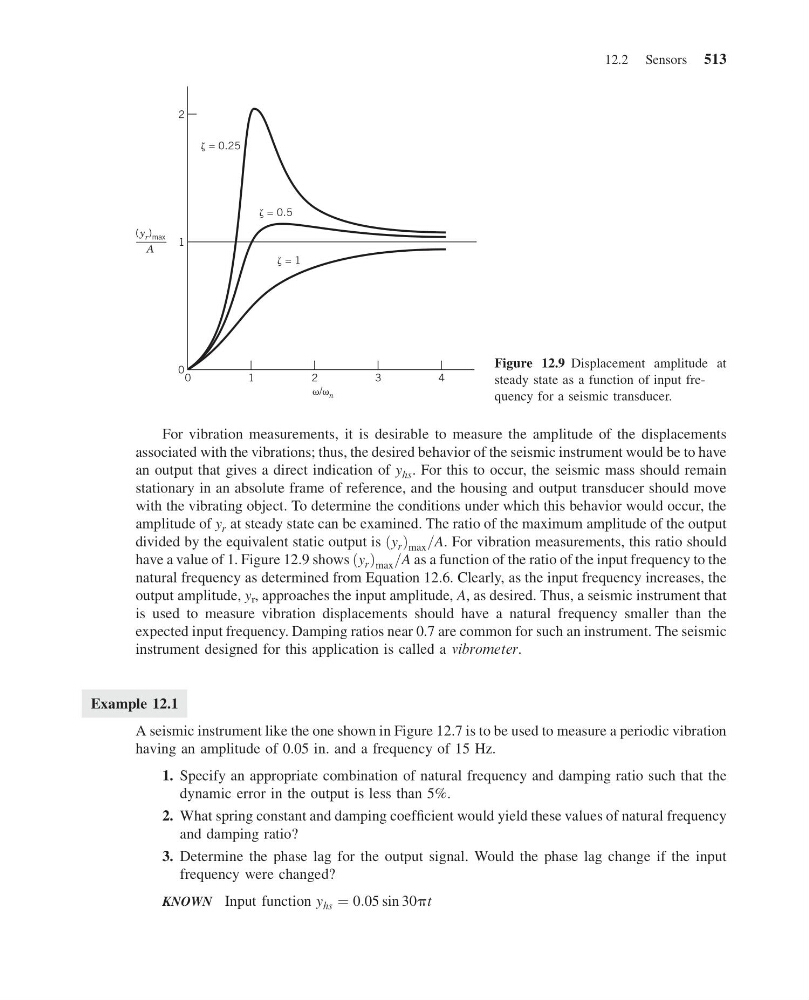
have a value of 1. Figure 12.9 shows y r
ð Þ max =A as a function of the ratio of the input frequency to the
natural frequency as determined from Equation 12.6. Clearly, as the input frequency increases, the
output amplitude, y r , approaches the input amplitude, A, as desired. Thus, a seismic instrument that
is used to measure vibration displacements should have a natural frequency smaller than the
expected input frequency. Damping ratios near 0.7 are common for such an instrument. The seismic
instrument designed for this application is called a vibrometer.
Example 12.1
A seismic instrument like the one shown in Figure 12.7 is to be used to measure a periodic vibration
having an amplitude of 0.05 in. and a frequency of 15 Hz.
1. Specify an appropriate combination of natural frequency and damping ratio such that the
dynamic error in the output is less than 5%.
2. What spring constant and damping coefficient would yield these values of natural frequency
and damping ratio?
3. Determine the phase lag for the output signal. Would the phase lag change if the input
frequency were changed?
KNOWN Input function y hs ¼ 0:05 sin 30pt
0
1
2
3
4
/ n
0
1
= 0.25
= 0.5
= 1
( y r ) max
A
2
Figure 12.9 Displacement amplitude at
steady state as a function of input frequency for a seismic transducer.
12.2 Sensors 513
13:54:9 Page 513
For vibration measurements, it is desirable to measure the amplitude of the displacements
associated with the vibrations; thus, the desired behavior of the seismic instrument would be to have
an output that gives a direct indication of y hs . For this to occur, the seismic mass should remain
stationary in an absolute frame of reference, and the housing and output transducer should move
with the vibrating object. To determine the conditions under which this behavior would occur, the
amplitude of y r at steady state can be examined. The ratio of the maximum amplitude of the output
divided by the equivalent static output is y r
ð Þ max =A. For vibration measurements, this ratio should
have a value of 1. Figure 12.9 shows y r
ð Þ max =A as a function of the ratio of the input frequency to the
natural frequency as determined from Equation 12.6. Clearly, as the input frequency increases, the
output amplitude, y r , approaches the input amplitude, A, as desired. Thus, a seismic instrument that
is used to measure vibration displacements should have a natural frequency smaller than the
expected input frequency. Damping ratios near 0.7 are common for such an instrument. The seismic
instrument designed for this application is called a vibrometer.
Example 12.1
A seismic instrument like the one shown in Figure 12.7 is to be used to measure a periodic vibration
having an amplitude of 0.05 in. and a frequency of 15 Hz.
1. Specify an appropriate combination of natural frequency and damping ratio such that the
dynamic error in the output is less than 5%.
2. What spring constant and damping coefficient would yield these values of natural frequency
and damping ratio?
3. Determine the phase lag for the output signal. Would the phase lag change if the input
frequency were changed?
KNOWN Input function y hs ¼ 0:05 sin 30pt
0
1
2
3
4
/ n
0
1
= 0.25
= 0.5
= 1
( y r ) max
A
2
Figure 12.9 Displacement amplitude at
steady state as a function of input frequency for a seismic transducer.
12.2 Sensors 513