

E1C11 09/14/2010
13:14:1 Page 468
volume for constant density) must be conserved. Similarly, if the rod were compressed in the axial
direction, the cross-sectional area would increase. This change in cross-sectional area is most
conveniently expressed in terms of a lateral (transverse) strain. For a circular rod, the lateral strain is
defined as the change in the diameter divided by the original diameter. In the elastic range, there is a
constant rate of change in the lateral strain as the axial strain increases. In the same sense that the
modulus of elasticity is a property of a given material, the ratio of lateral strain to axial strain is also a
material property. This property is called Poisson’s ratio, defined as
y P ¼
jLateral strainj
jAxial strainj
¼
e L
e a
ð11:4Þ
Engineering components are seldom subject to one-dimensional axial loading. The relationship
between stress and strain must be generalized to a multidimensional case. Consider a two-dimensional
geometry, as shown in Figure 11.3, subject to tensile loads in both the x and y directions, resulting in
normal stresses s x and s y . In this case, for a biaxial state of stress, the stresses and strains are
e y ¼
s y
E m
À y p
s x
E m
e x ¼
s x
E m
À y p
s y
E m
s x ¼
E m e x þ y p e y
À
Á
1 À y 2
p
s y ¼
E m e y þ y p e x
À
Á
1 À y 2
p
t xy ¼ Gg xy
ð11:5Þ
In this case, all of the stress and strain components lie in the same plane. The state of stress in the
elastic condition for a material is similarly related to the strains in a complete three-dimensional
situation (1, 2). Since stress and strain are related, it is possible to determine stress from measured
strains under appropriate conditions. However, strain measurements are made at the surface of an
engineering component. The measurement yields information about the state of stress on the surface
0.001
0.1
0.002
0.2
0.003
0.3
0.004
0.4
in./in. or m/m
percent
0
50
100
150
200
250
300
Strain
Stress (psi)
Stress (MN/m
2
)
10,000
20,000
30,000
40,000
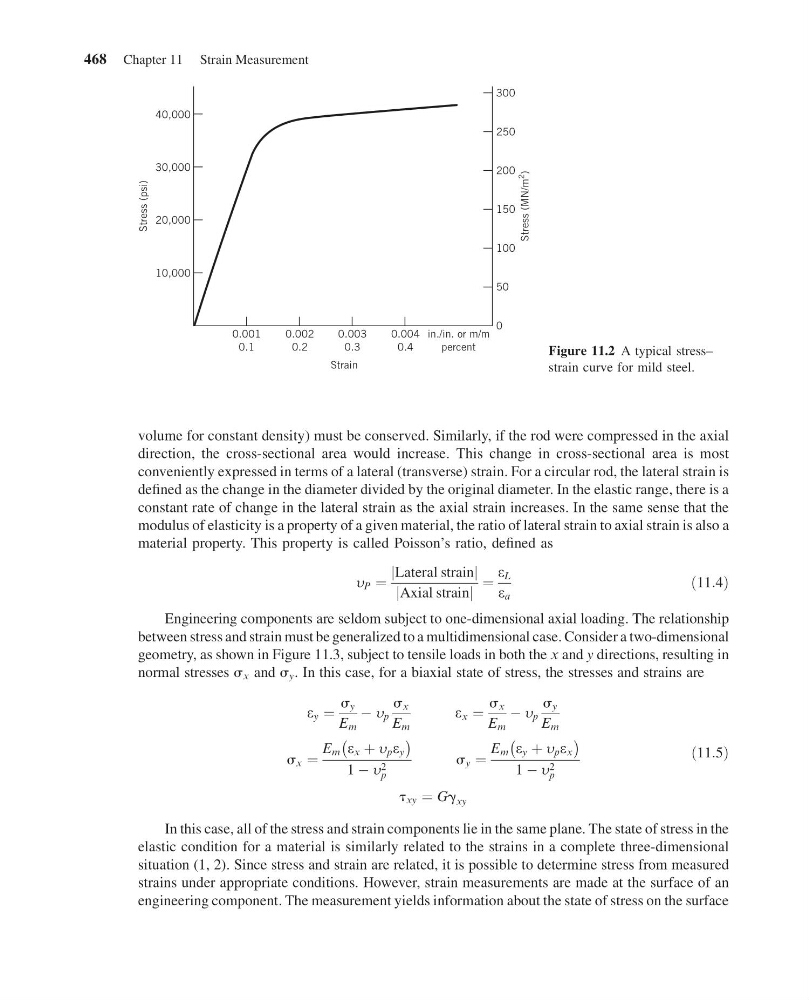
Figure 11.2 A typical stress–
strain curve for mild steel.
468 Chapter 11 Strain Measurement
13:14:1 Page 468
volume for constant density) must be conserved. Similarly, if the rod were compressed in the axial
direction, the cross-sectional area would increase. This change in cross-sectional area is most
conveniently expressed in terms of a lateral (transverse) strain. For a circular rod, the lateral strain is
defined as the change in the diameter divided by the original diameter. In the elastic range, there is a
constant rate of change in the lateral strain as the axial strain increases. In the same sense that the
modulus of elasticity is a property of a given material, the ratio of lateral strain to axial strain is also a
material property. This property is called Poisson’s ratio, defined as
y P ¼
jLateral strainj
jAxial strainj
¼
e L
e a
ð11:4Þ
Engineering components are seldom subject to one-dimensional axial loading. The relationship
between stress and strain must be generalized to a multidimensional case. Consider a two-dimensional
geometry, as shown in Figure 11.3, subject to tensile loads in both the x and y directions, resulting in
normal stresses s x and s y . In this case, for a biaxial state of stress, the stresses and strains are
e y ¼
s y
E m
À y p
s x
E m
e x ¼
s x
E m
À y p
s y
E m
s x ¼
E m e x þ y p e y
À
Á
1 À y 2
p
s y ¼
E m e y þ y p e x
À
Á
1 À y 2
p
t xy ¼ Gg xy
ð11:5Þ
In this case, all of the stress and strain components lie in the same plane. The state of stress in the
elastic condition for a material is similarly related to the strains in a complete three-dimensional
situation (1, 2). Since stress and strain are related, it is possible to determine stress from measured
strains under appropriate conditions. However, strain measurements are made at the surface of an
engineering component. The measurement yields information about the state of stress on the surface
0.001
0.1
0.002
0.2
0.003
0.3
0.004
0.4
in./in. or m/m
percent
0
50
100
150
200
250
300
Strain
Stress (psi)
Stress (MN/m
2
)
10,000
20,000
30,000
40,000
Figure 11.2 A typical stress–
strain curve for mild steel.
468 Chapter 11 Strain Measurement