

E1C11 09/14/2010
13:14:1 Page 469
of the part. The analysis of measured strains requires application of the relationship between stress
and strain at a surface. Such analysis of strain data is described elsewhere (3), and an example
provided in this chapter.
11.3 RESISTANCE STRAIN GAUGES
The measurement of the small displacements that occur in a material or object under mechanical
load can be accomplished by methods as simple as observing the change in the distance between two
scribe marks on the surface of a load-carrying member, or as advanced as optical holography. In any
case, the ideal sensor for the measurement of strain would (1) have good spatial resolution, implying
that the sensor would measure strain at a point; (2) be unaffected by changes in ambient conditions;
and (3) have a high-frequency response for dynamic (time-resolved) strain measurements. A sensor
that closely meets these characteristics is the bonded resistance strain gauge.
In practical application, the bonded resistance strain gauge is secured to the surface of the test
object by an adhesive so that it deforms as the test object deforms. The resistance of a strain gauge
changes when it is deformed, and this is easily related to the local strain. Both metallic and
semiconductor materials experience a change in electrical resistance when they are subjected to a
strain. The amount that the resistance changes depends on how the gauge is deformed, the material
from which it is made, and the design of the gauge. Gauges can be made quite small for good
resolution and with a low mass to provide a high-frequency response. With some ingenuity, ambient
effects can be minimized or eliminated.
In an 1856 publication in the Philosophical Transactions of the Royal Society in England, Lord
Kelvin (William Thomson) (4) laid the foundations for understanding the changes in electrical
resistance that metals undergo when subjected to loads, which eventually led to the strain gauge
concept. Two individuals began the modern development of strain measurement in the late 1930s—
Edward Simmons at the California Institute of Technology and Arthur Ruge at the Massachusetts
Institute of Technology. Their development of the bonded metallic wire strain gauge led to
commercially available strain gauges. The resistance strain gauge also forms the basis for a variety
of other transducers, such as load cells, pressure transducers, and torque meters.
σ x
σ x
σ y
σ y
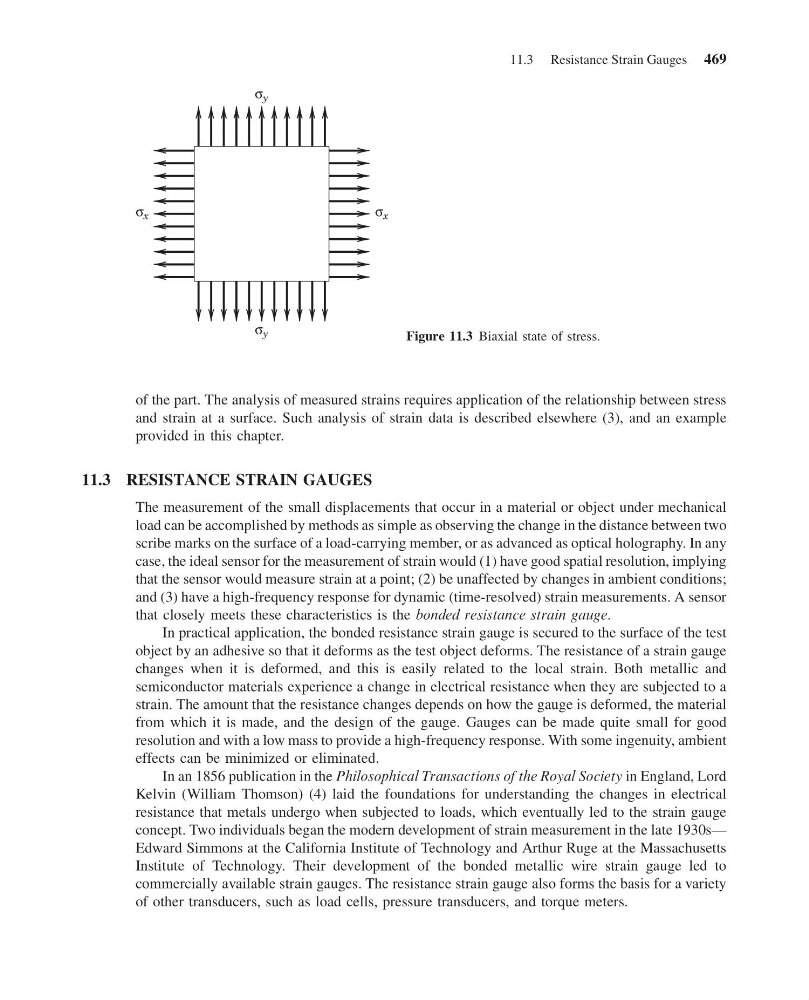
Figure 11.3 Biaxial state of stress.
11.3 Resistance Strain Gauges 469
13:14:1 Page 469
of the part. The analysis of measured strains requires application of the relationship between stress
and strain at a surface. Such analysis of strain data is described elsewhere (3), and an example
provided in this chapter.
11.3 RESISTANCE STRAIN GAUGES
The measurement of the small displacements that occur in a material or object under mechanical
load can be accomplished by methods as simple as observing the change in the distance between two
scribe marks on the surface of a load-carrying member, or as advanced as optical holography. In any
case, the ideal sensor for the measurement of strain would (1) have good spatial resolution, implying
that the sensor would measure strain at a point; (2) be unaffected by changes in ambient conditions;
and (3) have a high-frequency response for dynamic (time-resolved) strain measurements. A sensor
that closely meets these characteristics is the bonded resistance strain gauge.
In practical application, the bonded resistance strain gauge is secured to the surface of the test
object by an adhesive so that it deforms as the test object deforms. The resistance of a strain gauge
changes when it is deformed, and this is easily related to the local strain. Both metallic and
semiconductor materials experience a change in electrical resistance when they are subjected to a
strain. The amount that the resistance changes depends on how the gauge is deformed, the material
from which it is made, and the design of the gauge. Gauges can be made quite small for good
resolution and with a low mass to provide a high-frequency response. With some ingenuity, ambient
effects can be minimized or eliminated.
In an 1856 publication in the Philosophical Transactions of the Royal Society in England, Lord
Kelvin (William Thomson) (4) laid the foundations for understanding the changes in electrical
resistance that metals undergo when subjected to loads, which eventually led to the strain gauge
concept. Two individuals began the modern development of strain measurement in the late 1930s—
Edward Simmons at the California Institute of Technology and Arthur Ruge at the Massachusetts
Institute of Technology. Their development of the bonded metallic wire strain gauge led to
commercially available strain gauges. The resistance strain gauge also forms the basis for a variety
of other transducers, such as load cells, pressure transducers, and torque meters.
σ x
σ x
σ y
σ y
Figure 11.3 Biaxial state of stress.
11.3 Resistance Strain Gauges 469