

E1C10 09/14/2010
13:4:39 Page 448
laminar or turbulent flows, provided that the velocity profile is reasonably symmetrical. Uncertainty
down to 0.25% (95%) of the measured flow rate can be attained, although values from 1% to 5%
(95%) are more common for these meters in industrial settings. The fluid must be conductive, but the
minimum conductivity required depends on a particular meter’s design. Fluids with values as low as
0.1 microsieman (msieman)/cm have been metered. Adding salts to a fluid increases its conductivity.
Stray electronic noise is perhaps the most significant barrier in applying this type of meter.
Grounding close to the electrodes and increasing fluid conductivity reduce noise.
Vortex Shedding Meters
An oscillating street sign and the ‘‘singing’’ of power lines on a windy day are examples of the
effects induced by vortex shedding from bluff-shaped bodies, a natural phenomenon in which
alternating vortices are shed in the wake of the body. The vortices formed on opposite sides of the
body are carried downstream in the body’s wake, forming a ‘‘vortex street,’’ with each vortex having
an opposite sign of rotation. This behavior is seen in Figure 10.17, a photograph that captures the
vortex shedding downstream of a section of an aircraft wing. The aerodynamicist Theodore von
Karman (1881–1963) first deduced the existence of a vortex street, although Leonardo da Vinci
appears to have been the first to actually record the phenomenon (9).
A vortex flow meter operates on the principle that the frequency of vortex shedding depends on
the average velocity of the flow past the body and the body shape. The basic relationship between
shedding frequency, f, where f ½Hz ¼ v=2p, and average velocity, U , for a given shape is given by
the Strouhal number,
St ¼
f d
U
ð10:23Þ
where d is a characteristic length for the body.
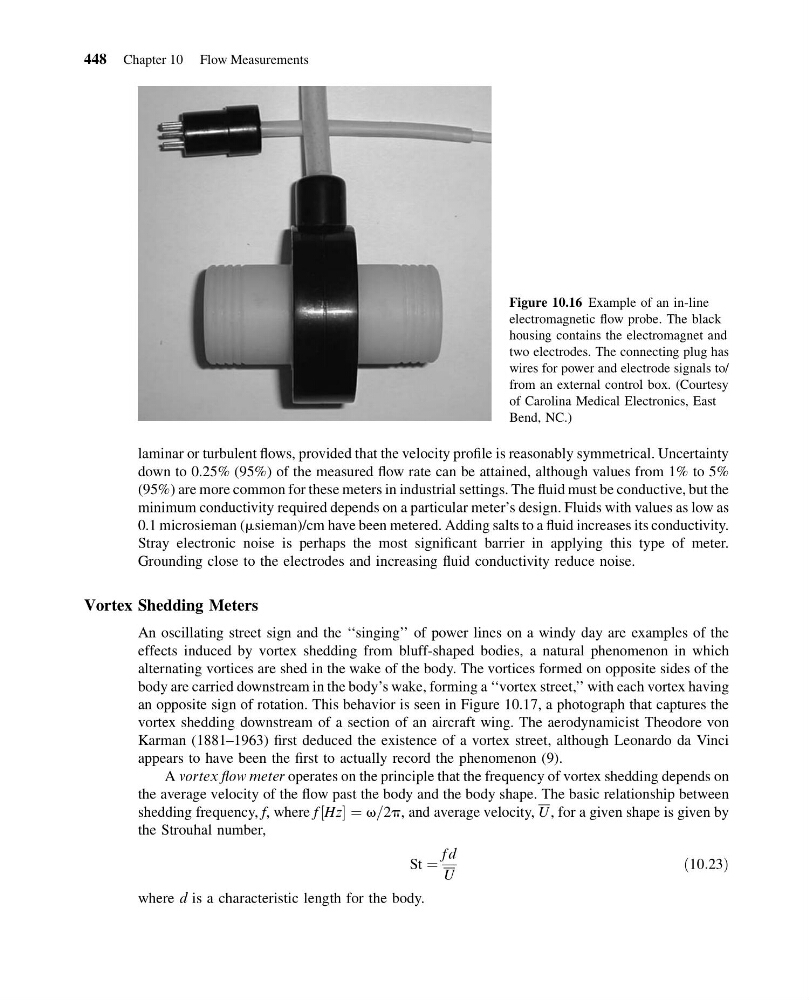
Figure 10.16 Example of an in-line
electromagnetic flow probe. The black
housing contains the electromagnet and
two electrodes. The connecting plug has
wires for power and electrode signals to/
from an external control box. (Courtesy
of Carolina Medical Electronics, East
Bend, NC.)
448 Chapter 10 Flow Measurements
13:4:39 Page 448
laminar or turbulent flows, provided that the velocity profile is reasonably symmetrical. Uncertainty
down to 0.25% (95%) of the measured flow rate can be attained, although values from 1% to 5%
(95%) are more common for these meters in industrial settings. The fluid must be conductive, but the
minimum conductivity required depends on a particular meter’s design. Fluids with values as low as
0.1 microsieman (msieman)/cm have been metered. Adding salts to a fluid increases its conductivity.
Stray electronic noise is perhaps the most significant barrier in applying this type of meter.
Grounding close to the electrodes and increasing fluid conductivity reduce noise.
Vortex Shedding Meters
An oscillating street sign and the ‘‘singing’’ of power lines on a windy day are examples of the
effects induced by vortex shedding from bluff-shaped bodies, a natural phenomenon in which
alternating vortices are shed in the wake of the body. The vortices formed on opposite sides of the
body are carried downstream in the body’s wake, forming a ‘‘vortex street,’’ with each vortex having
an opposite sign of rotation. This behavior is seen in Figure 10.17, a photograph that captures the
vortex shedding downstream of a section of an aircraft wing. The aerodynamicist Theodore von
Karman (1881–1963) first deduced the existence of a vortex street, although Leonardo da Vinci
appears to have been the first to actually record the phenomenon (9).
A vortex flow meter operates on the principle that the frequency of vortex shedding depends on
the average velocity of the flow past the body and the body shape. The basic relationship between
shedding frequency, f, where f ½Hz ¼ v=2p, and average velocity, U , for a given shape is given by
the Strouhal number,
St ¼
f d
U
ð10:23Þ
where d is a characteristic length for the body.
Figure 10.16 Example of an in-line
electromagnetic flow probe. The black
housing contains the electromagnet and
two electrodes. The connecting plug has
wires for power and electrode signals to/
from an external control box. (Courtesy
of Carolina Medical Electronics, East
Bend, NC.)
448 Chapter 10 Flow Measurements