

E1C09 09/14/2010
15:4:55 Page 407
In high-speed gas flows, compressibility effects near the probe leading edge require a closer
inspection of the governing equation for a pitot-static pressure probe. An energy balance along a
streamline for a perfect gas between any point x and the stagnation point can be written as
U
2
2
¼ c p T t À T 1
ð
Þ
ð 8:34Þ
For an isentropic process, the relationship between temperature and pressure can be stated as
T x
T t
¼
p x
p t
kÀ1
ð
Þ=k
ð9:39Þ
where k is the ratio of specific heats for the gas, k ¼ c p /c v . The Mach number of a moving fluid
relates its local velocity to the local speed of sound,
M ¼ U=a
ð9:40Þ
where the speed of sound, also called the acoustic wave speed, for a perfect gas is a ¼
ffiffiffiffiffiffiffiffiffiffiffi
kRT x
p
where
T x is the absolute temperature of the gas at the point of interest. Combining these equations and
using a binomial expansion gives a relationship between total pressure and static pressure at any
point x in a moving compressible flow,
p v ¼ p t À p x ¼
1
2
rU
2
x 1 þ M
2
=4 þ ð2 À kÞM
4
=24 þ Á Á Á
Â
Ã
ð9:41Þ
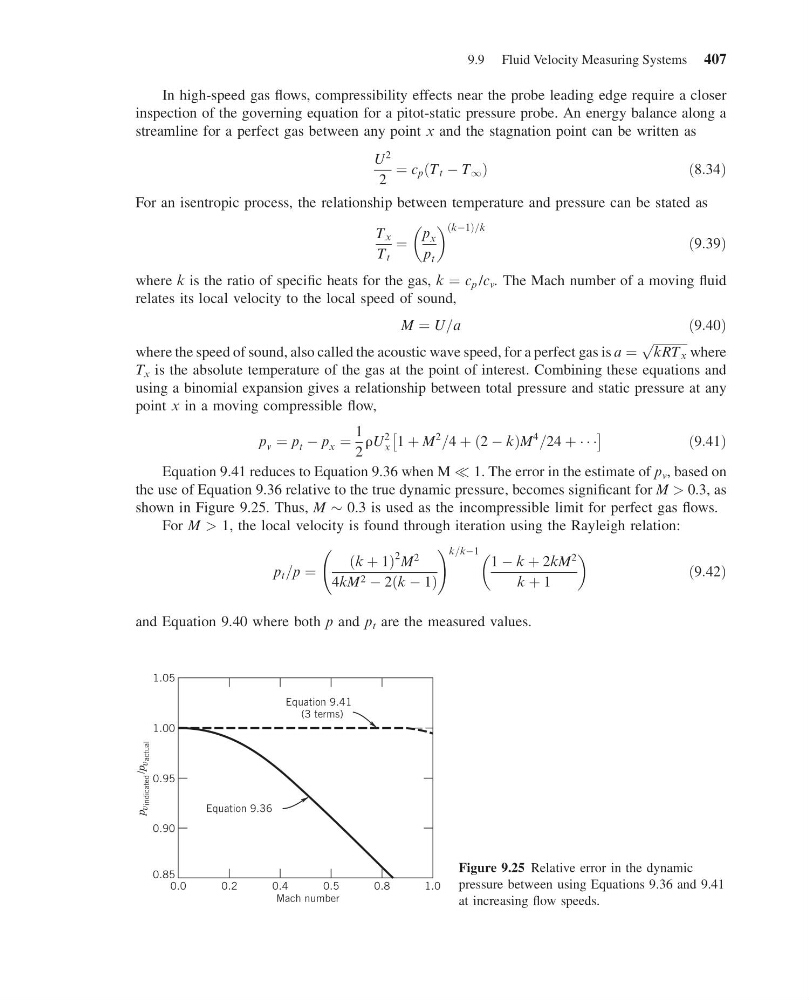
Equation 9.41 reduces to Equation 9.36 when M ( 1. The error in the estimate of p v , based on
the use of Equation 9.36 relative to the true dynamic pressure, becomes significant for M > 0.3, as
shown in Figure 9.25. Thus, M $ 0.3 is used as the incompressible limit for perfect gas flows.
For M > 1, the local velocity is found through iteration using the Rayleigh relation:
p t =p ¼
ðk þ 1Þ
2 M
2
4kM 2 À 2ðk À 1Þ
! k=kÀ1
1 À k þ 2kM
2
k þ 1
ð9:42Þ
and Equation 9.40 where both p and p t are the measured values.
0.0
0.2
0.4
0.5
0.8
Equation 9.36
Equation 9.41
(3 terms)
1.0
p
vindicated /p
vactual
Mach number
0.85
0.90
0.95
1.00
1.05
Figure 9.25 Relative error in the dynamic
pressure between using Equations 9.36 and 9.41
at increasing flow speeds.
9.9 Fluid Velocity Measuring Systems 407
15:4:55 Page 407
In high-speed gas flows, compressibility effects near the probe leading edge require a closer
inspection of the governing equation for a pitot-static pressure probe. An energy balance along a
streamline for a perfect gas between any point x and the stagnation point can be written as
U
2
2
¼ c p T t À T 1
ð
Þ
ð 8:34Þ
For an isentropic process, the relationship between temperature and pressure can be stated as
T x
T t
¼
p x
p t
kÀ1
ð
Þ=k
ð9:39Þ
where k is the ratio of specific heats for the gas, k ¼ c p /c v . The Mach number of a moving fluid
relates its local velocity to the local speed of sound,
M ¼ U=a
ð9:40Þ
where the speed of sound, also called the acoustic wave speed, for a perfect gas is a ¼
ffiffiffiffiffiffiffiffiffiffiffi
kRT x
p
where
T x is the absolute temperature of the gas at the point of interest. Combining these equations and
using a binomial expansion gives a relationship between total pressure and static pressure at any
point x in a moving compressible flow,
p v ¼ p t À p x ¼
1
2
rU
2
x 1 þ M
2
=4 þ ð2 À kÞM
4
=24 þ Á Á Á
Â
Ã
ð9:41Þ
Equation 9.41 reduces to Equation 9.36 when M ( 1. The error in the estimate of p v , based on
the use of Equation 9.36 relative to the true dynamic pressure, becomes significant for M > 0.3, as
shown in Figure 9.25. Thus, M $ 0.3 is used as the incompressible limit for perfect gas flows.
For M > 1, the local velocity is found through iteration using the Rayleigh relation:
p t =p ¼
ðk þ 1Þ
2 M
2
4kM 2 À 2ðk À 1Þ
! k=kÀ1
1 À k þ 2kM
2
k þ 1
ð9:42Þ
and Equation 9.40 where both p and p t are the measured values.
0.0
0.2
0.4
0.5
0.8
Equation 9.36
Equation 9.41
(3 terms)
1.0
p
vindicated /p
vactual
Mach number
0.85
0.90
0.95
1.00
1.05
Figure 9.25 Relative error in the dynamic
pressure between using Equations 9.36 and 9.41
at increasing flow speeds.
9.9 Fluid Velocity Measuring Systems 407