

E1C09 09/14/2010
15:4:55 Page 406
or, rearranging,
p v ¼ p t À p x ¼
1
2
rU
2
x
ð9:36Þ
Again p v , the difference between the total and static pressures at any point in the flow, is the dynamic
pressure. Hence, measuring the dynamic pressure of a moving fluid at a point provides a method for
estimating the local velocity,
U x ¼
ffiffiffiffiffiffiffi
2p v
r
s
¼
ffiffiffiffiffiffiffiffiffiffiffiffiffiffiffiffiffiffiffiffi ffi
2 p t À p x
ð
Þ
r
s
ð9:37Þ
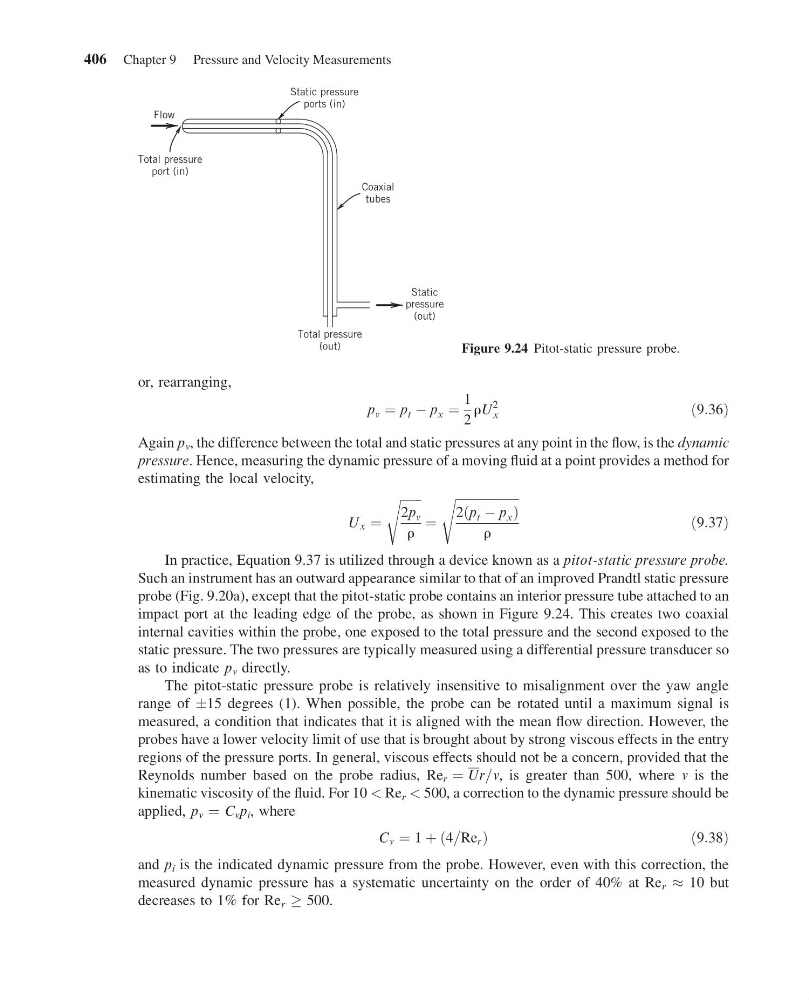
In practice, Equation 9.37 is utilized through a device known as a pitot-static pressure probe.
Such an instrument has an outward appearance similar to that of an improved Prandtl static pressure
probe (Fig. 9.20a), except that the pitot-static probe contains an interior pressure tube attached to an
impact port at the leading edge of the probe, as shown in Figure 9.24. This creates two coaxial
internal cavities within the probe, one exposed to the total pressure and the second exposed to the
static pressure. The two pressures are typically measured using a differential pressure transducer so
as to indicate p v directly.
The pitot-static pressure probe is relatively insensitive to misalignment over the yaw angle
range of Æ15 degrees (1). When possible, the probe can be rotated until a maximum signal is
measured, a condition that indicates that it is aligned with the mean flow direction. However, the
probes have a lower velocity limit of use that is brought about by strong viscous effects in the entry
regions of the pressure ports. In general, viscous effects should not be a concern, provided that the
Reynolds number based on the probe radius, Re r ¼ Ur=v, is greater than 500, where v is the
kinematic viscosity of the fluid. For 10 < Re r < 500, a correction to the dynamic pressure should be
applied, p v ¼ C v p i , where
C v ¼ 1 þ 4=Re r
ð
Þ
ð9:38Þ
and p i is the indicated dynamic pressure from the probe. However, even with this correction, the
measured dynamic pressure has a systematic uncertainty on the order of 40% at Re r % 10 but
decreases to 1% for Re r ! 500.
Static pressure
ports (in)
Total pressure
port (in)
Flow
Coaxial
tubes
Static
pressure
(out)
Total pressure
(out)
Figure 9.24 Pitot-static pressure probe.
406 Chapter 9 Pressure and Velocity Measurements
15:4:55 Page 406
or, rearranging,
p v ¼ p t À p x ¼
1
2
rU
2
x
ð9:36Þ
Again p v , the difference between the total and static pressures at any point in the flow, is the dynamic
pressure. Hence, measuring the dynamic pressure of a moving fluid at a point provides a method for
estimating the local velocity,
U x ¼
ffiffiffiffiffiffiffi
2p v
r
s
¼
ffiffiffiffiffiffiffiffiffiffiffiffiffiffiffiffiffiffiffiffi ffi
2 p t À p x
ð
Þ
r
s
ð9:37Þ
In practice, Equation 9.37 is utilized through a device known as a pitot-static pressure probe.
Such an instrument has an outward appearance similar to that of an improved Prandtl static pressure
probe (Fig. 9.20a), except that the pitot-static probe contains an interior pressure tube attached to an
impact port at the leading edge of the probe, as shown in Figure 9.24. This creates two coaxial
internal cavities within the probe, one exposed to the total pressure and the second exposed to the
static pressure. The two pressures are typically measured using a differential pressure transducer so
as to indicate p v directly.
The pitot-static pressure probe is relatively insensitive to misalignment over the yaw angle
range of Æ15 degrees (1). When possible, the probe can be rotated until a maximum signal is
measured, a condition that indicates that it is aligned with the mean flow direction. However, the
probes have a lower velocity limit of use that is brought about by strong viscous effects in the entry
regions of the pressure ports. In general, viscous effects should not be a concern, provided that the
Reynolds number based on the probe radius, Re r ¼ Ur=v, is greater than 500, where v is the
kinematic viscosity of the fluid. For 10 < Re r < 500, a correction to the dynamic pressure should be
applied, p v ¼ C v p i , where
C v ¼ 1 þ 4=Re r
ð
Þ
ð9:38Þ
and p i is the indicated dynamic pressure from the probe. However, even with this correction, the
measured dynamic pressure has a systematic uncertainty on the order of 40% at Re r % 10 but
decreases to 1% for Re r ! 500.
Static pressure
ports (in)
Total pressure
port (in)
Flow
Coaxial
tubes
Static
pressure
(out)
Total pressure
(out)
Figure 9.24 Pitot-static pressure probe.
406 Chapter 9 Pressure and Velocity Measurements