

E1C08 09/14/2010
14:54:1 Page 358
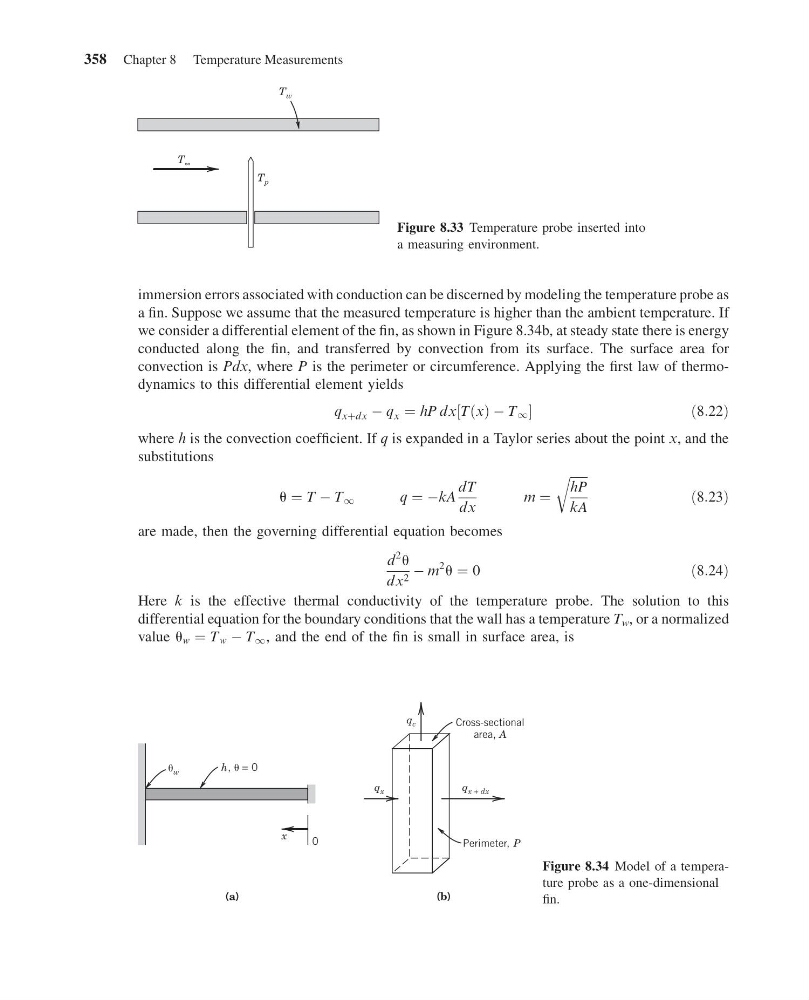
immersion errors associated with conduction can be discerned by modeling the temperature probe as
a fin. Suppose we assume that the measured temperature is higher than the ambient temperature. If
we consider a differential element of the fin, as shown in Figure 8.34b, at steady state there is energy
conducted along the fin, and transferred by convection from its surface. The surface area for
convection is Pdx, where P is the perimeter or circumference. Applying the first law of thermodynamics to this differential element yields
q xþdx À q x ¼ hP dx T x
ð Þ À T 1
½
ð 8:22Þ
where h is the convection coefficient. If q is expanded in a Taylor series about the point x, and the
substitutions
u ¼ T À T 1
q ¼ ÀkA
dT
dx
m ¼
ffiffiffiffiffiffi
hP
kA
r
ð8:23Þ
are made, then the governing differential equation becomes
d
2
u
dx 2 À m
2
u ¼ 0
ð8:24Þ
Here k is the effective thermal conductivity of the temperature probe. The solution to this
differential equation for the boundary conditions that the wall has a temperature T w , or a normalized
value u w ¼ T w À T 1 , and the end of the fin is small in surface area, is
T ∞
T p
T w
Figure 8.33 Temperature probe inserted into
a measuring environment.
q x
q c
q x + dx
x
Perimeter, P
Cross-sectional
area, A
0
(a)
( b)
w
h, = 0
Figure 8.34 Model of a temperature probe as a one-dimensional
fin.
358 Chapter 8 Temperature Measurements
14:54:1 Page 358
immersion errors associated with conduction can be discerned by modeling the temperature probe as
a fin. Suppose we assume that the measured temperature is higher than the ambient temperature. If
we consider a differential element of the fin, as shown in Figure 8.34b, at steady state there is energy
conducted along the fin, and transferred by convection from its surface. The surface area for
convection is Pdx, where P is the perimeter or circumference. Applying the first law of thermodynamics to this differential element yields
q xþdx À q x ¼ hP dx T x
ð Þ À T 1
½
ð 8:22Þ
where h is the convection coefficient. If q is expanded in a Taylor series about the point x, and the
substitutions
u ¼ T À T 1
q ¼ ÀkA
dT
dx
m ¼
ffiffiffiffiffiffi
hP
kA
r
ð8:23Þ
are made, then the governing differential equation becomes
d
2
u
dx 2 À m
2
u ¼ 0
ð8:24Þ
Here k is the effective thermal conductivity of the temperature probe. The solution to this
differential equation for the boundary conditions that the wall has a temperature T w , or a normalized
value u w ¼ T w À T 1 , and the end of the fin is small in surface area, is
T ∞
T p
T w
Figure 8.33 Temperature probe inserted into
a measuring environment.
q x
q c
q x + dx
x
Perimeter, P
Cross-sectional
area, A
0
(a)
( b)
w
h, = 0
Figure 8.34 Model of a temperature probe as a one-dimensional
fin.
358 Chapter 8 Temperature Measurements