

E1C08 09/14/2010
14:54:1 Page 351
8.6 RADIATIVE TEMPERATURE MEASUREMENTS
There is a distinct advantage to measuring temperature by detecting thermal radiation. The sensor
for thermal radiation need not be in contact with the surface to be measured, making this method
attractive for a wide variety of applications. The basic operation of a radiation thermometer is
predicated upon some knowledge of the radiation characteristics of the surface whose temperature is
being measured, relative to the calibration of the thermometer. The spectral characteristics of
radiative measurements of temperature is beyond the scope of the present discussion; an excellent
source for further information is Dewitt and Nutter (11).
Radiation Fundamentals
Radiation refers to the emission of electromagnetic waves from the surface of an object. This
radiation has characteristics of both waves and particles, which leads to a description of the radiation
as being composed of photons. The photons generally travel in straight lines from points of emission
to another surface, where they are absorbed, reflected, or transmitted. This electromagnetic radiation
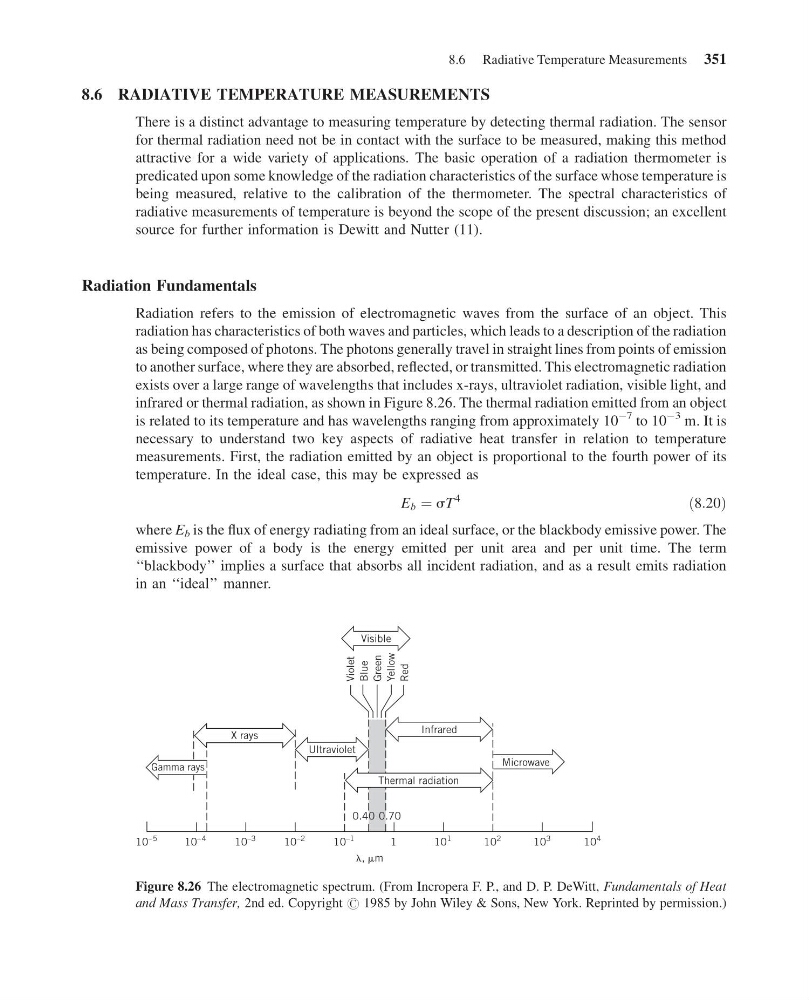
exists over a large range of wavelengths that includes x-rays, ultraviolet radiation, visible light, and
infrared or thermal radiation, as shown in Figure 8.26. The thermal radiation emitted from an object
is related to its temperature and has wavelengths ranging from approximately 10
À7 to 10
À3 m. It is
necessary to understand two key aspects of radiative heat transfer in relation to temperature
measurements. First, the radiation emitted by an object is proportional to the fourth power of its
temperature. In the ideal case, this may be expressed as
E b ¼ sT
4
ð8:20Þ
where E b is the flux of energy radiating from an ideal surface, or the blackbody emissive power. The
emissive power of a body is the energy emitted per unit area and per unit time. The term
‘‘blackbody’’ implies a surface that absorbs all incident radiation, and as a result emits radiation
in an ‘‘ideal’’ manner.
, m
10
–5
10
–4
10
–3
10
–2
10
–1
1
1 0
1
10
2
10
3
10
4
X rays
Ultraviolet
Visible
Infrared
Microwave
Thermal radiation
Violet
Blue
Green
Yellow
Red
Gamma rays
0.70
0.40
Figure 8.26 The electromagnetic spectrum. (From Incropera F. P., and D. P. DeWitt, Fundamentals of Heat
and Mass Transfer, 2nd ed. Copyright # 1985 by John Wiley & Sons, New York. Reprinted by permission.)
8.6 Radiative Temperature Measurements 351
14:54:1 Page 351
8.6 RADIATIVE TEMPERATURE MEASUREMENTS
There is a distinct advantage to measuring temperature by detecting thermal radiation. The sensor
for thermal radiation need not be in contact with the surface to be measured, making this method
attractive for a wide variety of applications. The basic operation of a radiation thermometer is
predicated upon some knowledge of the radiation characteristics of the surface whose temperature is
being measured, relative to the calibration of the thermometer. The spectral characteristics of
radiative measurements of temperature is beyond the scope of the present discussion; an excellent
source for further information is Dewitt and Nutter (11).
Radiation Fundamentals
Radiation refers to the emission of electromagnetic waves from the surface of an object. This
radiation has characteristics of both waves and particles, which leads to a description of the radiation
as being composed of photons. The photons generally travel in straight lines from points of emission
to another surface, where they are absorbed, reflected, or transmitted. This electromagnetic radiation
exists over a large range of wavelengths that includes x-rays, ultraviolet radiation, visible light, and
infrared or thermal radiation, as shown in Figure 8.26. The thermal radiation emitted from an object
is related to its temperature and has wavelengths ranging from approximately 10
À7 to 10
À3 m. It is
necessary to understand two key aspects of radiative heat transfer in relation to temperature
measurements. First, the radiation emitted by an object is proportional to the fourth power of its
temperature. In the ideal case, this may be expressed as
E b ¼ sT
4
ð8:20Þ
where E b is the flux of energy radiating from an ideal surface, or the blackbody emissive power. The
emissive power of a body is the energy emitted per unit area and per unit time. The term
‘‘blackbody’’ implies a surface that absorbs all incident radiation, and as a result emits radiation
in an ‘‘ideal’’ manner.
, m
10
–5
10
–4
10
–3
10
–2
10
–1
1
1 0
1
10
2
10
3
10
4
X rays
Ultraviolet
Visible
Infrared
Microwave
Thermal radiation
Violet
Blue
Green
Yellow
Red
Gamma rays
0.70
0.40
Figure 8.26 The electromagnetic spectrum. (From Incropera F. P., and D. P. DeWitt, Fundamentals of Heat
and Mass Transfer, 2nd ed. Copyright # 1985 by John Wiley & Sons, New York. Reprinted by permission.)
8.6 Radiative Temperature Measurements 351