

E1C08 09/14/2010
14:54:1 Page 350
reasonable expense and care, an uncertainty level in the thermocouple of Æ0.1
C can be achieved,
compared to the uncalibrated value of Æ1
C. If the thermocouple were so calibrated, the resulting
uncertainty in the overall measurement of temperature is reduced to Æ0.68
C, so that by reducing
the uncertainty contribution of the thermocouple by a factor of 10, the system uncertainty would be
reduced by a factor of 2.
Example 8.12
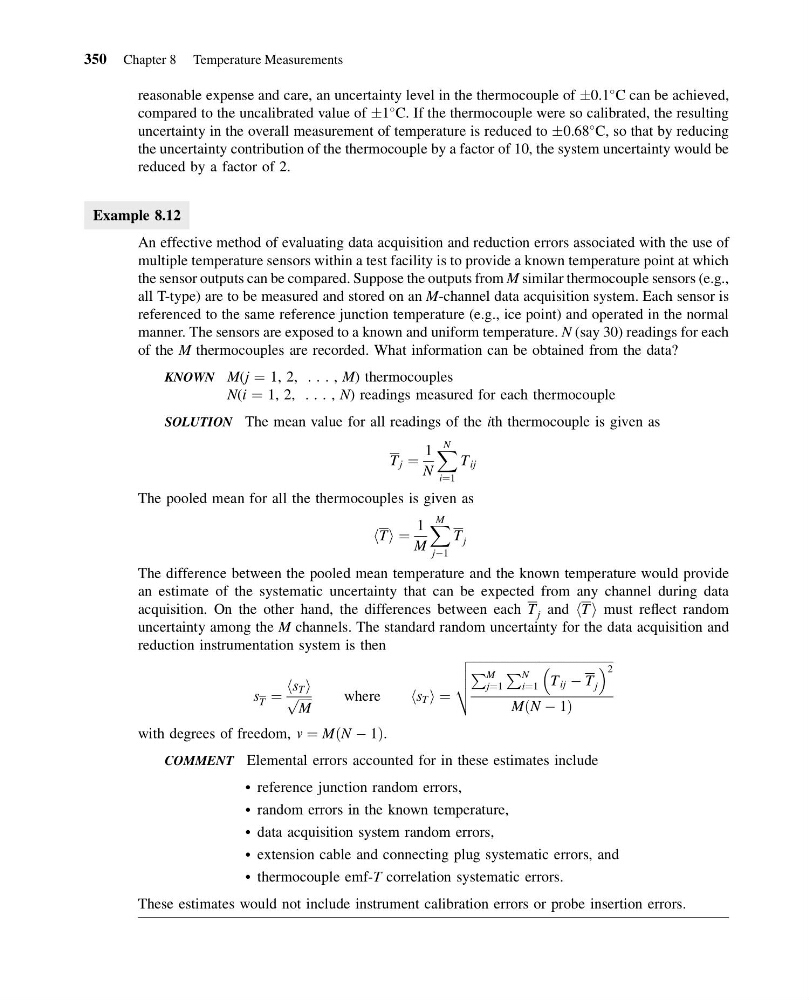
An effective method of evaluating data acquisition and reduction errors associated with the use of
multiple temperature sensors within a test facility is to provide a known temperature point at which
the sensor outputs can be compared. Suppose the outputs from M similar thermocouple sensors (e.g.,
all T-type) are to be measured and stored on an M-channel data acquisition system. Each sensor is
referenced to the same reference junction temperature (e.g., ice point) and operated in the normal
manner. The sensors are exposed to a known and uniform temperature. N (say 30) readings for each
of the M thermocouples are recorded. What information can be obtained from the data?
KNOWN M(j ¼ 1, 2, . . . , M) thermocouples
N(i ¼ 1, 2, . . . , N) readings measured for each thermocouple
SOLUTION The mean value for all readings of the ith thermocouple is given as
T j ¼
1
N
X N
i¼1
T ij
The pooled mean for all the thermocouples is given as
hTi ¼
1
M
X M
jÀ1
T j
The difference between the pooled mean temperature and the known temperature would provide
an estimate of the systematic uncertainty that can be expected from any channel during data
acquisition. On the other hand, the differences between each T j and hT i must reflect random
uncertainty among the M channels. The standard random uncertainty for the data acquisition and
reduction instrumentation system is then
s T ¼
hs T i
ffiffiffiffi ffi
M
p
where
hs T i ¼
ffiffiffiffiffiffiffiffiffiffiffiffiffiffiffiffiffiffiffiffiffiffiffiffiffiffiffiffiffiffiffiffiffiffiffiffiffiffiffiffiffiffiffiffiffiffi
P M
j¼1
P N
i¼1 T ij À T j
2
M N À 1
ð
Þ
v
u
u
t
with degrees of freedom, v ¼ M N À 1
ð
Þ.
COMMENT Elemental errors accounted for in these estimates include
reference junction random errors,
random errors in the known temperature,
data acquisition system random errors,
extension cable and connecting plug systematic errors, and
thermocouple emf-T correlation systematic errors.
These estimates would not include instrument calibration errors or probe insertion errors.
350 Chapter 8 Temperature Measurements
14:54:1 Page 350
reasonable expense and care, an uncertainty level in the thermocouple of Æ0.1
C can be achieved,
compared to the uncalibrated value of Æ1
C. If the thermocouple were so calibrated, the resulting
uncertainty in the overall measurement of temperature is reduced to Æ0.68
C, so that by reducing
the uncertainty contribution of the thermocouple by a factor of 10, the system uncertainty would be
reduced by a factor of 2.
Example 8.12
An effective method of evaluating data acquisition and reduction errors associated with the use of
multiple temperature sensors within a test facility is to provide a known temperature point at which
the sensor outputs can be compared. Suppose the outputs from M similar thermocouple sensors (e.g.,
all T-type) are to be measured and stored on an M-channel data acquisition system. Each sensor is
referenced to the same reference junction temperature (e.g., ice point) and operated in the normal
manner. The sensors are exposed to a known and uniform temperature. N (say 30) readings for each
of the M thermocouples are recorded. What information can be obtained from the data?
KNOWN M(j ¼ 1, 2, . . . , M) thermocouples
N(i ¼ 1, 2, . . . , N) readings measured for each thermocouple
SOLUTION The mean value for all readings of the ith thermocouple is given as
T j ¼
1
N
X N
i¼1
T ij
The pooled mean for all the thermocouples is given as
hTi ¼
1
M
X M
jÀ1
T j
The difference between the pooled mean temperature and the known temperature would provide
an estimate of the systematic uncertainty that can be expected from any channel during data
acquisition. On the other hand, the differences between each T j and hT i must reflect random
uncertainty among the M channels. The standard random uncertainty for the data acquisition and
reduction instrumentation system is then
s T ¼
hs T i
ffiffiffiffi ffi
M
p
where
hs T i ¼
ffiffiffiffiffiffiffiffiffiffiffiffiffiffiffiffiffiffiffiffiffiffiffiffiffiffiffiffiffiffiffiffiffiffiffiffiffiffiffiffiffiffiffiffiffiffi
P M
j¼1
P N
i¼1 T ij À T j
2
M N À 1
ð
Þ
v
u
u
t
with degrees of freedom, v ¼ M N À 1
ð
Þ.
COMMENT Elemental errors accounted for in these estimates include
reference junction random errors,
random errors in the known temperature,
data acquisition system random errors,
extension cable and connecting plug systematic errors, and
thermocouple emf-T correlation systematic errors.
These estimates would not include instrument calibration errors or probe insertion errors.
350 Chapter 8 Temperature Measurements