

E1C08 09/14/2010
14:54:1 Page 352
Second, the emissive power is a direct measure of the total radiation emitted by an object.
However, energy is emitted by an ideal radiator over a range of wavelengths, and at any given
temperature the distribution of the energy emitted as a function of wavelength is unique. Max Planck
(1858–1947) developed the basis for the theory of quantum mechanics in 1900 as a result of
examining the wavelength distribution of radiation. He proposed the following equation to describe
the wavelength distribution of thermal radiation for an ideal or blackbody radiator:
E bl ¼
2ph p c
2
l
5 exp h p c=k B lT
À
Á À 1
Â
Ã
ð8:21Þ
where
E bl ¼ total emissive power at the wavelength l
l ¼ wavelength
c ¼ speed of light in a vacuum ¼ 2.998 Â 10
8 m/s
h p ¼ Planck’s constant ¼ 6:6256 Â 10
À34 J s
k B ¼ Boltzmann’s constant ¼ 1:3805 Â 10
À23 J=K
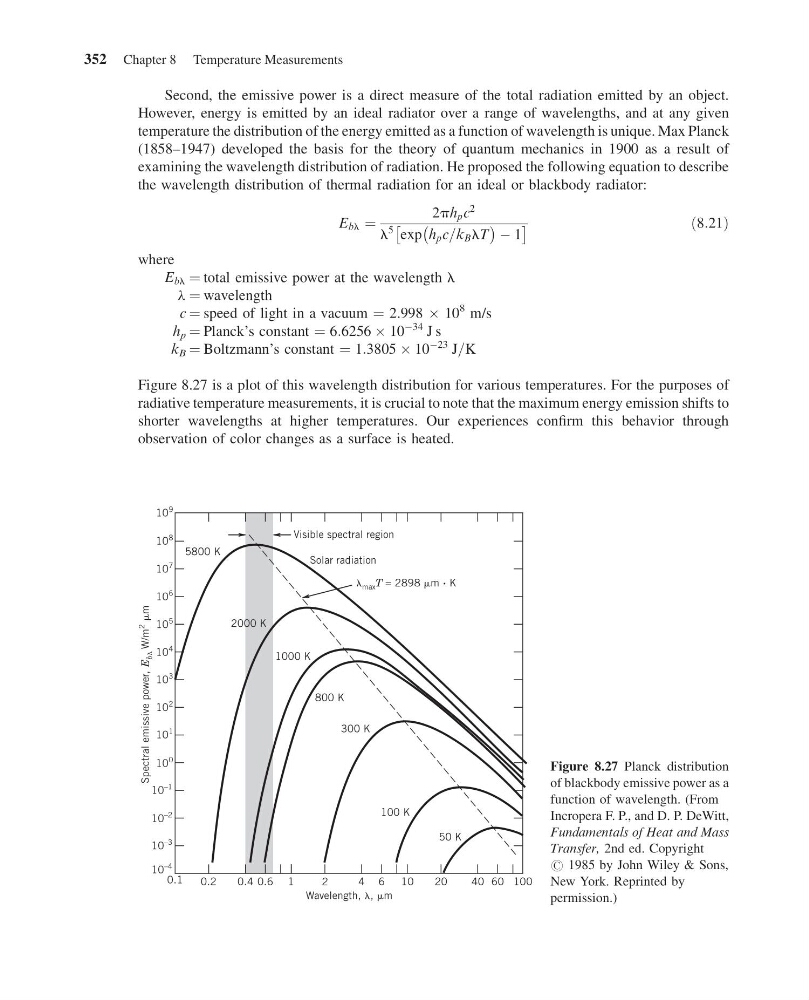
Figure 8.27 is a plot of this wavelength distribution for various temperatures. For the purposes of
radiative temperature measurements, it is crucial to note that the maximum energy emission shifts to
shorter wavelengths at higher temperatures. Our experiences confirm this behavior through
observation of color changes as a surface is heated.
10
–2
10
–1
10
–3
10
–4
10
0
10
1
10
2
10
3
10
4
10
5
10
6
10
7
10
8
10
9
0.1
0.2
0.4 0.6 1
2
Visible spectral region
Solar radiation
5800 K
2000 K
1000 K
800 K
300 K
100 K
50 K
max T = 2898 m K
4 6
10
20
40 60 100
Wavelength, , m
Spectral emissive power,
E
b W/m
2
m
Figure 8.27 Planck distribution
of blackbody emissive power as a
function of wavelength. (From
Incropera F. P., and D. P. DeWitt,
Fundamentals of Heat and Mass
Transfer, 2nd ed. Copyright
# 1985 by John Wiley & Sons,
New York. Reprinted by
permission.)
352 Chapter 8 Temperature Measurements
14:54:1 Page 352
Second, the emissive power is a direct measure of the total radiation emitted by an object.
However, energy is emitted by an ideal radiator over a range of wavelengths, and at any given
temperature the distribution of the energy emitted as a function of wavelength is unique. Max Planck
(1858–1947) developed the basis for the theory of quantum mechanics in 1900 as a result of
examining the wavelength distribution of radiation. He proposed the following equation to describe
the wavelength distribution of thermal radiation for an ideal or blackbody radiator:
E bl ¼
2ph p c
2
l
5 exp h p c=k B lT
À
Á À 1
Â
Ã
ð8:21Þ
where
E bl ¼ total emissive power at the wavelength l
l ¼ wavelength
c ¼ speed of light in a vacuum ¼ 2.998 Â 10
8 m/s
h p ¼ Planck’s constant ¼ 6:6256 Â 10
À34 J s
k B ¼ Boltzmann’s constant ¼ 1:3805 Â 10
À23 J=K
Figure 8.27 is a plot of this wavelength distribution for various temperatures. For the purposes of
radiative temperature measurements, it is crucial to note that the maximum energy emission shifts to
shorter wavelengths at higher temperatures. Our experiences confirm this behavior through
observation of color changes as a surface is heated.
10
–2
10
–1
10
–3
10
–4
10
0
10
1
10
2
10
3
10
4
10
5
10
6
10
7
10
8
10
9
0.1
0.2
0.4 0.6 1
2
Visible spectral region
Solar radiation
5800 K
2000 K
1000 K
800 K
300 K
100 K
50 K
max T = 2898 m K
4 6
10
20
40 60 100
Wavelength, , m
Spectral emissive power,
E
b W/m
2
m
Figure 8.27 Planck distribution
of blackbody emissive power as a
function of wavelength. (From
Incropera F. P., and D. P. DeWitt,
Fundamentals of Heat and Mass
Transfer, 2nd ed. Copyright
# 1985 by John Wiley & Sons,
New York. Reprinted by
permission.)
352 Chapter 8 Temperature Measurements