

E1C08 09/14/2010
14:53:56 Page 319
By properly constructing an RTD, and correctly measuring its resistance, an uncertainty in temperature measurement as low as Æ0.005
C is possible. Because of this potential for low uncertainties and
the predictable and stable behavior of platinum, the platinum RTD is widely used as a local standard.
For an NIST-certified RTD, a table and interpolating equation would be provided.
Resistance Temperature Device Resistance Measurement
The resistance of an RTD may be measured by a number of means, and the choice of an
appropriate resistance measuring device must be made based on the required level of uncertainty
in the final temperature measurement. Conventional ohmmeters cause a small current to flow
during resistance measurements, creating self-heating in the RTD. An appreciable temperature
change of the sensor may be caused by this current, in effect causing a loading error. This is an
important consideration for RTDs.
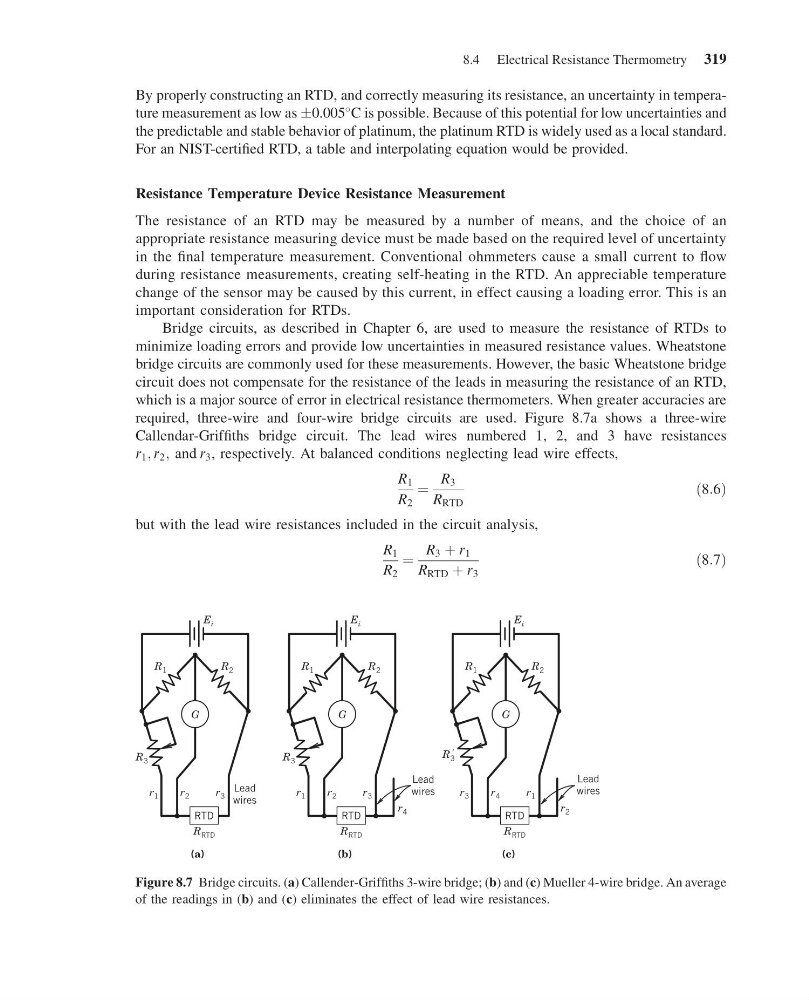
Bridge circuits, as described in Chapter 6, are used to measure the resistance of RTDs to
minimize loading errors and provide low uncertainties in measured resistance values. Wheatstone
bridge circuits are commonly used for these measurements. However, the basic Wheatstone bridge
circuit does not compensate for the resistance of the leads in measuring the resistance of an RTD,
which is a major source of error in electrical resistance thermometers. When greater accuracies are
required, three-wire and four-wire bridge circuits are used. Figure 8.7a shows a three-wire
Callendar-Griffiths bridge circuit. The lead wires numbered 1, 2, and 3 have resistances
r 1 ; r 2 ; and r 3 , respectively. At balanced conditions neglecting lead wire effects,
R 1
R 2
¼
R 3
R RTD
ð8:6Þ
but with the lead wire resistances included in the circuit analysis,
R 1
R 2
¼
R 3 þ r 1
R RTD þ r 3
ð8:7Þ
E i
R RTD
RTD
Lead
wires
(a)
r 1
R 3
R 1
R 2
r 2
r 3
G
E i
R RTD
RTD
Lead
wires
(b)
r 1
R 3
R 1
R 2
r 2
r 3
r 4
r 2
G
E i
R RTD
RTD
(c)
r 3
R 3 '
R 1
R 2
r 4
r 1
G
Lead
wires
Figure 8.7 Bridge circuits. (a) Callender-Griffiths 3-wire bridge; (b) and (c) Mueller 4-wire bridge. An average
of the readings in (b) and (c) eliminates the effect of lead wire resistances.
8.4 Electrical Resistance Thermometry 319
14:53:56 Page 319
By properly constructing an RTD, and correctly measuring its resistance, an uncertainty in temperature measurement as low as Æ0.005
C is possible. Because of this potential for low uncertainties and
the predictable and stable behavior of platinum, the platinum RTD is widely used as a local standard.
For an NIST-certified RTD, a table and interpolating equation would be provided.
Resistance Temperature Device Resistance Measurement
The resistance of an RTD may be measured by a number of means, and the choice of an
appropriate resistance measuring device must be made based on the required level of uncertainty
in the final temperature measurement. Conventional ohmmeters cause a small current to flow
during resistance measurements, creating self-heating in the RTD. An appreciable temperature
change of the sensor may be caused by this current, in effect causing a loading error. This is an
important consideration for RTDs.
Bridge circuits, as described in Chapter 6, are used to measure the resistance of RTDs to
minimize loading errors and provide low uncertainties in measured resistance values. Wheatstone
bridge circuits are commonly used for these measurements. However, the basic Wheatstone bridge
circuit does not compensate for the resistance of the leads in measuring the resistance of an RTD,
which is a major source of error in electrical resistance thermometers. When greater accuracies are
required, three-wire and four-wire bridge circuits are used. Figure 8.7a shows a three-wire
Callendar-Griffiths bridge circuit. The lead wires numbered 1, 2, and 3 have resistances
r 1 ; r 2 ; and r 3 , respectively. At balanced conditions neglecting lead wire effects,
R 1
R 2
¼
R 3
R RTD
ð8:6Þ
but with the lead wire resistances included in the circuit analysis,
R 1
R 2
¼
R 3 þ r 1
R RTD þ r 3
ð8:7Þ
E i
R RTD
RTD
Lead
wires
(a)
r 1
R 3
R 1
R 2
r 2
r 3
G
E i
R RTD
RTD
Lead
wires
(b)
r 1
R 3
R 1
R 2
r 2
r 3
r 4
r 2
G
E i
R RTD
RTD
(c)
r 3
R 3 '
R 1
R 2
r 4
r 1
G
Lead
wires
Figure 8.7 Bridge circuits. (a) Callender-Griffiths 3-wire bridge; (b) and (c) Mueller 4-wire bridge. An average
of the readings in (b) and (c) eliminates the effect of lead wire resistances.
8.4 Electrical Resistance Thermometry 319