

E1C08 09/14/2010
14:53:56 Page 318
Platinum Resistance Temperature Device (RTD)
Platinum is the most common material chosen for the construction of RTDs. The principle of
operation is quite simple: platinum exhibits a predictable and reproducible change in electrical
resistance with temperature, which can be calibrated and interpolated to a high degree of accuracy.
The linear approximation for the relationship between temperature and resistance is valid over
a wide temperature range, and platinum is highly stable. To be suitable for use as a secondary
temperature standard, a platinum resistance thermometer should have a value of a not less than
0.003925
C
À1 . This minimum value is an indication of the purity of the platinum. In general, RTDs
may be used for the measurement of temperatures ranging from cryogenic to approximately 650
C.
–300 –200 –100 0
100 200 300 400 500
Nickel
Copper
Platinum
600 700 800 900
Temperature [ºC]
Relative resistance,
R/R
o
0
1
2
3
4
5
6
8
7
9
10
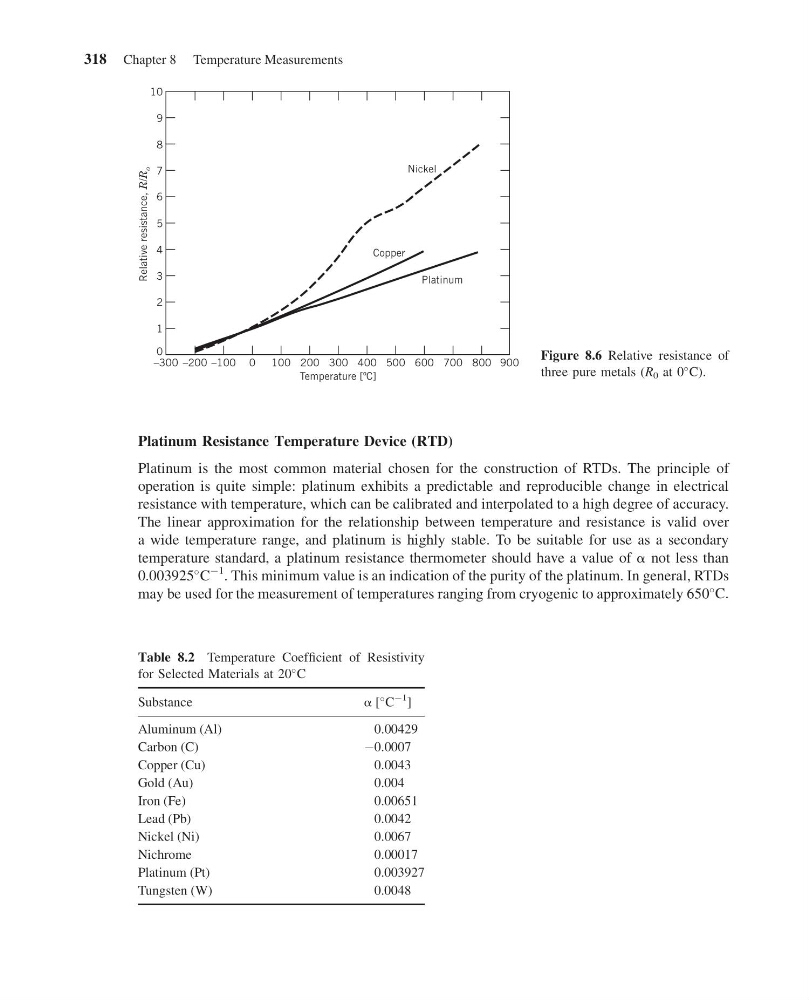
Figure 8.6 Relative resistance of
three pure metals (R 0 at 0
C).
Table 8.2 Temperature Coefficient of Resistivity
for Selected Materials at 20
C
Substance
a [
C
À1 ]
Aluminum (Al)
0.00429
Carbon (C)
À0.0007
Copper (Cu)
0.0043
Gold (Au)
0.004
Iron (Fe)
0.00651
Lead (Pb)
0.0042
Nickel (Ni)
0.0067
Nichrome
0.00017
Platinum (Pt)
0.003927
Tungsten (W)
0.0048
318 Chapter 8 Temperature Measurements
14:53:56 Page 318
Platinum Resistance Temperature Device (RTD)
Platinum is the most common material chosen for the construction of RTDs. The principle of
operation is quite simple: platinum exhibits a predictable and reproducible change in electrical
resistance with temperature, which can be calibrated and interpolated to a high degree of accuracy.
The linear approximation for the relationship between temperature and resistance is valid over
a wide temperature range, and platinum is highly stable. To be suitable for use as a secondary
temperature standard, a platinum resistance thermometer should have a value of a not less than
0.003925
C
À1 . This minimum value is an indication of the purity of the platinum. In general, RTDs
may be used for the measurement of temperatures ranging from cryogenic to approximately 650
C.
–300 –200 –100 0
100 200 300 400 500
Nickel
Copper
Platinum
600 700 800 900
Temperature [ºC]
Relative resistance,
R/R
o
0
1
2
3
4
5
6
8
7
9
10
Figure 8.6 Relative resistance of
three pure metals (R 0 at 0
C).
Table 8.2 Temperature Coefficient of Resistivity
for Selected Materials at 20
C
Substance
a [
C
À1 ]
Aluminum (Al)
0.00429
Carbon (C)
À0.0007
Copper (Cu)
0.0043
Gold (Au)
0.004
Iron (Fe)
0.00651
Lead (Pb)
0.0042
Nickel (Ni)
0.0067
Nichrome
0.00017
Platinum (Pt)
0.003927
Tungsten (W)
0.0048
318 Chapter 8 Temperature Measurements