

E1C08 09/14/2010
14:53:56 Page 317
The physical basis for the relationship between resistance and temperature is the temperature
dependence of the resistivity r e of a material. The resistance of a conductor of length l and crosssectional area A c may be expressed in terms of the resistivity r e as
R ¼
r e l
A c
ð8:3Þ
The relationship between the resistance of a metal conductor and its temperature may also be
expressed as the polynomial expansion:
R ¼ R 0 1 þ a T À T 0
ð
Þþb T À T 0
ð
Þ
2 þ Á Á Á
h
i
ð8:4Þ
where R 0 is a reference resistance measured at temperature T 0 . The coefficients a,b, . . . are
material constants. Figure 8.6 shows the relative relation between resistance and temperature for
three common metals. This figure provides evidence that the relationship between temperature and
resistance over specific small temperature ranges is linear. This approximation can be expressed as
R ¼ R 0 1 þ a T À T 0
ð
Þ
½
ð 8:5Þ
where a is the temperature coefficient of resistivity. For example, for platinum conductors the linear
approximation is accurate to within an uncertainty of Æ0.3% over the range 0–200
C and Æ1.2%
over the range 200–800
C. Table 8.2 lists a number of temperature coefficients of resistivity a for
materials at 20
C.
3
8
Evacuated
space
Mica cross form
Sensitive
helical
coil
Pyrex tube
in. O.D.
l
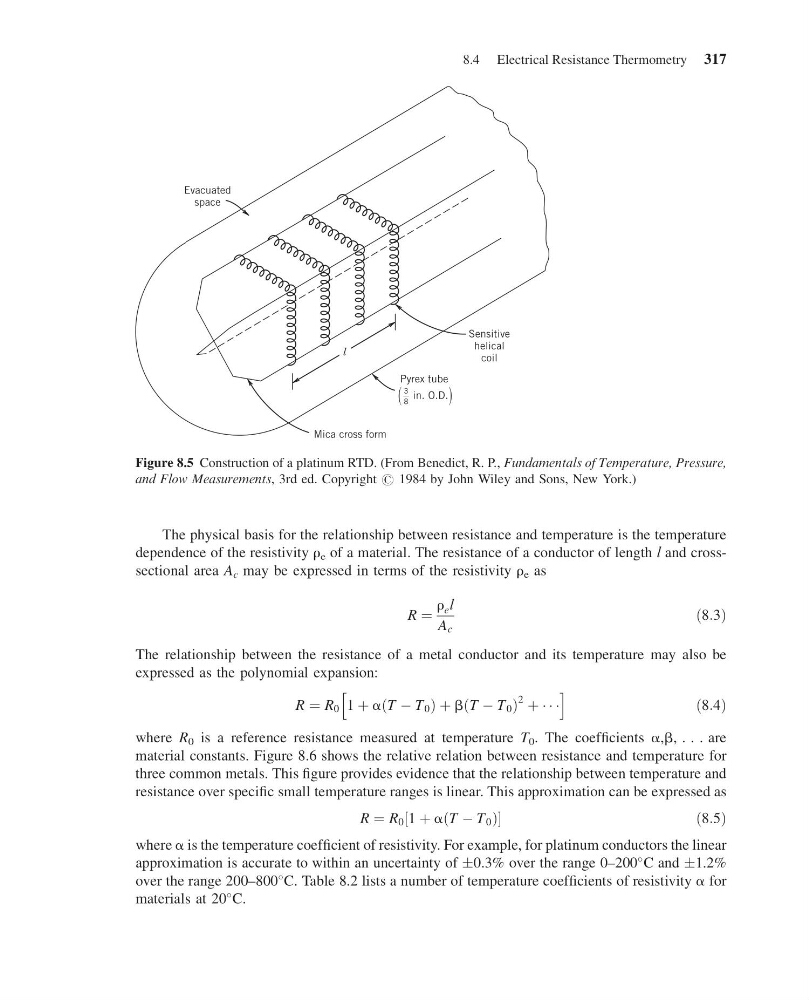
Figure 8.5 Construction of a platinum RTD. (From Benedict, R. P., Fundamentals of Temperature, Pressure,
and Flow Measurements, 3rd ed. Copyright # 1984 by John Wiley and Sons, New York.)
8.4 Electrical Resistance Thermometry 317
14:53:56 Page 317
The physical basis for the relationship between resistance and temperature is the temperature
dependence of the resistivity r e of a material. The resistance of a conductor of length l and crosssectional area A c may be expressed in terms of the resistivity r e as
R ¼
r e l
A c
ð8:3Þ
The relationship between the resistance of a metal conductor and its temperature may also be
expressed as the polynomial expansion:
R ¼ R 0 1 þ a T À T 0
ð
Þþb T À T 0
ð
Þ
2 þ Á Á Á
h
i
ð8:4Þ
where R 0 is a reference resistance measured at temperature T 0 . The coefficients a,b, . . . are
material constants. Figure 8.6 shows the relative relation between resistance and temperature for
three common metals. This figure provides evidence that the relationship between temperature and
resistance over specific small temperature ranges is linear. This approximation can be expressed as
R ¼ R 0 1 þ a T À T 0
ð
Þ
½
ð 8:5Þ
where a is the temperature coefficient of resistivity. For example, for platinum conductors the linear
approximation is accurate to within an uncertainty of Æ0.3% over the range 0–200
C and Æ1.2%
over the range 200–800
C. Table 8.2 lists a number of temperature coefficients of resistivity a for
materials at 20
C.
3
8
Evacuated
space
Mica cross form
Sensitive
helical
coil
Pyrex tube
in. O.D.
l
Figure 8.5 Construction of a platinum RTD. (From Benedict, R. P., Fundamentals of Temperature, Pressure,
and Flow Measurements, 3rd ed. Copyright # 1984 by John Wiley and Sons, New York.)
8.4 Electrical Resistance Thermometry 317