

E1C08 09/14/2010
14:53:56 Page 316
Resistance Temperature Detectors
In the case of a resistance temperature detector (RTD),
3 the sensor is generally constructed by
mounting a metal wire on an insulating support structure to eliminate mechanical strains, and by
encasing the wire to prevent changes in resistance due to influences from the sensor’s environment,
such as corrosion. Figure 8.5 shows such a typical RTD construction.
Mechanical strain changes a conductor’s resistance and must be eliminated if accurate
temperature measurements are to be made. This factor is essential because the resistance changes
with mechanical strain are significant, as evidenced by the use of metal wire as sensors for the direct
measurement of strain. Such mechanical stresses and resulting strains can be created by thermal
expansion. Thus, provision for strain-free expansion of the conductor as its temperature changes is
essential in the construction of an RTD. The support structure also expands as the temperature of the
RTD increases, and the construction allows for strain-free differential expansion.
3 The term RTD in this context refers to metallic PTC resistance sensors.
0.1
10
-1
10
0
10
1
10
2
10 3
10
4
10
5
10 6
1
10
100
1000
Temperature (K)
Carbon-glass
Platinum RTD (100 ohm)
Rhodium-iron
Cernox (CX-1030)
Ruthenium oxide (1000 ohm)
Germanium RTD (GR-200A-30)
Resistance (OHMS)
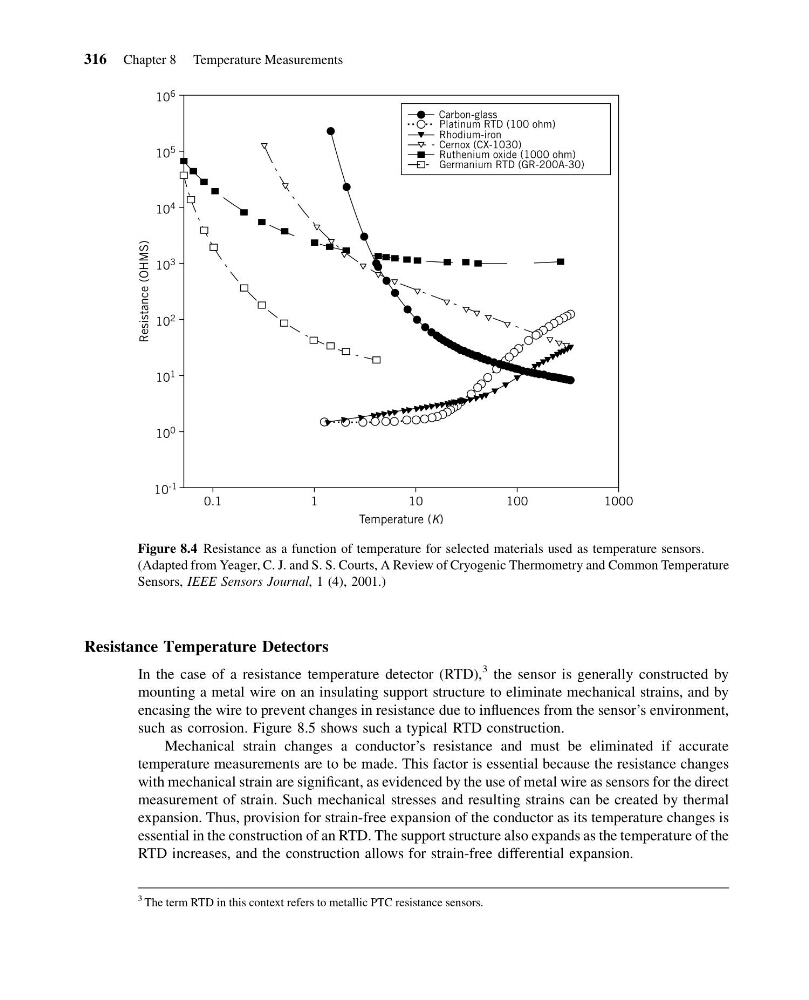
Figure 8.4 Resistance as a function of temperature for selected materials used as temperature sensors.
(Adapted from Yeager, C. J. and S. S. Courts, A Review of Cryogenic Thermometry and Common Temperature
Sensors, IEEE Sensors Journal, 1 (4), 2001.)
316 Chapter 8 Temperature Measurements
14:53:56 Page 316
Resistance Temperature Detectors
In the case of a resistance temperature detector (RTD),
3 the sensor is generally constructed by
mounting a metal wire on an insulating support structure to eliminate mechanical strains, and by
encasing the wire to prevent changes in resistance due to influences from the sensor’s environment,
such as corrosion. Figure 8.5 shows such a typical RTD construction.
Mechanical strain changes a conductor’s resistance and must be eliminated if accurate
temperature measurements are to be made. This factor is essential because the resistance changes
with mechanical strain are significant, as evidenced by the use of metal wire as sensors for the direct
measurement of strain. Such mechanical stresses and resulting strains can be created by thermal
expansion. Thus, provision for strain-free expansion of the conductor as its temperature changes is
essential in the construction of an RTD. The support structure also expands as the temperature of the
RTD increases, and the construction allows for strain-free differential expansion.
3 The term RTD in this context refers to metallic PTC resistance sensors.
0.1
10
-1
10
0
10
1
10
2
10 3
10
4
10
5
10 6
1
10
100
1000
Temperature (K)
Carbon-glass
Platinum RTD (100 ohm)
Rhodium-iron
Cernox (CX-1030)
Ruthenium oxide (1000 ohm)
Germanium RTD (GR-200A-30)
Resistance (OHMS)
Figure 8.4 Resistance as a function of temperature for selected materials used as temperature sensors.
(Adapted from Yeager, C. J. and S. S. Courts, A Review of Cryogenic Thermometry and Common Temperature
Sensors, IEEE Sensors Journal, 1 (4), 2001.)
316 Chapter 8 Temperature Measurements