

E1C08 09/14/2010
14:53:56 Page 315
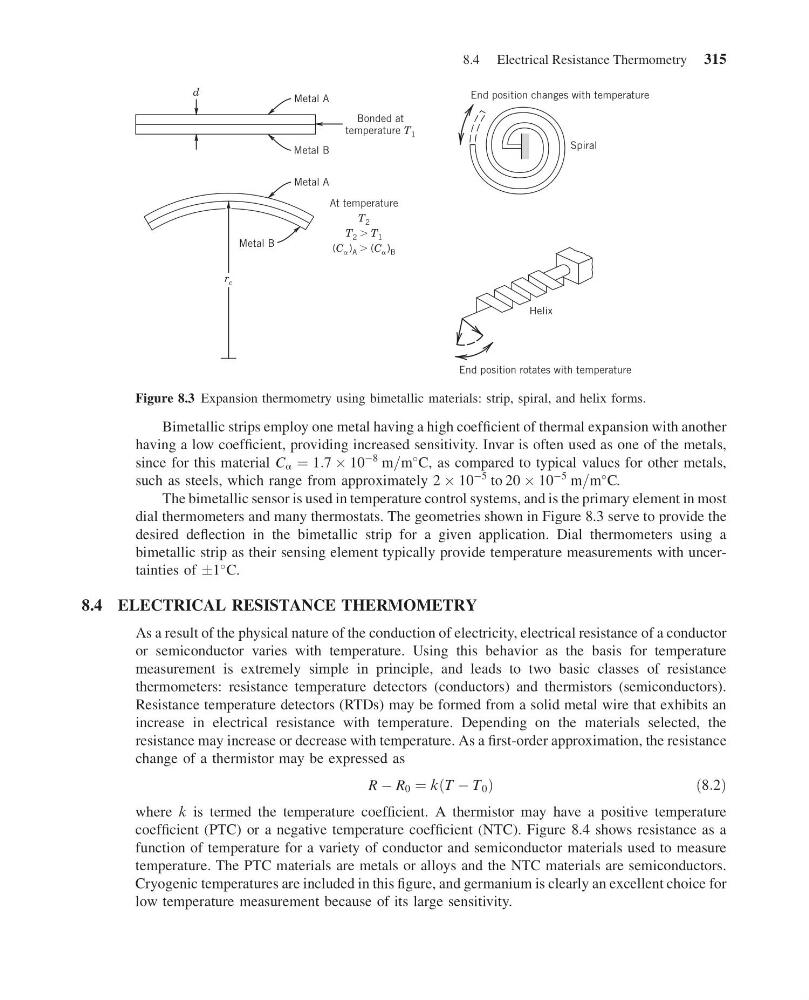
Bimetallic strips employ one metal having a high coefficient of thermal expansion with another
having a low coefficient, providing increased sensitivity. Invar is often used as one of the metals,
since for this material C a ¼ 1:7 Â 10
À8 m=m
C, as compared to typical values for other metals,
such as steels, which range from approximately 2 Â 10
À5 to 20 Â 10
À5 m=m
C.
The bimetallic sensor is used in temperature control systems, and is the primary element in most
dial thermometers and many thermostats. The geometries shown in Figure 8.3 serve to provide the
desired deflection in the bimetallic strip for a given application. Dial thermometers using a
bimetallic strip as their sensing element typically provide temperature measurements with uncertainties of Æ1
C.
8.4 ELECTRICAL RESISTANCE THERMOMETRY
As a result of the physical nature of the conduction of electricity, electrical resistance of a conductor
or semiconductor varies with temperature. Using this behavior as the basis for temperature
measurement is extremely simple in principle, and leads to two basic classes of resistance
thermometers: resistance temperature detectors (conductors) and thermistors (semiconductors).
Resistance temperature detectors (RTDs) may be formed from a solid metal wire that exhibits an
increase in electrical resistance with temperature. Depending on the materials selected, the
resistance may increase or decrease with temperature. As a first-order approximation, the resistance
change of a thermistor may be expressed as
R À R 0 ¼ k T À T 0
ð
Þ
ð8:2Þ
where k is termed the temperature coefficient. A thermistor may have a positive temperature
coefficient (PTC) or a negative temperature coefficient (NTC). Figure 8.4 shows resistance as a
function of temperature for a variety of conductor and semiconductor materials used to measure
temperature. The PTC materials are metals or alloys and the NTC materials are semiconductors.
Cryogenic temperatures are included in this figure, and germanium is clearly an excellent choice for
low temperature measurement because of its large sensitivity.
d
Helix
Metal A
Metal A
Metal B
Metal B
Bonded at
temperature T 1
At temperature
T 2
T 2 T 1
(C ) A (C ) B
Spiral
End position changes with temperature
End position rotates with temperature
r c
Figure 8.3 Expansion thermometry using bimetallic materials: strip, spiral, and helix forms.
8.4 Electrical Resistance Thermometry 315
14:53:56 Page 315
Bimetallic strips employ one metal having a high coefficient of thermal expansion with another
having a low coefficient, providing increased sensitivity. Invar is often used as one of the metals,
since for this material C a ¼ 1:7 Â 10
À8 m=m
C, as compared to typical values for other metals,
such as steels, which range from approximately 2 Â 10
À5 to 20 Â 10
À5 m=m
C.
The bimetallic sensor is used in temperature control systems, and is the primary element in most
dial thermometers and many thermostats. The geometries shown in Figure 8.3 serve to provide the
desired deflection in the bimetallic strip for a given application. Dial thermometers using a
bimetallic strip as their sensing element typically provide temperature measurements with uncertainties of Æ1
C.
8.4 ELECTRICAL RESISTANCE THERMOMETRY
As a result of the physical nature of the conduction of electricity, electrical resistance of a conductor
or semiconductor varies with temperature. Using this behavior as the basis for temperature
measurement is extremely simple in principle, and leads to two basic classes of resistance
thermometers: resistance temperature detectors (conductors) and thermistors (semiconductors).
Resistance temperature detectors (RTDs) may be formed from a solid metal wire that exhibits an
increase in electrical resistance with temperature. Depending on the materials selected, the
resistance may increase or decrease with temperature. As a first-order approximation, the resistance
change of a thermistor may be expressed as
R À R 0 ¼ k T À T 0
ð
Þ
ð8:2Þ
where k is termed the temperature coefficient. A thermistor may have a positive temperature
coefficient (PTC) or a negative temperature coefficient (NTC). Figure 8.4 shows resistance as a
function of temperature for a variety of conductor and semiconductor materials used to measure
temperature. The PTC materials are metals or alloys and the NTC materials are semiconductors.
Cryogenic temperatures are included in this figure, and germanium is clearly an excellent choice for
low temperature measurement because of its large sensitivity.
d
Helix
Metal A
Metal A
Metal B
Metal B
Bonded at
temperature T 1
At temperature
T 2
T 2 T 1
(C ) A (C ) B
Spiral
End position changes with temperature
End position rotates with temperature
r c
Figure 8.3 Expansion thermometry using bimetallic materials: strip, spiral, and helix forms.
8.4 Electrical Resistance Thermometry 315