

E1C08 09/14/2010
14:53:56 Page 313
Standards for Interpolation
Along with the fixed temperature points established by ITS-90, a standard for interpolation between
these fixed points is necessary. Standards for acceptable thermometers and interpolating equations
are provided in ITS-90. For temperatures ranging from 13.8033 to 1234.93 K, ITS-90 establishes a
platinum resistance thermometer as the standard interpolating instrument, and establishes interpolating equations that relate temperature to resistance. Above 1234.93 K, temperature is defined in
terms of blackbody radiation, without specifying an instrument for interpolation (3).
In summary, temperature measurement, a practical temperature scale, and standards for fixed
points and interpolation have evolved over a period of about two centuries. Present standards for
fixed-point temperatures and interpolation allow for practical and accurate measurements of
temperature. In the United States, the National Institute of Standards and Technology (NIST)
provides for a means to obtain accurately calibrated platinum wire thermometers for use as
secondary standards in the calibration of a temperature measuring system to any practical level
of uncertainty.
8.3 THERMOMETRY BASED ON THERMAL EXPANSION
Most materials exhibit a change in size with changes in temperature. Since this physical
phenomenon is well defined and repeatable, it is useful for temperature measurement. The
liquid-in-glass thermometer and the bimetallic thermometer are based on this phenomenon.
Liquid-in-Glass Thermometers
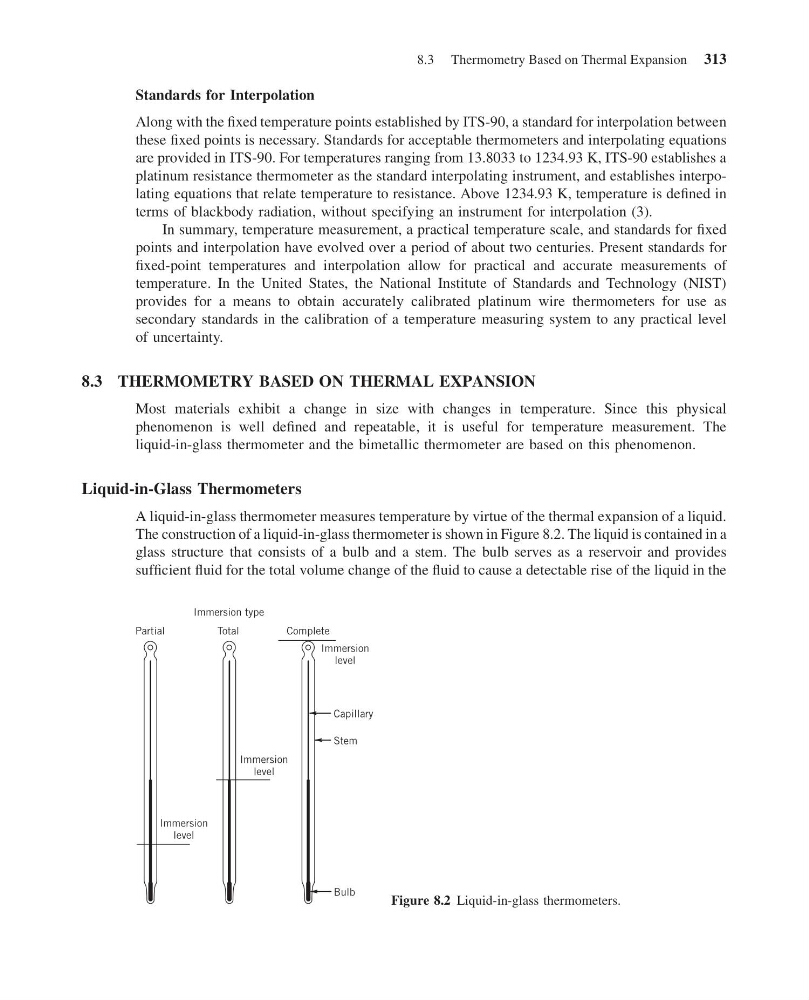
A liquid-in-glass thermometer measures temperature by virtue of the thermal expansion of a liquid.
The construction of a liquid-in-glass thermometer is shown in Figure 8.2. The liquid is contained in a
glass structure that consists of a bulb and a stem. The bulb serves as a reservoir and provides
sufficient fluid for the total volume change of the fluid to cause a detectable rise of the liquid in the
Capillary
Immersion
level
Immersion
level
Immersion
level
Complete
Total
Immersion type
Partial
Stem
Bulb
Figure 8.2 Liquid-in-glass thermometers.
8.3 Thermometry Based on Thermal Expansion 313
14:53:56 Page 313
Standards for Interpolation
Along with the fixed temperature points established by ITS-90, a standard for interpolation between
these fixed points is necessary. Standards for acceptable thermometers and interpolating equations
are provided in ITS-90. For temperatures ranging from 13.8033 to 1234.93 K, ITS-90 establishes a
platinum resistance thermometer as the standard interpolating instrument, and establishes interpolating equations that relate temperature to resistance. Above 1234.93 K, temperature is defined in
terms of blackbody radiation, without specifying an instrument for interpolation (3).
In summary, temperature measurement, a practical temperature scale, and standards for fixed
points and interpolation have evolved over a period of about two centuries. Present standards for
fixed-point temperatures and interpolation allow for practical and accurate measurements of
temperature. In the United States, the National Institute of Standards and Technology (NIST)
provides for a means to obtain accurately calibrated platinum wire thermometers for use as
secondary standards in the calibration of a temperature measuring system to any practical level
of uncertainty.
8.3 THERMOMETRY BASED ON THERMAL EXPANSION
Most materials exhibit a change in size with changes in temperature. Since this physical
phenomenon is well defined and repeatable, it is useful for temperature measurement. The
liquid-in-glass thermometer and the bimetallic thermometer are based on this phenomenon.
Liquid-in-Glass Thermometers
A liquid-in-glass thermometer measures temperature by virtue of the thermal expansion of a liquid.
The construction of a liquid-in-glass thermometer is shown in Figure 8.2. The liquid is contained in a
glass structure that consists of a bulb and a stem. The bulb serves as a reservoir and provides
sufficient fluid for the total volume change of the fluid to cause a detectable rise of the liquid in the
Capillary
Immersion
level
Immersion
level
Immersion
level
Complete
Total
Immersion type
Partial
Stem
Bulb
Figure 8.2 Liquid-in-glass thermometers.
8.3 Thermometry Based on Thermal Expansion 313