

E1C08 09/14/2010
14:53:56 Page 312
0 and 100 into equally spaced degree divisions. This places 50
C as shown in Figure 8.1. What
assumption is implicit in this method of interpolation? It is obvious that we do not have enough
information to appropriately divide the interval between 0 and 100 on the thermometer into degrees.
A theory of the behavior of the mercury in the thermometer or many fixed points for calibration are
necessary to resolve our dilemma.
Even by the late eighteenth century, there was no standard for interpolating between fixed points
on the temperature scale; the result was that different thermometers indicated different temperatures
away from fixed points, sometimes with surprisingly large errors.
Temperature Scales and Standards
At this point, it is necessary to reconcile this arbitrary temperature scale with the idea of absolute
temperature. Thermodynamics defines a temperature scale that has an absolute reference, and
defines an absolute zero for temperature. For example, this absolute temperature governs the energy
behavior of an ideal gas, and is used in the ideal gas equation of state. The behavior of real gases at
very low pressure may be used as a temperature standard to define a practical measure of
temperature that approximates the thermodynamic temperature. The unit of degrees Celsius
(
C) is a practical scale related to the Kelvin as
C ¼ K À 273.15.
The modern engineering definition of the temperature scale is provided by a standard called the
International Temperature Scale of 1990 (ITS-90) (3). This standard establishes fixed points for
temperature, and provides standard procedures and devices for interpolating between fixed points. It
establishes the Kelvin (K) as the unit for the fundamental increment in temperature. Temperatures
established according to ITS-90 do not deviate from the thermodynamic temperature scale by more
than the uncertainty in the thermodynamic temperature at the time of adoption of ITS-90. The
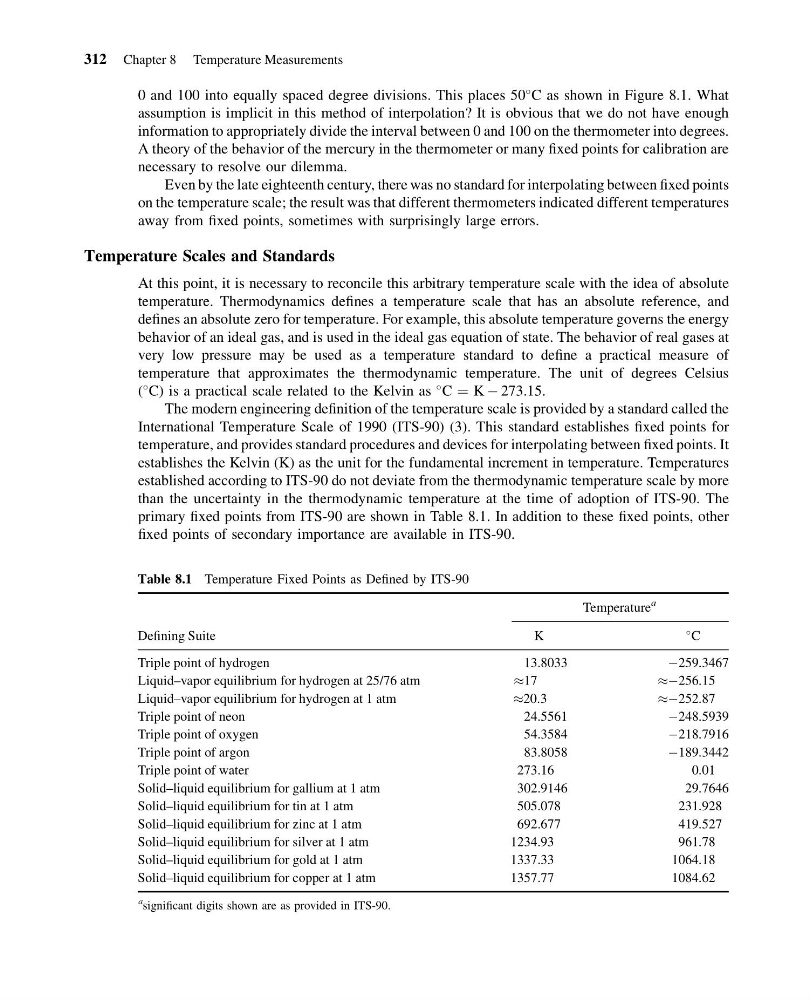
primary fixed points from ITS-90 are shown in Table 8.1. In addition to these fixed points, other
fixed points of secondary importance are available in ITS-90.
Table 8.1 Temperature Fixed Points as Defined by ITS-90
Temperature
a
Defining Suite
K
C
Triple point of hydrogen
13.8033
À259.3467
Liquid–vapor equilibrium for hydrogen at 25/76 atm
%17
%À256.15
Liquid–vapor equilibrium for hydrogen at 1 atm
%20.3
%À252.87
Triple point of neon
24.5561
À248.5939
Triple point of oxygen
54.3584
À218.7916
Triple point of argon
83.8058
À189.3442
Triple point of water
273.16
0.01
Solid–liquid equilibrium for gallium at 1 atm
302.9146
29.7646
Solid–liquid equilibrium for tin at 1 atm
505.078
231.928
Solid–liquid equilibrium for zinc at 1 atm
692.677
419.527
Solid–liquid equilibrium for silver at 1 atm
1234.93
961.78
Solid–liquid equilibrium for gold at 1 atm
1337.33
1064.18
Solid–liquid equilibrium for copper at 1 atm
1357.77
1084.62
a significant digits shown are as provided in ITS-90.
312 Chapter 8 Temperature Measurements
14:53:56 Page 312
0 and 100 into equally spaced degree divisions. This places 50
C as shown in Figure 8.1. What
assumption is implicit in this method of interpolation? It is obvious that we do not have enough
information to appropriately divide the interval between 0 and 100 on the thermometer into degrees.
A theory of the behavior of the mercury in the thermometer or many fixed points for calibration are
necessary to resolve our dilemma.
Even by the late eighteenth century, there was no standard for interpolating between fixed points
on the temperature scale; the result was that different thermometers indicated different temperatures
away from fixed points, sometimes with surprisingly large errors.
Temperature Scales and Standards
At this point, it is necessary to reconcile this arbitrary temperature scale with the idea of absolute
temperature. Thermodynamics defines a temperature scale that has an absolute reference, and
defines an absolute zero for temperature. For example, this absolute temperature governs the energy
behavior of an ideal gas, and is used in the ideal gas equation of state. The behavior of real gases at
very low pressure may be used as a temperature standard to define a practical measure of
temperature that approximates the thermodynamic temperature. The unit of degrees Celsius
(
C) is a practical scale related to the Kelvin as
C ¼ K À 273.15.
The modern engineering definition of the temperature scale is provided by a standard called the
International Temperature Scale of 1990 (ITS-90) (3). This standard establishes fixed points for
temperature, and provides standard procedures and devices for interpolating between fixed points. It
establishes the Kelvin (K) as the unit for the fundamental increment in temperature. Temperatures
established according to ITS-90 do not deviate from the thermodynamic temperature scale by more
than the uncertainty in the thermodynamic temperature at the time of adoption of ITS-90. The
primary fixed points from ITS-90 are shown in Table 8.1. In addition to these fixed points, other
fixed points of secondary importance are available in ITS-90.
Table 8.1 Temperature Fixed Points as Defined by ITS-90
Temperature
a
Defining Suite
K
C
Triple point of hydrogen
13.8033
À259.3467
Liquid–vapor equilibrium for hydrogen at 25/76 atm
%17
%À256.15
Liquid–vapor equilibrium for hydrogen at 1 atm
%20.3
%À252.87
Triple point of neon
24.5561
À248.5939
Triple point of oxygen
54.3584
À218.7916
Triple point of argon
83.8058
À189.3442
Triple point of water
273.16
0.01
Solid–liquid equilibrium for gallium at 1 atm
302.9146
29.7646
Solid–liquid equilibrium for tin at 1 atm
505.078
231.928
Solid–liquid equilibrium for zinc at 1 atm
692.677
419.527
Solid–liquid equilibrium for silver at 1 atm
1234.93
961.78
Solid–liquid equilibrium for gold at 1 atm
1337.33
1064.18
Solid–liquid equilibrium for copper at 1 atm
1357.77
1084.62
a significant digits shown are as provided in ITS-90.
312 Chapter 8 Temperature Measurements