

E1C08 09/14/2010
14:53:55 Page 311
Fixed Point Temperatures and Interpolation
To begin, consider the definition of the triple point of water as having a value of 0.01 for our
temperature scale, as is done for the Celsius scale (0.01
C). This provides for an arbitrary starting
point for a temperature scale; in fact, the number value assigned to this temperature could be
anything. On the Fahrenheit temperature scale it has a value very close to 32. Consider another fixed
point on our temperature scale. Fixed points are typically defined by phase-transition temperatures
or the triple point of a pure substance. The point at which pure water boils at one standard
atmosphere pressure is an easily reproducible fixed temperature. For our purposes let’s assign this
fixed point a numerical value of 100.
The next problem is to define the size of the degree. Since we have two fixed points on our
temperature scale, we can see that the degree is 1/100th of the temperature difference between the
ice point and the boiling point of water at atmospheric pressure.
Conceptually, this defines a workable scale for the measurement of temperature; however, as yet
we have made no provision for interpolating between the two fixed-point temperatures.
Interpolation
The calibration of a temperature measurement device entails not only the establishment of fixed
temperature points but also the indication of any temperature between fixed points. The operation of
a mercury-in-glass thermometer is based on the thermal expansion of mercury contained in a glass
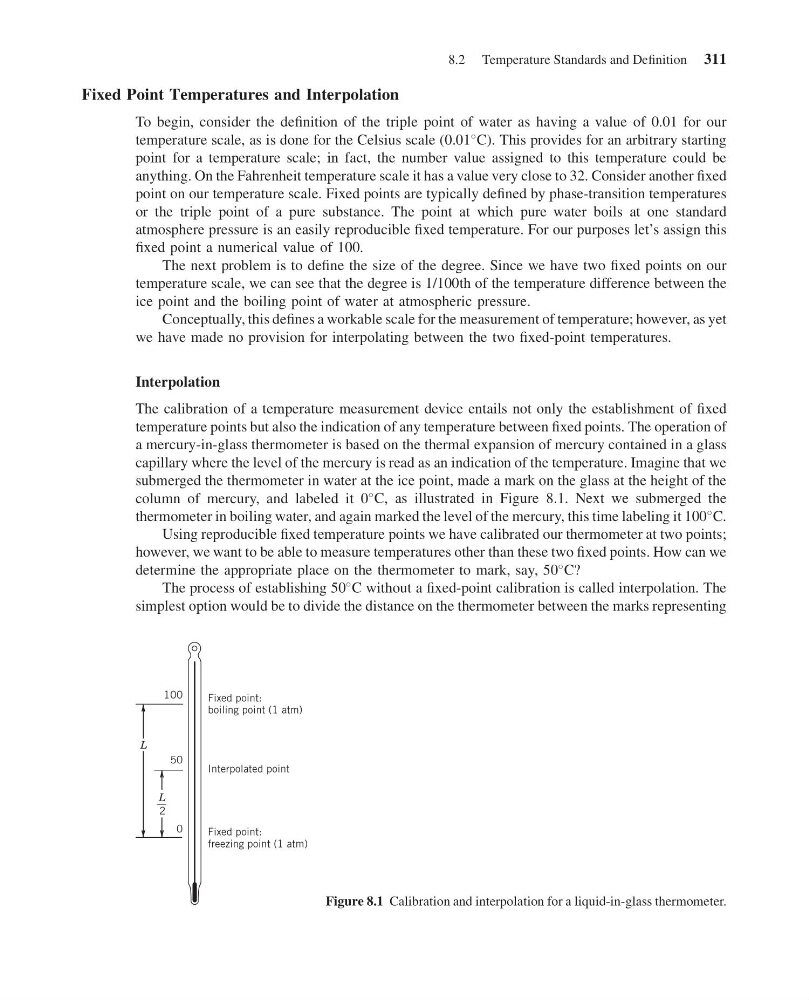
capillary where the level of the mercury is read as an indication of the temperature. Imagine that we
submerged the thermometer in water at the ice point, made a mark on the glass at the height of the
column of mercury, and labeled it 0
C, as illustrated in Figure 8.1. Next we submerged the
thermometer in boiling water, and again marked the level of the mercury, this time labeling it 100
C.
Using reproducible fixed temperature points we have calibrated our thermometer at two points;
however, we want to be able to measure temperatures other than these two fixed points. How can we
determine the appropriate place on the thermometer to mark, say, 50
C?
The process of establishing 50
C without a fixed-point calibration is called interpolation. The
simplest option would be to divide the distance on the thermometer between the marks representing
Fixed point:
boiling point (1 atm)
Fixed point:
freezing point (1 atm)
Interpolated point
100
50
0
L
2
L
Figure 8.1 Calibration and interpolation for a liquid-in-glass thermometer.
8.2 Temperature Standards and Definition 311
14:53:55 Page 311
Fixed Point Temperatures and Interpolation
To begin, consider the definition of the triple point of water as having a value of 0.01 for our
temperature scale, as is done for the Celsius scale (0.01
C). This provides for an arbitrary starting
point for a temperature scale; in fact, the number value assigned to this temperature could be
anything. On the Fahrenheit temperature scale it has a value very close to 32. Consider another fixed
point on our temperature scale. Fixed points are typically defined by phase-transition temperatures
or the triple point of a pure substance. The point at which pure water boils at one standard
atmosphere pressure is an easily reproducible fixed temperature. For our purposes let’s assign this
fixed point a numerical value of 100.
The next problem is to define the size of the degree. Since we have two fixed points on our
temperature scale, we can see that the degree is 1/100th of the temperature difference between the
ice point and the boiling point of water at atmospheric pressure.
Conceptually, this defines a workable scale for the measurement of temperature; however, as yet
we have made no provision for interpolating between the two fixed-point temperatures.
Interpolation
The calibration of a temperature measurement device entails not only the establishment of fixed
temperature points but also the indication of any temperature between fixed points. The operation of
a mercury-in-glass thermometer is based on the thermal expansion of mercury contained in a glass
capillary where the level of the mercury is read as an indication of the temperature. Imagine that we
submerged the thermometer in water at the ice point, made a mark on the glass at the height of the
column of mercury, and labeled it 0
C, as illustrated in Figure 8.1. Next we submerged the
thermometer in boiling water, and again marked the level of the mercury, this time labeling it 100
C.
Using reproducible fixed temperature points we have calibrated our thermometer at two points;
however, we want to be able to measure temperatures other than these two fixed points. How can we
determine the appropriate place on the thermometer to mark, say, 50
C?
The process of establishing 50
C without a fixed-point calibration is called interpolation. The
simplest option would be to divide the distance on the thermometer between the marks representing
Fixed point:
boiling point (1 atm)
Fixed point:
freezing point (1 atm)
Interpolated point
100
50
0
L
2
L
Figure 8.1 Calibration and interpolation for a liquid-in-glass thermometer.
8.2 Temperature Standards and Definition 311