

E1C07 09/14/2010
14:43:51 Page 296
Parallel Communications GPIB (IEEE-488)
The general purpose interface bus (GPIB) is a high-speed parallel interface. Originally developed
by Hewlett-Packard, it is sometimes referred to as the HP-IB. The GPIB is usually operated under
the IEEE-488 communication standard. In 2004 the international and IEEE standards were
combined and the current standard is designated IEC-60488-1. The bus allows for the control
of other devices through a central controller, and it allows devices to receive/transmit information
from/to the controller. This standard is well defined and widely used to interface communication
between computers and printers and scientific instrumentation.
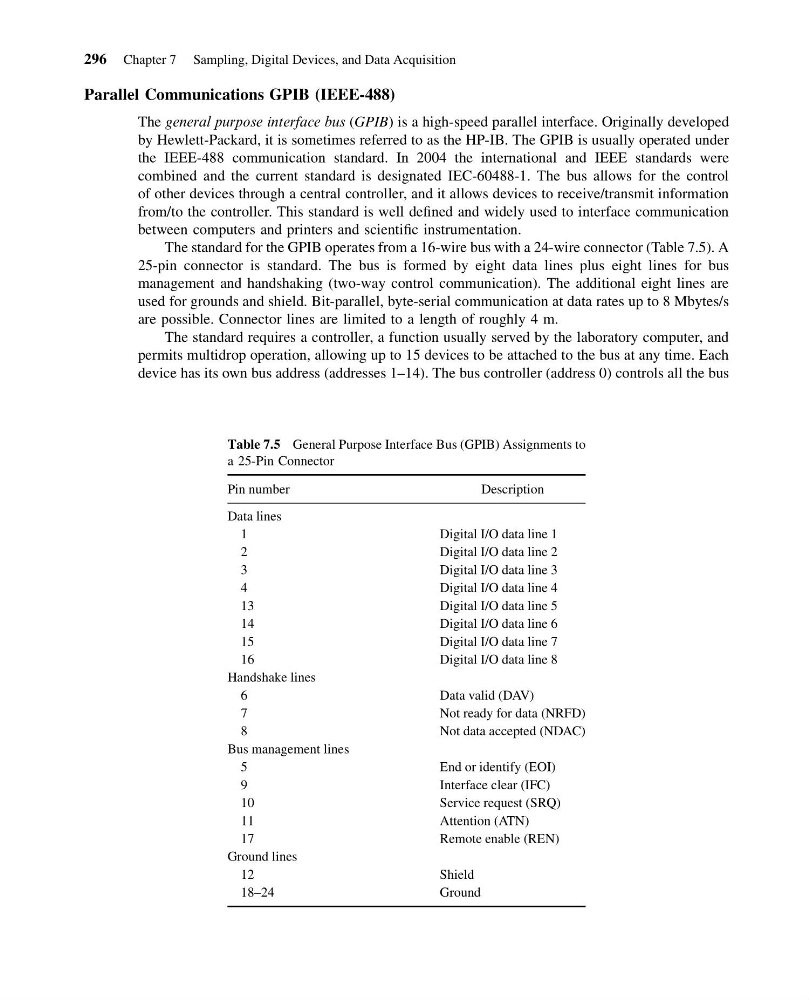
The standard for the GPIB operates from a 16-wire bus with a 24-wire connector (Table 7.5). A
25-pin connector is standard. The bus is formed by eight data lines plus eight lines for bus
management and handshaking (two-way control communication). The additional eight lines are
used for grounds and shield. Bit-parallel, byte-serial communication at data rates up to 8 Mbytes/s
are possible. Connector lines are limited to a length of roughly 4 m.
The standard requires a controller, a function usually served by the laboratory computer, and
permits multidrop operation, allowing up to 15 devices to be attached to the bus at any time. Each
device has its own bus address (addresses 1–14). The bus controller (address 0) controls all the bus
Table 7.5 General Purpose Interface Bus (GPIB) Assignments to
a 25-Pin Connector
Pin number
Description
Data lines
1
Digital I/O data line 1
2
Digital I/O data line 2
3
Digital I/O data line 3
4
Digital I/O data line 4
13
Digital I/O data line 5
14
Digital I/O data line 6
15
Digital I/O data line 7
16
Digital I/O data line 8
Handshake lines
6
Data valid (DAV)
7
Not ready for data (NRFD)
8
Not data accepted (NDAC)
Bus management lines
5
End or identify (EOI)
9
Interface clear (IFC)
10
Service request (SRQ)
11
Attention (ATN)
17
Remote enable (REN)
Ground lines
12
Shield
18–24
Ground
296 Chapter 7 Sampling, Digital Devices, and Data Acquisition
14:43:51 Page 296
Parallel Communications GPIB (IEEE-488)
The general purpose interface bus (GPIB) is a high-speed parallel interface. Originally developed
by Hewlett-Packard, it is sometimes referred to as the HP-IB. The GPIB is usually operated under
the IEEE-488 communication standard. In 2004 the international and IEEE standards were
combined and the current standard is designated IEC-60488-1. The bus allows for the control
of other devices through a central controller, and it allows devices to receive/transmit information
from/to the controller. This standard is well defined and widely used to interface communication
between computers and printers and scientific instrumentation.
The standard for the GPIB operates from a 16-wire bus with a 24-wire connector (Table 7.5). A
25-pin connector is standard. The bus is formed by eight data lines plus eight lines for bus
management and handshaking (two-way control communication). The additional eight lines are
used for grounds and shield. Bit-parallel, byte-serial communication at data rates up to 8 Mbytes/s
are possible. Connector lines are limited to a length of roughly 4 m.
The standard requires a controller, a function usually served by the laboratory computer, and
permits multidrop operation, allowing up to 15 devices to be attached to the bus at any time. Each
device has its own bus address (addresses 1–14). The bus controller (address 0) controls all the bus
Table 7.5 General Purpose Interface Bus (GPIB) Assignments to
a 25-Pin Connector
Pin number
Description
Data lines
1
Digital I/O data line 1
2
Digital I/O data line 2
3
Digital I/O data line 3
4
Digital I/O data line 4
13
Digital I/O data line 5
14
Digital I/O data line 6
15
Digital I/O data line 7
16
Digital I/O data line 8
Handshake lines
6
Data valid (DAV)
7
Not ready for data (NRFD)
8
Not data accepted (NDAC)
Bus management lines
5
End or identify (EOI)
9
Interface clear (IFC)
10
Service request (SRQ)
11
Attention (ATN)
17
Remote enable (REN)
Ground lines
12
Shield
18–24
Ground
296 Chapter 7 Sampling, Digital Devices, and Data Acquisition