

E1C07 09/14/2010
14:43:51 Page 295
through enclosures, walls, and clothes. Devices are independent of aiming position. As such, the
specification overcomes problems inherent with popular infrared port communication devices, for
example those used on common electronic remote controls, which require line-of-sight interaction.
However, Bluetooth is not intended or written to be a wireless LAN network protocol, such as is
IEEE 802.11. Instead, it does permit communication between peripheral devices that use their own
protocol by setting up a personal area network (PAN). Up to eight devices can communicate
simultaneously over distances of up to about 10 m of separation within the 2.402- and 2.480-GHz
radio spectrum on a PAN. Bluetooth 2.0 can manage data transfer rates up to 3 Mbps.
Universal Serial Bus and Firewire
The USB permits peripheral expansion for up to 128 devices at low- to high-speed data transfer
rates. The original USB (USB 1.0/1.1) supports transfer rates from 1.5 Mbs up to 12Mbs, and the
high-speed USB (USB 2.0) supports rates up to 480 Mbs. In January 2010 the first certified USB 3.0
consumer products were announced; the USB 3.0 achievable data rate is 3.2 Gbit/sec. Notably the
maximum current that a USB 3.0 device can draw is 900 mA, an 80% increase over USB 2.0. The
USB supports a ‘‘hot swap’’ feature that allows the user to plug in a USB-compatible device and to
use it without reboot. This bus connects USB devices to a single computer host through a USB root
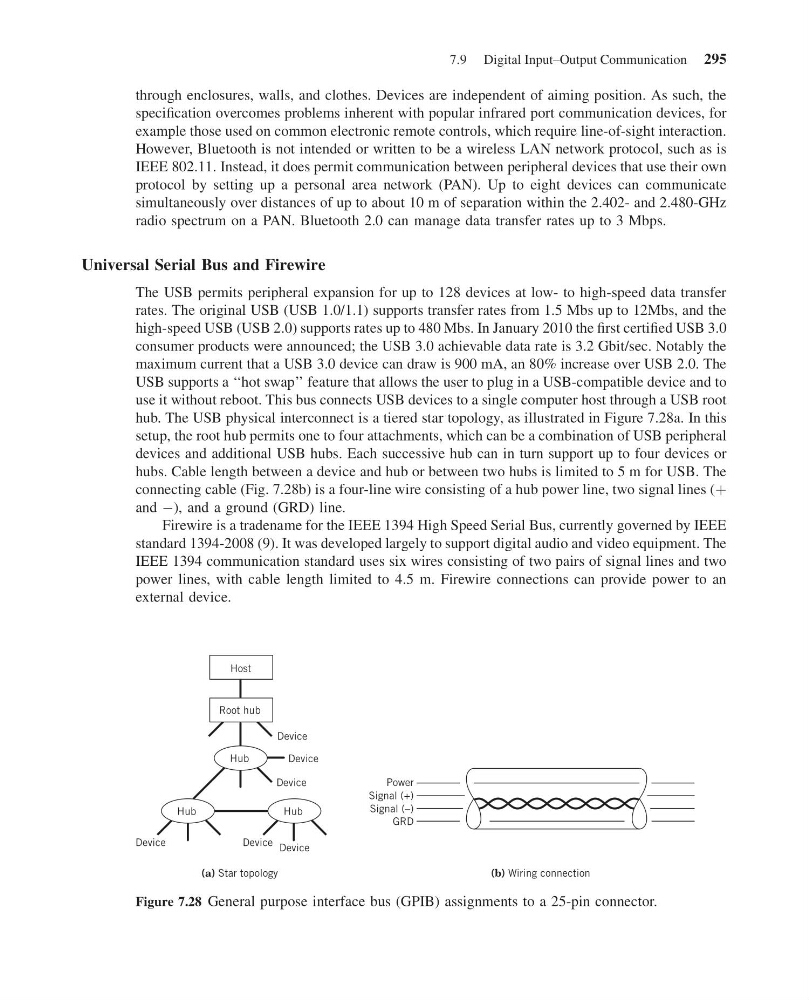
hub. The USB physical interconnect is a tiered star topology, as illustrated in Figure 7.28a. In this
setup, the root hub permits one to four attachments, which can be a combination of USB peripheral
devices and additional USB hubs. Each successive hub can in turn support up to four devices or
hubs. Cable length between a device and hub or between two hubs is limited to 5 m for USB. The
connecting cable (Fig. 7.28b) is a four-line wire consisting of a hub power line, two signal lines (þ
and À), and a ground (GRD) line.
Firewire is a tradename for the IEEE 1394 High Speed Serial Bus, currently governed by IEEE
standard 1394-2008 (9). It was developed largely to support digital audio and video equipment. The
IEEE 1394 communication standard uses six wires consisting of two pairs of signal lines and two
power lines, with cable length limited to 4.5 m. Firewire connections can provide power to an
external device.
Device
Device
Device
Device
Device
Device
(a) Star topology
Host
Root hub
Hub
Hub
Hub
Power
Signal (+)
Signal (–)
GRD
(b) Wiring connection
Figure 7.28 General purpose interface bus (GPIB) assignments to a 25-pin connector.
7.9 Digital Input–Output Communication 295
14:43:51 Page 295
through enclosures, walls, and clothes. Devices are independent of aiming position. As such, the
specification overcomes problems inherent with popular infrared port communication devices, for
example those used on common electronic remote controls, which require line-of-sight interaction.
However, Bluetooth is not intended or written to be a wireless LAN network protocol, such as is
IEEE 802.11. Instead, it does permit communication between peripheral devices that use their own
protocol by setting up a personal area network (PAN). Up to eight devices can communicate
simultaneously over distances of up to about 10 m of separation within the 2.402- and 2.480-GHz
radio spectrum on a PAN. Bluetooth 2.0 can manage data transfer rates up to 3 Mbps.
Universal Serial Bus and Firewire
The USB permits peripheral expansion for up to 128 devices at low- to high-speed data transfer
rates. The original USB (USB 1.0/1.1) supports transfer rates from 1.5 Mbs up to 12Mbs, and the
high-speed USB (USB 2.0) supports rates up to 480 Mbs. In January 2010 the first certified USB 3.0
consumer products were announced; the USB 3.0 achievable data rate is 3.2 Gbit/sec. Notably the
maximum current that a USB 3.0 device can draw is 900 mA, an 80% increase over USB 2.0. The
USB supports a ‘‘hot swap’’ feature that allows the user to plug in a USB-compatible device and to
use it without reboot. This bus connects USB devices to a single computer host through a USB root
hub. The USB physical interconnect is a tiered star topology, as illustrated in Figure 7.28a. In this
setup, the root hub permits one to four attachments, which can be a combination of USB peripheral
devices and additional USB hubs. Each successive hub can in turn support up to four devices or
hubs. Cable length between a device and hub or between two hubs is limited to 5 m for USB. The
connecting cable (Fig. 7.28b) is a four-line wire consisting of a hub power line, two signal lines (þ
and À), and a ground (GRD) line.
Firewire is a tradename for the IEEE 1394 High Speed Serial Bus, currently governed by IEEE
standard 1394-2008 (9). It was developed largely to support digital audio and video equipment. The
IEEE 1394 communication standard uses six wires consisting of two pairs of signal lines and two
power lines, with cable length limited to 4.5 m. Firewire connections can provide power to an
external device.
Device
Device
Device
Device
Device
Device
(a) Star topology
Host
Root hub
Hub
Hub
Hub
Power
Signal (+)
Signal (–)
GRD
(b) Wiring connection
Figure 7.28 General purpose interface bus (GPIB) assignments to a 25-pin connector.
7.9 Digital Input–Output Communication 295