

E1C01 09/14/2010
15:40:34 Page 12
Example 1.2
Develop a test matrix that will minimize the interference effects of any extraneous variables in
Example 1.1.
KNOWN p ¼ f 8; T; z 1 ; z 2 ; z 3
ð
Þ , where 8 ¼ f 1 x; T
ð
Þ. Control variable 8 is changed.
Dependent variable p is measured.
FIND Randomize possible effects of extraneous variables.
SOLUTION Part of our test strategy is to vary volume, control gas temperature, and measure
pressure. An important feature of all test plans is a strategy that minimizes the superposition of
false trends onto the data set by the extraneous variables. Since z 1 , z 2 , and z 3 and any inability to
hold the gas temperature constant are continuous extraneous variables, their influence on p can be
randomized by a random test. This entails shuffling the order by which 8 is applied. Say that we pick
six values of volume, 8 1 , 8 2 , 8 3 , 8 4 , 8 5 , and 8 6 , where the subscripts correspond to an increasing
sequential order of the respective values of volume. Any random order will do fine. One possibility,
found by using the random function features of a hand-held calculator, is
8 2 8 5 8 1 8 4 8 6 8 3
If we perform our measurements in a random order, interference trends will be broken up.
Example 1.3
The manufacture of a particular composite material requires mixing a percentage by weight of
binder with resin to produce a gel. The gel is used to impregnate a fiber to produce the composite
material in a manual process called the lay-up. The strength, s, of the finished material depends
on the percent binder in the gel. However, the strength may also be lay-up operator dependent.
Formulate a test matrix by which the strength to percent binder–gel ratio under production
conditions can be established.
KNOWN s ¼ f (binder; operator)
ASSUMPTION Strength is affected only by binder and operator.
FIND Test matrix to randomize effects of operator.
SOLUTION The dependent variable, s, is to be tested against the independent variable,
percent binder–gel ratio. The operator is an extraneous variable in actual production. As a
simple test, we could test the relationship between three binder–gel ratios, A, B, and C, and
measure strength. We could also choose three typical operators (z 1 , z 2 , and z 3 ) to produce N
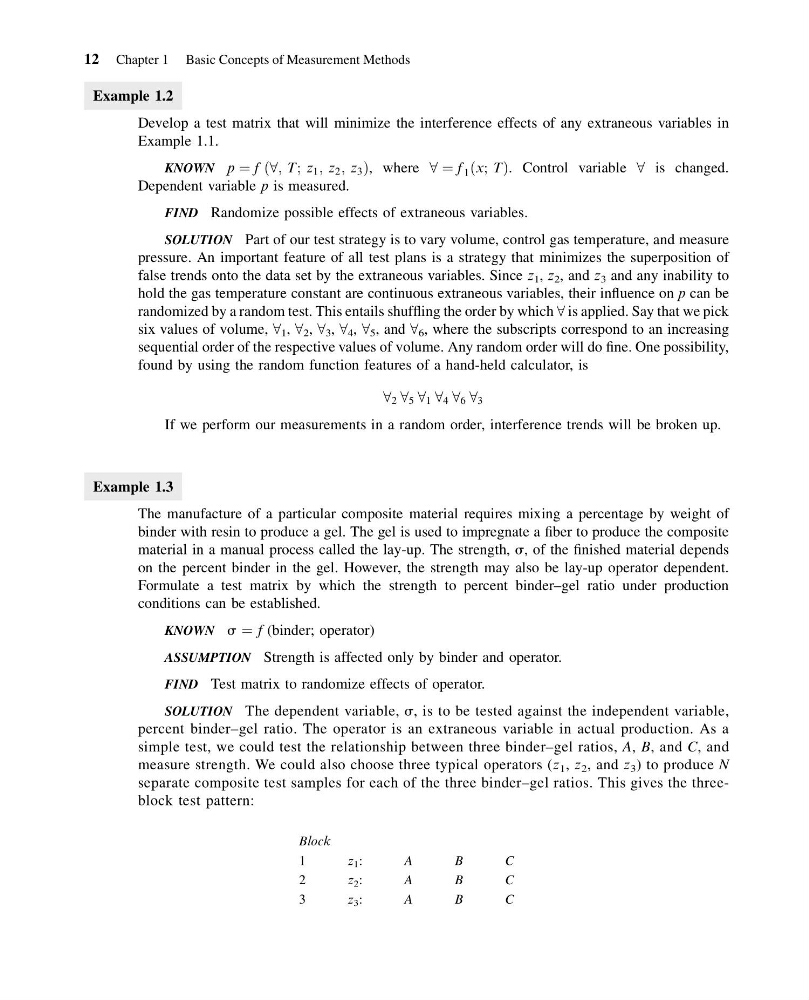
separate composite test samples for each of the three binder–gel ratios. This gives the threeblock test pattern:
Block
1
z 1 :
A
B
C
2
z 2 :
A
B
C
3
z 3 :
A
B
C
12 Chapter 1 Basic Concepts of Measurement Methods
15:40:34 Page 12
Example 1.2
Develop a test matrix that will minimize the interference effects of any extraneous variables in
Example 1.1.
KNOWN p ¼ f 8; T; z 1 ; z 2 ; z 3
ð
Þ , where 8 ¼ f 1 x; T
ð
Þ. Control variable 8 is changed.
Dependent variable p is measured.
FIND Randomize possible effects of extraneous variables.
SOLUTION Part of our test strategy is to vary volume, control gas temperature, and measure
pressure. An important feature of all test plans is a strategy that minimizes the superposition of
false trends onto the data set by the extraneous variables. Since z 1 , z 2 , and z 3 and any inability to
hold the gas temperature constant are continuous extraneous variables, their influence on p can be
randomized by a random test. This entails shuffling the order by which 8 is applied. Say that we pick
six values of volume, 8 1 , 8 2 , 8 3 , 8 4 , 8 5 , and 8 6 , where the subscripts correspond to an increasing
sequential order of the respective values of volume. Any random order will do fine. One possibility,
found by using the random function features of a hand-held calculator, is
8 2 8 5 8 1 8 4 8 6 8 3
If we perform our measurements in a random order, interference trends will be broken up.
Example 1.3
The manufacture of a particular composite material requires mixing a percentage by weight of
binder with resin to produce a gel. The gel is used to impregnate a fiber to produce the composite
material in a manual process called the lay-up. The strength, s, of the finished material depends
on the percent binder in the gel. However, the strength may also be lay-up operator dependent.
Formulate a test matrix by which the strength to percent binder–gel ratio under production
conditions can be established.
KNOWN s ¼ f (binder; operator)
ASSUMPTION Strength is affected only by binder and operator.
FIND Test matrix to randomize effects of operator.
SOLUTION The dependent variable, s, is to be tested against the independent variable,
percent binder–gel ratio. The operator is an extraneous variable in actual production. As a
simple test, we could test the relationship between three binder–gel ratios, A, B, and C, and
measure strength. We could also choose three typical operators (z 1 , z 2 , and z 3 ) to produce N
separate composite test samples for each of the three binder–gel ratios. This gives the threeblock test pattern:
Block
1
z 1 :
A
B
C
2
z 2 :
A
B
C
3
z 3 :
A
B
C
12 Chapter 1 Basic Concepts of Measurement Methods