

E1C01 09/14/2010
15:40:34 Page 11
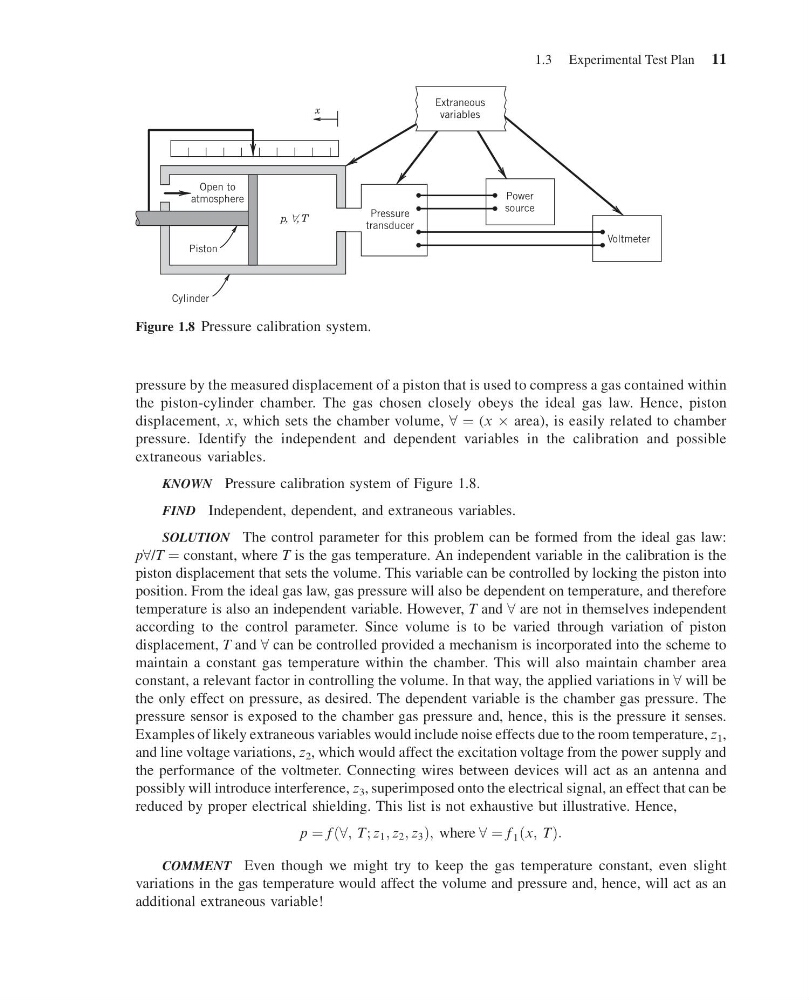
pressure by the measured displacement of a piston that is used to compress a gas contained within
the piston-cylinder chamber. The gas chosen closely obeys the ideal gas law. Hence, piston
displacement, x, which sets the chamber volume, 8 ¼ (x  area), is easily related to chamber
pressure. Identify the independent and dependent variables in the calibration and possible
extraneous variables.
KNOWN Pressure calibration system of Figure 1.8.
FIND Independent, dependent, and extraneous variables.
SOLUTION The control parameter for this problem can be formed from the ideal gas law:
p8/T ¼ constant, where T is the gas temperature. An independent variable in the calibration is the
piston displacement that sets the volume. This variable can be controlled by locking the piston into
position. From the ideal gas law, gas pressure will also be dependent on temperature, and therefore
temperature is also an independent variable. However, T and 8 are not in themselves independent
according to the control parameter. Since volume is to be varied through variation of piston
displacement, T and 8 can be controlled provided a mechanism is incorporated into the scheme to
maintain a constant gas temperature within the chamber. This will also maintain chamber area
constant, a relevant factor in controlling the volume. In that way, the applied variations in 8 will be
the only effect on pressure, as desired. The dependent variable is the chamber gas pressure. The
pressure sensor is exposed to the chamber gas pressure and, hence, this is the pressure it senses.
Examples of likely extraneous variables would include noise effects due to the room temperature, z 1 ,
and line voltage variations, z 2 , which would affect the excitation voltage from the power supply and
the performance of the voltmeter. Connecting wires between devices will act as an antenna and
possibly will introduce interference, z 3 , superimposed onto the electrical signal, an effect that can be
reduced by proper electrical shielding. This list is not exhaustive but illustrative. Hence,
p ¼ f 8; T; z 1 ; z 2 ; z 3
ð
Þ ; where 8 ¼ f 1 x; T
ð
Þ:
COMMENT Even though we might try to keep the gas temperature constant, even slight
variations in the gas temperature would affect the volume and pressure and, hence, will act as an
additional extraneous variable!
Extraneous
variables
Pressure
transducer
Open to
atmosphere
Piston
p, ∀, T
Cylinder
x
Power
source
Voltmeter
Figure 1.8 Pressure calibration system.
1.3 Experimental Test Plan 11
15:40:34 Page 11
pressure by the measured displacement of a piston that is used to compress a gas contained within
the piston-cylinder chamber. The gas chosen closely obeys the ideal gas law. Hence, piston
displacement, x, which sets the chamber volume, 8 ¼ (x  area), is easily related to chamber
pressure. Identify the independent and dependent variables in the calibration and possible
extraneous variables.
KNOWN Pressure calibration system of Figure 1.8.
FIND Independent, dependent, and extraneous variables.
SOLUTION The control parameter for this problem can be formed from the ideal gas law:
p8/T ¼ constant, where T is the gas temperature. An independent variable in the calibration is the
piston displacement that sets the volume. This variable can be controlled by locking the piston into
position. From the ideal gas law, gas pressure will also be dependent on temperature, and therefore
temperature is also an independent variable. However, T and 8 are not in themselves independent
according to the control parameter. Since volume is to be varied through variation of piston
displacement, T and 8 can be controlled provided a mechanism is incorporated into the scheme to
maintain a constant gas temperature within the chamber. This will also maintain chamber area
constant, a relevant factor in controlling the volume. In that way, the applied variations in 8 will be
the only effect on pressure, as desired. The dependent variable is the chamber gas pressure. The
pressure sensor is exposed to the chamber gas pressure and, hence, this is the pressure it senses.
Examples of likely extraneous variables would include noise effects due to the room temperature, z 1 ,
and line voltage variations, z 2 , which would affect the excitation voltage from the power supply and
the performance of the voltmeter. Connecting wires between devices will act as an antenna and
possibly will introduce interference, z 3 , superimposed onto the electrical signal, an effect that can be
reduced by proper electrical shielding. This list is not exhaustive but illustrative. Hence,
p ¼ f 8; T; z 1 ; z 2 ; z 3
ð
Þ ; where 8 ¼ f 1 x; T
ð
Þ:
COMMENT Even though we might try to keep the gas temperature constant, even slight
variations in the gas temperature would affect the volume and pressure and, hence, will act as an
additional extraneous variable!
Extraneous
variables
Pressure
transducer
Open to
atmosphere
Piston
p, ∀, T
Cylinder
x
Power
source
Voltmeter
Figure 1.8 Pressure calibration system.
1.3 Experimental Test Plan 11