

E1C01 09/14/2010
15:40:34 Page 13
In the analysis of the test, all of these data can be combined. The results of each block will
include each operator’s influence as a variation. We can assume that the order used within each
block is unimportant. But if only the data from one operator are considered, the results may show a
trend consistent with the lay-up technique of that operator. The test matrix above will randomize the
influence of any one operator on the strength test results by introducing the influence of several
operators.
Example 1.4
Suppose following lay-up, the composite material of Example 1.3 is allowed to cure at a controlled
but elevated temperature. We wish to develop a relationship between the binder–gel ratio and the
cure temperature and strength. Develop a suitable test matrix.
KNOWN s ¼ f (binder, temperature, operator)
ASSUMPTION Strength is affected only by binder, temperature, and operator.
FIND Test matrix to randomize effect of operator.
SOLUTION We develop a simple matrix to test for the dependence of composite strength on
the independent variables of binder–gel ratio and cure temperature. We could proceed as in Example
1.3 and set up three randomized blocks for ratio and three for temperature for a total of 18 separate
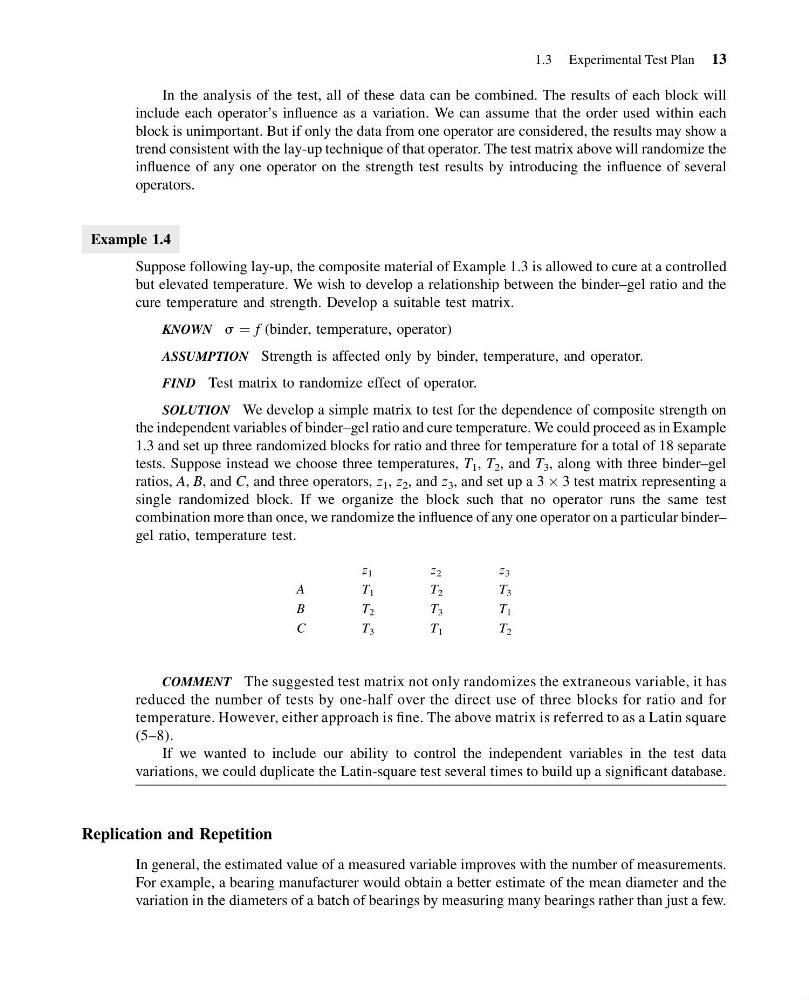
tests. Suppose instead we choose three temperatures, T 1 , T 2 , and T 3 , along with three binder–gel
ratios, A, B, and C, and three operators, z 1 , z 2 , and z 3 , and set up a 3 Â 3 test matrix representing a
single randomized block. If we organize the block such that no operator runs the same test
combination more than once, we randomize the influence of any one operator on a particular binder–
gel ratio, temperature test.
z 1
z 2
z 3
A
T 1
T 2
T 3
B
T 2
T 3
T 1
C
T 3
T 1
T 2
COMMENT The suggested test matrix not only randomizes the extraneous variable, it has
reduced the number of tests by one-half over the direct use of three blocks for ratio and for
temperature. However, either approach is fine. The above matrix is referred to as a Latin square
(5–8).
If we wanted to include our ability to control the independent variables in the test data
variations, we could duplicate the Latin-square test several times to build up a significant database.
Replication and Repetition
In general, the estimated value of a measured variable improves with the number of measurements.
For example, a bearing manufacturer would obtain a better estimate of the mean diameter and the
variation in the diameters of a batch of bearings by measuring many bearings rather than just a few.
1.3 Experimental Test Plan 13
15:40:34 Page 13
In the analysis of the test, all of these data can be combined. The results of each block will
include each operator’s influence as a variation. We can assume that the order used within each
block is unimportant. But if only the data from one operator are considered, the results may show a
trend consistent with the lay-up technique of that operator. The test matrix above will randomize the
influence of any one operator on the strength test results by introducing the influence of several
operators.
Example 1.4
Suppose following lay-up, the composite material of Example 1.3 is allowed to cure at a controlled
but elevated temperature. We wish to develop a relationship between the binder–gel ratio and the
cure temperature and strength. Develop a suitable test matrix.
KNOWN s ¼ f (binder, temperature, operator)
ASSUMPTION Strength is affected only by binder, temperature, and operator.
FIND Test matrix to randomize effect of operator.
SOLUTION We develop a simple matrix to test for the dependence of composite strength on
the independent variables of binder–gel ratio and cure temperature. We could proceed as in Example
1.3 and set up three randomized blocks for ratio and three for temperature for a total of 18 separate
tests. Suppose instead we choose three temperatures, T 1 , T 2 , and T 3 , along with three binder–gel
ratios, A, B, and C, and three operators, z 1 , z 2 , and z 3 , and set up a 3 Â 3 test matrix representing a
single randomized block. If we organize the block such that no operator runs the same test
combination more than once, we randomize the influence of any one operator on a particular binder–
gel ratio, temperature test.
z 1
z 2
z 3
A
T 1
T 2
T 3
B
T 2
T 3
T 1
C
T 3
T 1
T 2
COMMENT The suggested test matrix not only randomizes the extraneous variable, it has
reduced the number of tests by one-half over the direct use of three blocks for ratio and for
temperature. However, either approach is fine. The above matrix is referred to as a Latin square
(5–8).
If we wanted to include our ability to control the independent variables in the test data
variations, we could duplicate the Latin-square test several times to build up a significant database.
Replication and Repetition
In general, the estimated value of a measured variable improves with the number of measurements.
For example, a bearing manufacturer would obtain a better estimate of the mean diameter and the
variation in the diameters of a batch of bearings by measuring many bearings rather than just a few.
1.3 Experimental Test Plan 13