

E1C05 09/14/2010
14:36:26 Page 169
Data-Acquisition Errors
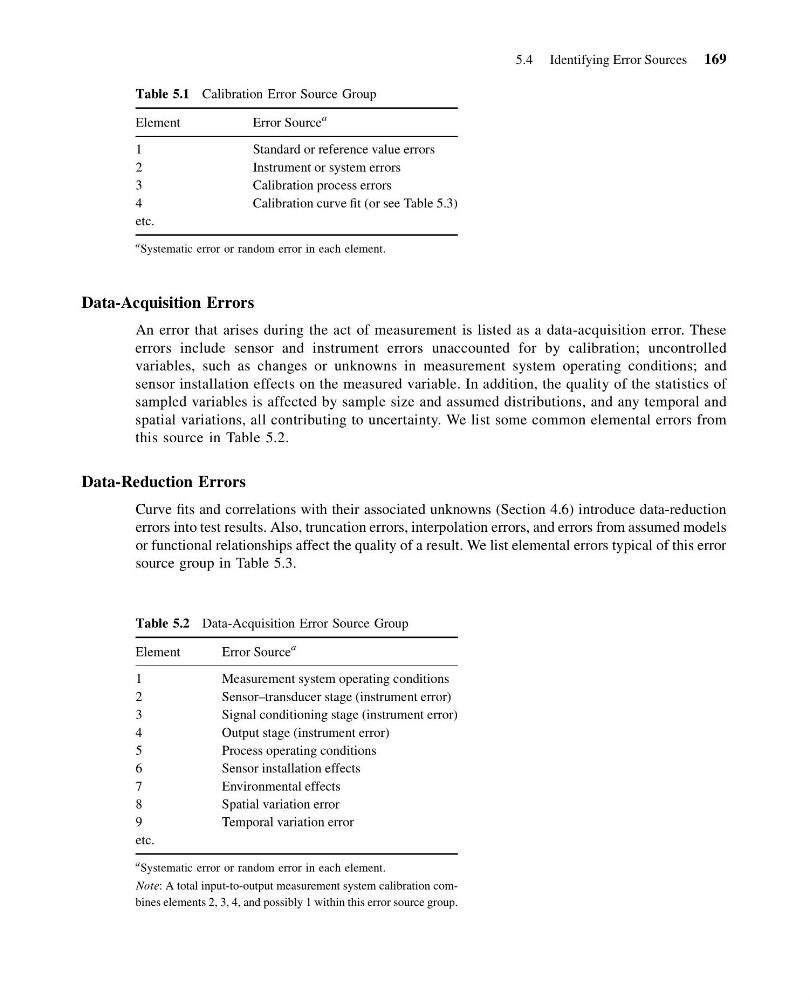
An error that arises during the act of measurement is listed as a data-acquisition error. These
errors include sensor and instrument errors unaccounted for by calibration; uncontrolled
variables, such as changes or unknowns in measurement system operating conditions; and
sensor installation effects on the measured variable. In addition, the quality of the statistics of
sampled variables is affected by sample size and assumed distributions, and any temporal and
spatial variations, all contributing to uncertainty. We list some common elemental errors from
this source in Table 5.2.
Data-Reduction Errors
Curve fits and correlations with their associated unknowns (Section 4.6) introduce data-reduction
errors into test results. Also, truncation errors, interpolation errors, and errors from assumed models
or functional relationships affect the quality of a result. We list elemental errors typical of this error
source group in Table 5.3.
Table 5.2 Data-Acquisition Error Source Group
Element
Error Source
a
1
Measurement system operating conditions
2
Sensor–transducer stage (instrument error)
3
Signal conditioning stage (instrument error)
4
Output stage (instrument error)
5
Process operating conditions
6
Sensor installation effects
7
Environmental effects
8
Spatial variation error
9
Temporal variation error
etc.
a Systematic error or random error in each element.
Note: A total input-to-output measurement system calibration combines elements 2, 3, 4, and possibly 1 within this error source group.
Table 5.1 Calibration Error Source Group
Element
Error Source
a
1
Standard or reference value errors
2
Instrument or system errors
3
Calibration process errors
4
Calibration curve fit (or see Table 5.3)
etc.
a Systematic error or random error in each element.
5.4 Identifying Error Sources 169
14:36:26 Page 169
Data-Acquisition Errors
An error that arises during the act of measurement is listed as a data-acquisition error. These
errors include sensor and instrument errors unaccounted for by calibration; uncontrolled
variables, such as changes or unknowns in measurement system operating conditions; and
sensor installation effects on the measured variable. In addition, the quality of the statistics of
sampled variables is affected by sample size and assumed distributions, and any temporal and
spatial variations, all contributing to uncertainty. We list some common elemental errors from
this source in Table 5.2.
Data-Reduction Errors
Curve fits and correlations with their associated unknowns (Section 4.6) introduce data-reduction
errors into test results. Also, truncation errors, interpolation errors, and errors from assumed models
or functional relationships affect the quality of a result. We list elemental errors typical of this error
source group in Table 5.3.
Table 5.2 Data-Acquisition Error Source Group
Element
Error Source
a
1
Measurement system operating conditions
2
Sensor–transducer stage (instrument error)
3
Signal conditioning stage (instrument error)
4
Output stage (instrument error)
5
Process operating conditions
6
Sensor installation effects
7
Environmental effects
8
Spatial variation error
9
Temporal variation error
etc.
a Systematic error or random error in each element.
Note: A total input-to-output measurement system calibration combines elements 2, 3, 4, and possibly 1 within this error source group.
Table 5.1 Calibration Error Source Group
Element
Error Source
a
1
Standard or reference value errors
2
Instrument or system errors
3
Calibration process errors
4
Calibration curve fit (or see Table 5.3)
etc.
a Systematic error or random error in each element.
5.4 Identifying Error Sources 169