

E1C05 09/14/2010
14:36:26 Page 168
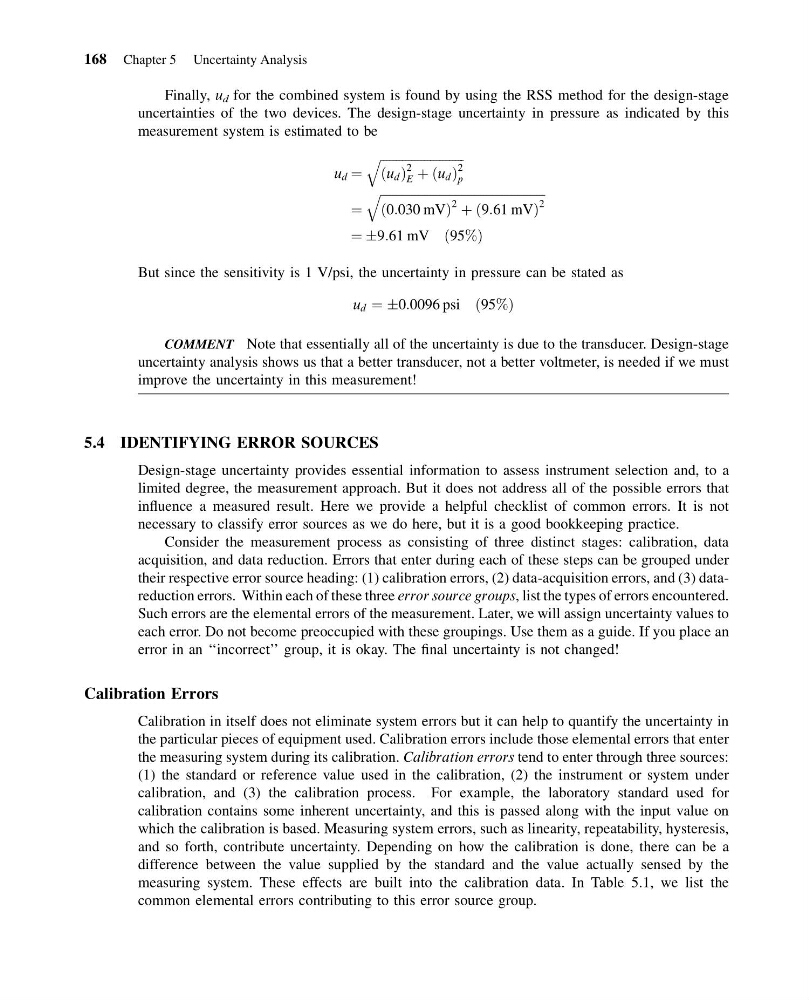
Finally, u d for the combined system is found by using the RSS method for the design-stage
uncertainties of the two devices. The design-stage uncertainty in pressure as indicated by this
measurement system is estimated to be
u d ¼
ffiffiffiffiffiffiffiffiffiffiffiffiffiffiffiffiffiffiffiffiffiffiffiffiffiffiffi
u d
ð Þ
2
E þ u d
ð Þ
2
p
q
¼
ffiffiffiffiffiffiffiffiffiffiffiffiffiffiffiffiffiffiffiffiffiffiffiffiffiffiffiffiffiffiffiffiffiffiffiffiffiffiffiffiffiffiffiffiffiffiffiffiffiffiffiffiffi
0:030 mV
ð
Þ
2 þ 9:61 mV
ð
Þ
2
q
¼ Æ9:61 mV 95%
ð
Þ
But since the sensitivity is 1 V/psi, the uncertainty in pressure can be stated as
u d ¼ Æ0:0096 psi 95%
ð
Þ
COMMENT Note that essentially all of the uncertainty is due to the transducer. Design-stage
uncertainty analysis shows us that a better transducer, not a better voltmeter, is needed if we must
improve the uncertainty in this measurement!
5.4 IDENTIFYING ERROR SOURCES
Design-stage uncertainty provides essential information to assess instrument selection and, to a
limited degree, the measurement approach. But it does not address all of the possible errors that
influence a measured result. Here we provide a helpful checklist of common errors. It is not
necessary to classify error sources as we do here, but it is a good bookkeeping practice.
Consider the measurement process as consisting of three distinct stages: calibration, data
acquisition, and data reduction. Errors that enter during each of these steps can be grouped under
their respective error source heading: (1) calibration errors, (2) data-acquisition errors, and (3) datareduction errors. Within each of these three error source groups, list the types of errors encountered.
Such errors are the elemental errors of the measurement. Later, we will assign uncertainty values to
each error. Do not become preoccupied with these groupings. Use them as a guide. If you place an
error in an ‘‘incorrect’’ group, it is okay. The final uncertainty is not changed!
Calibration Errors
Calibration in itself does not eliminate system errors but it can help to quantify the uncertainty in
the particular pieces of equipment used. Calibration errors include those elemental errors that enter
the measuring system during its calibration. Calibration errors tend to enter through three sources:
(1) the standard or reference value used in the calibration, (2) the instrument or system under
calibration, and (3) the calibration process. For example, the laboratory standard used for
calibration contains some inherent uncertainty, and this is passed along with the input value on
which the calibration is based. Measuring system errors, such as linearity, repeatability, hysteresis,
and so forth, contribute uncertainty. Depending on how the calibration is done, there can be a
difference between the value supplied by the standard and the value actually sensed by the
measuring system. These effects are built into the calibration data. In Table 5.1, we list the
common elemental errors contributing to this error source group.
168 Chapter 5 Uncertainty Analysis
14:36:26 Page 168
Finally, u d for the combined system is found by using the RSS method for the design-stage
uncertainties of the two devices. The design-stage uncertainty in pressure as indicated by this
measurement system is estimated to be
u d ¼
ffiffiffiffiffiffiffiffiffiffiffiffiffiffiffiffiffiffiffiffiffiffiffiffiffiffiffi
u d
ð Þ
2
E þ u d
ð Þ
2
p
q
¼
ffiffiffiffiffiffiffiffiffiffiffiffiffiffiffiffiffiffiffiffiffiffiffiffiffiffiffiffiffiffiffiffiffiffiffiffiffiffiffiffiffiffiffiffiffiffiffiffiffiffiffiffiffi
0:030 mV
ð
Þ
2 þ 9:61 mV
ð
Þ
2
q
¼ Æ9:61 mV 95%
ð
Þ
But since the sensitivity is 1 V/psi, the uncertainty in pressure can be stated as
u d ¼ Æ0:0096 psi 95%
ð
Þ
COMMENT Note that essentially all of the uncertainty is due to the transducer. Design-stage
uncertainty analysis shows us that a better transducer, not a better voltmeter, is needed if we must
improve the uncertainty in this measurement!
5.4 IDENTIFYING ERROR SOURCES
Design-stage uncertainty provides essential information to assess instrument selection and, to a
limited degree, the measurement approach. But it does not address all of the possible errors that
influence a measured result. Here we provide a helpful checklist of common errors. It is not
necessary to classify error sources as we do here, but it is a good bookkeeping practice.
Consider the measurement process as consisting of three distinct stages: calibration, data
acquisition, and data reduction. Errors that enter during each of these steps can be grouped under
their respective error source heading: (1) calibration errors, (2) data-acquisition errors, and (3) datareduction errors. Within each of these three error source groups, list the types of errors encountered.
Such errors are the elemental errors of the measurement. Later, we will assign uncertainty values to
each error. Do not become preoccupied with these groupings. Use them as a guide. If you place an
error in an ‘‘incorrect’’ group, it is okay. The final uncertainty is not changed!
Calibration Errors
Calibration in itself does not eliminate system errors but it can help to quantify the uncertainty in
the particular pieces of equipment used. Calibration errors include those elemental errors that enter
the measuring system during its calibration. Calibration errors tend to enter through three sources:
(1) the standard or reference value used in the calibration, (2) the instrument or system under
calibration, and (3) the calibration process. For example, the laboratory standard used for
calibration contains some inherent uncertainty, and this is passed along with the input value on
which the calibration is based. Measuring system errors, such as linearity, repeatability, hysteresis,
and so forth, contribute uncertainty. Depending on how the calibration is done, there can be a
difference between the value supplied by the standard and the value actually sensed by the
measuring system. These effects are built into the calibration data. In Table 5.1, we list the
common elemental errors contributing to this error source group.
168 Chapter 5 Uncertainty Analysis