

82
4 Characteristic Properties of Redox Enzymes as Electrocatalysts
0
1
2
3
0
30
60
90
120
θ
Nc
A
B
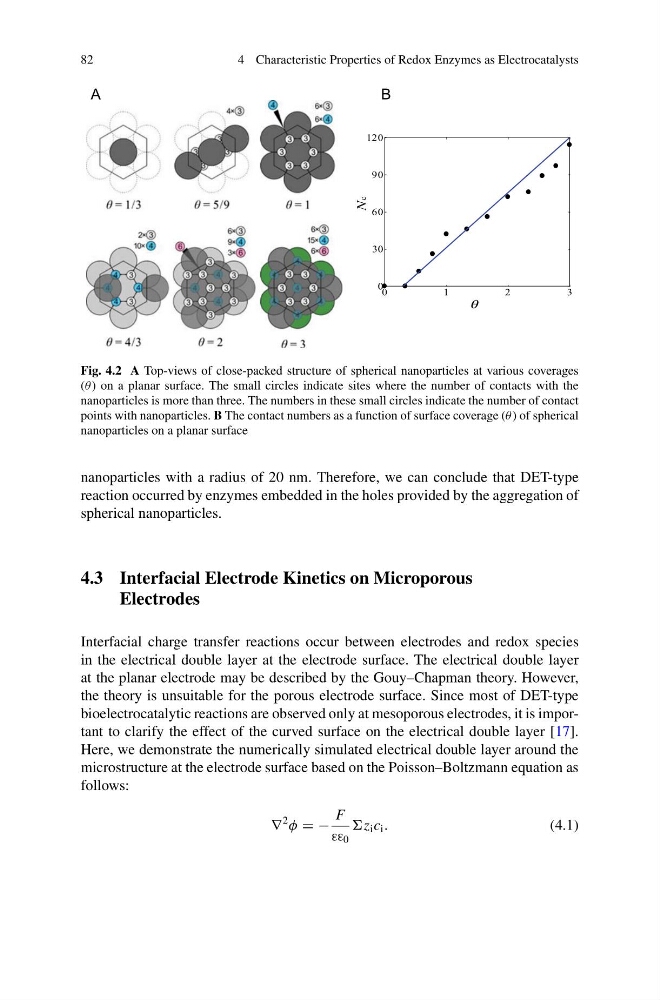
Fig. 4.2 A Top-views of close-packed structure of spherical nanoparticles at various coverages
(θ) on a planar surface. The small circles indicate sites where the number of contacts with the
nanoparticles is more than three. The numbers in these small circles indicate the number of contact
points with nanoparticles. B The contact numbers as a function of surface coverage (θ) of spherical
nanoparticles on a planar surface
nanoparticles with a radius of 20 nm. Therefore, we can conclude that DET-type
reaction occurred by enzymes embedded in the holes provided by the aggregation of
spherical nanoparticles.
4.3 Interfacial Electrode Kinetics on Microporous
Electrodes
Interfacial charge transfer reactions occur between electrodes and redox species
in the electrical double layer at the electrode surface. The electrical double layer
at the planar electrode may be described by the Gouy–Chapman theory. However,
the theory is unsuitable for the porous electrode surface. Since most of DET-type
bioelectrocatalytic reactions are observed only at mesoporous electrodes, it is important to clarify the effect of the curved surface on the electrical double layer [17].
Here, we demonstrate the numerically simulated electrical double layer around the
microstructure at the electrode surface based on the Poisson–Boltzmann equation as
follows:
∇
2
φ = −
F
εε 0
i c i .
(4.1)
4 Characteristic Properties of Redox Enzymes as Electrocatalysts
0
1
2
3
0
30
60
90
120
θ
Nc
A
B
Fig. 4.2 A Top-views of close-packed structure of spherical nanoparticles at various coverages
(θ) on a planar surface. The small circles indicate sites where the number of contacts with the
nanoparticles is more than three. The numbers in these small circles indicate the number of contact
points with nanoparticles. B The contact numbers as a function of surface coverage (θ) of spherical
nanoparticles on a planar surface
nanoparticles with a radius of 20 nm. Therefore, we can conclude that DET-type
reaction occurred by enzymes embedded in the holes provided by the aggregation of
spherical nanoparticles.
4.3 Interfacial Electrode Kinetics on Microporous
Electrodes
Interfacial charge transfer reactions occur between electrodes and redox species
in the electrical double layer at the electrode surface. The electrical double layer
at the planar electrode may be described by the Gouy–Chapman theory. However,
the theory is unsuitable for the porous electrode surface. Since most of DET-type
bioelectrocatalytic reactions are observed only at mesoporous electrodes, it is important to clarify the effect of the curved surface on the electrical double layer [17].
Here, we demonstrate the numerically simulated electrical double layer around the
microstructure at the electrode surface based on the Poisson–Boltzmann equation as
follows:
∇
2
φ = −
F
εε 0
i c i .
(4.1)