

4.2 Surface-Area Effect and Curvature Effects (or Cage Effect) on Mesoporous Electrodes
81
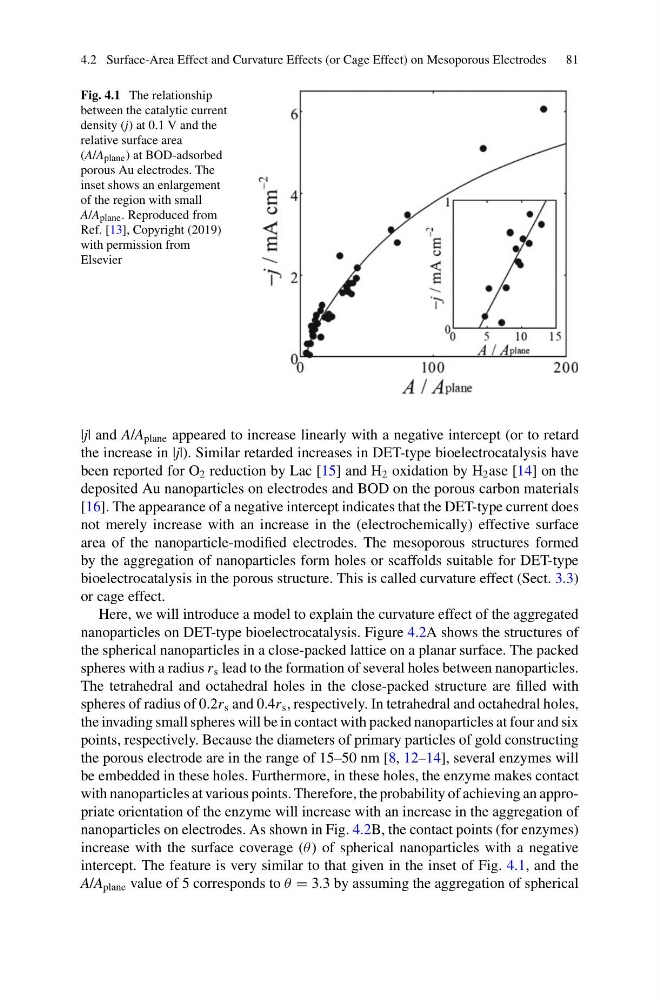
Fig. 4.1 The relationship
between the catalytic current
density (j) at 0.1 V and the
relative surface area
(A/A plane ) at BOD-adsorbed
porous Au electrodes. The
inset shows an enlargement
of the region with small
A/A plane . Reproduced from
Ref. [13], Copyright (2019)
with permission from
Elsevier
|j| and A/A plane appeared to increase linearly with a negative intercept (or to retard
the increase in |j|). Similar retarded increases in DET-type bioelectrocatalysis have
been reported for O 2 reduction by Lac [15] and H 2 oxidation by H 2 ase [14] on the
deposited Au nanoparticles on electrodes and BOD on the porous carbon materials
[16]. The appearance of a negative intercept indicates that the DET-type current does
not merely increase with an increase in the (electrochemically) effective surface
area of the nanoparticle-modified electrodes. The mesoporous structures formed
by the aggregation of nanoparticles form holes or scaffolds suitable for DET-type
bioelectrocatalysis in the porous structure. This is called curvature effect (Sect. 3.3)
or cage effect.
Here, we will introduce a model to explain the curvature effect of the aggregated
nanoparticles on DET-type bioelectrocatalysis. Figure 4.2A shows the structures of
the spherical nanoparticles in a close-packed lattice on a planar surface. The packed
spheres with a radius r s lead to the formation of several holes between nanoparticles.
The tetrahedral and octahedral holes in the close-packed structure are filled with
spheres of radius of 0.2r s and 0.4r s , respectively. In tetrahedral and octahedral holes,
the invading small spheres will be in contact with packed nanoparticles at four and six
points, respectively. Because the diameters of primary particles of gold constructing
the porous electrode are in the range of 15–50 nm [8, 12–14], several enzymes will
be embedded in these holes. Furthermore, in these holes, the enzyme makes contact
with nanoparticles at various points. Therefore, the probability of achieving an appropriate orientation of the enzyme will increase with an increase in the aggregation of
nanoparticles on electrodes. As shown in Fig. 4.2B, the contact points (for enzymes)
increase with the surface coverage (θ ) of spherical nanoparticles with a negative
intercept. The feature is very similar to that given in the inset of Fig. 4.1, and the
A/A plane value of 5 corresponds to θ = 3.3 by assuming the aggregation of spherical
81
Fig. 4.1 The relationship
between the catalytic current
density (j) at 0.1 V and the
relative surface area
(A/A plane ) at BOD-adsorbed
porous Au electrodes. The
inset shows an enlargement
of the region with small
A/A plane . Reproduced from
Ref. [13], Copyright (2019)
with permission from
Elsevier
|j| and A/A plane appeared to increase linearly with a negative intercept (or to retard
the increase in |j|). Similar retarded increases in DET-type bioelectrocatalysis have
been reported for O 2 reduction by Lac [15] and H 2 oxidation by H 2 ase [14] on the
deposited Au nanoparticles on electrodes and BOD on the porous carbon materials
[16]. The appearance of a negative intercept indicates that the DET-type current does
not merely increase with an increase in the (electrochemically) effective surface
area of the nanoparticle-modified electrodes. The mesoporous structures formed
by the aggregation of nanoparticles form holes or scaffolds suitable for DET-type
bioelectrocatalysis in the porous structure. This is called curvature effect (Sect. 3.3)
or cage effect.
Here, we will introduce a model to explain the curvature effect of the aggregated
nanoparticles on DET-type bioelectrocatalysis. Figure 4.2A shows the structures of
the spherical nanoparticles in a close-packed lattice on a planar surface. The packed
spheres with a radius r s lead to the formation of several holes between nanoparticles.
The tetrahedral and octahedral holes in the close-packed structure are filled with
spheres of radius of 0.2r s and 0.4r s , respectively. In tetrahedral and octahedral holes,
the invading small spheres will be in contact with packed nanoparticles at four and six
points, respectively. Because the diameters of primary particles of gold constructing
the porous electrode are in the range of 15–50 nm [8, 12–14], several enzymes will
be embedded in these holes. Furthermore, in these holes, the enzyme makes contact
with nanoparticles at various points. Therefore, the probability of achieving an appropriate orientation of the enzyme will increase with an increase in the aggregation of
nanoparticles on electrodes. As shown in Fig. 4.2B, the contact points (for enzymes)
increase with the surface coverage (θ ) of spherical nanoparticles with a negative
intercept. The feature is very similar to that given in the inset of Fig. 4.1, and the
A/A plane value of 5 corresponds to θ = 3.3 by assuming the aggregation of spherical