

72
3 Fundamentals of DET-Type Bioelectrocatalysis
can participate in fast DET-type bioelectrocatalysis at k ox >> k c in the limiting region
for oxidation and vice versa for k red >> k c in the reduction reaction.
Mesoporous electrodes are very effective and sometime essential for proceeding
the DET-type bioelectrocatalysis. It is also necessary to consider orientations of
enzymes in mesopores. Herein, we assume a spherical enzyme with a radius r located
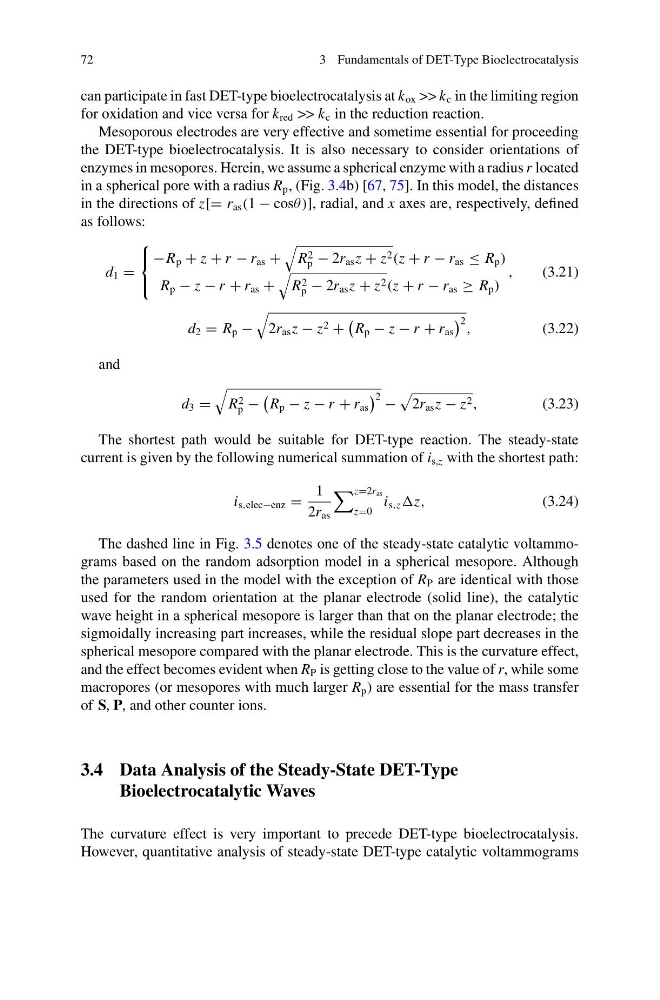
in a spherical pore with a radius R p , (Fig. 3.4b) [67, 75]. In this model, the distances
in the directions of z[= r as (1 − cosθ )], radial, and x axes are, respectively, defined
as follows:
d 1 =
⎧
⎨
⎩
−R p + z + r − r as +
R 2
p − 2r as z + z 2 (z + r − r as ≤ R p )
R p − z − r + r as +
R 2
p − 2r as z + z 2 (z + r − r as ≥ R p )
,
(3.21)
d 2 = R p −
2r as z − z 2 +
R p − z − r + r as
2 ,
(3.22)
and
d 3 =
R 2
p −
R p − z − r + r as
2 −
2r as z − z 2 ,
(3.23)
The shortest path would be suitable for DET-type reaction. The steady-state
current is given by the following numerical summation of i s,z with the shortest path:
i s,elec−enz =
1
2r as
z=2r as
z=0
i s,z z,
(3.24)
The dashed line in Fig. 3.5 denotes one of the steady-state catalytic voltammograms based on the random adsorption model in a spherical mesopore. Although
the parameters used in the model with the exception of R P are identical with those
used for the random orientation at the planar electrode (solid line), the catalytic
wave height in a spherical mesopore is larger than that on the planar electrode; the
sigmoidally increasing part increases, while the residual slope part decreases in the
spherical mesopore compared with the planar electrode. This is the curvature effect,
and the effect becomes evident when R P is getting close to the value of r, while some
macropores (or mesopores with much larger R p ) are essential for the mass transfer
of S, P, and other counter ions.
3.4 Data Analysis of the Steady-State DET-Type
Bioelectrocatalytic Waves
The curvature effect is very important to precede DET-type bioelectrocatalysis.
However, quantitative analysis of steady-state DET-type catalytic voltammograms
3 Fundamentals of DET-Type Bioelectrocatalysis
can participate in fast DET-type bioelectrocatalysis at k ox >> k c in the limiting region
for oxidation and vice versa for k red >> k c in the reduction reaction.
Mesoporous electrodes are very effective and sometime essential for proceeding
the DET-type bioelectrocatalysis. It is also necessary to consider orientations of
enzymes in mesopores. Herein, we assume a spherical enzyme with a radius r located
in a spherical pore with a radius R p , (Fig. 3.4b) [67, 75]. In this model, the distances
in the directions of z[= r as (1 − cosθ )], radial, and x axes are, respectively, defined
as follows:
d 1 =
⎧
⎨
⎩
−R p + z + r − r as +
R 2
p − 2r as z + z 2 (z + r − r as ≤ R p )
R p − z − r + r as +
R 2
p − 2r as z + z 2 (z + r − r as ≥ R p )
,
(3.21)
d 2 = R p −
2r as z − z 2 +
R p − z − r + r as
2 ,
(3.22)
and
d 3 =
R 2
p −
R p − z − r + r as
2 −
2r as z − z 2 ,
(3.23)
The shortest path would be suitable for DET-type reaction. The steady-state
current is given by the following numerical summation of i s,z with the shortest path:
i s,elec−enz =
1
2r as
z=2r as
z=0
i s,z z,
(3.24)
The dashed line in Fig. 3.5 denotes one of the steady-state catalytic voltammograms based on the random adsorption model in a spherical mesopore. Although
the parameters used in the model with the exception of R P are identical with those
used for the random orientation at the planar electrode (solid line), the catalytic
wave height in a spherical mesopore is larger than that on the planar electrode; the
sigmoidally increasing part increases, while the residual slope part decreases in the
spherical mesopore compared with the planar electrode. This is the curvature effect,
and the effect becomes evident when R P is getting close to the value of r, while some
macropores (or mesopores with much larger R p ) are essential for the mass transfer
of S, P, and other counter ions.
3.4 Data Analysis of the Steady-State DET-Type
Bioelectrocatalytic Waves
The curvature effect is very important to precede DET-type bioelectrocatalysis.
However, quantitative analysis of steady-state DET-type catalytic voltammograms