

3.4 Data Analysis of the Steady-State DET-Type …
73
based on Eq. (3.24) is somewhat complicated owing to lack of detailed (and complicated) information on the size and distribution of mesoporous structures on an electrode surface. Therefore, DET-type steady-state catalytic waves were frequently
analyzed using Eq. (3.19) or Eq. (3.20), for example for H 2 ases [73, 74, 76]. In
the analysis, Eq. (3.19) or Eq. (3.20) is fitted to the experimental data by a non-linear
least square method using suitable adjustable parameters.
On the other hand, suppose that only enzymes with limited orientations on an
electrode surface can participate in the DET-type bioelectrocatalysis even in the
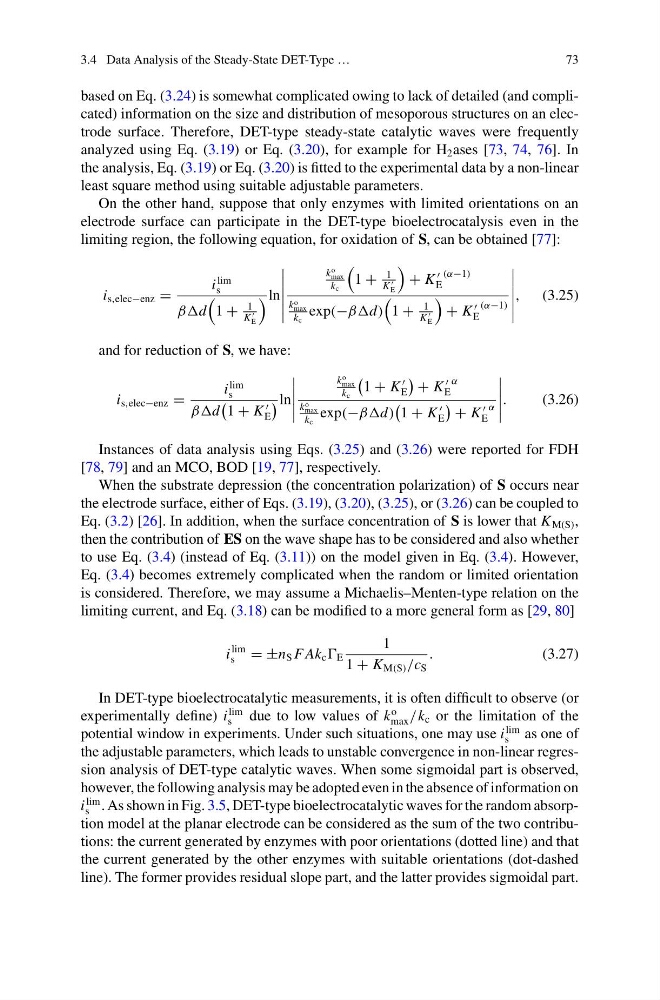
limiting region, the following equation, for oxidation of S, can be obtained [77]:
i s,elec−enz =
i
lim
s
ββd
1 +
1
K
E
ln
k
o
max
k c
1 +
1
K
E
+ K
E
(α−1)
k o
max
k c
exp(−ββd)
1 +
1
K
E
+ K
E
(α−1)
, (3.25)
and for reduction of S, we have:
i s,elec−enz =
i
lim
s
ββd
1 + K
E
ln
k
o
max
k c
1 + K
E
+ K
E
α
k o
max
k c
exp(−ββd)
1 + K
E
+ K
E
α
.
(3.26)
Instances of data analysis using Eqs. (3.25) and (3.26) were reported for FDH
[78, 79] and an MCO, BOD [19, 77], respectively.
When the substrate depression (the concentration polarization) of S occurs near
the electrode surface, either of Eqs. (3.19), (3.20), (3.25), or (3.26) can be coupled to
Eq. (3.2) [26]. In addition, when the surface concentration of S is lower that K M(S) ,
then the contribution of ES on the wave shape has to be considered and also whether
to use Eq. (3.4) (instead of Eq. (3.11)) on the model given in Eq. (3.4). However,
Eq. (3.4) becomes extremely complicated when the random or limited orientation
is considered. Therefore, we may assume a Michaelis–Menten-type relation on the
limiting current, and Eq. (3.18) can be modified to a more general form as [29, 80]
i
lim
s
= ±n S F Ak c E
1
1 + K M(S) /c S
.
(3.27)
In DET-type bioelectrocatalytic measurements, it is often difficult to observe (or
experimentally define) i
lim
s
due to low values of k
o
max /k c or the limitation of the
potential window in experiments. Under such situations, one may use i
lim
s as one of
the adjustable parameters, which leads to unstable convergence in non-linear regression analysis of DET-type catalytic waves. When some sigmoidal part is observed,
however, the following analysis may be adopted even in the absence of information on
i
lim
s . As shown in Fig. 3.5, DET-type bioelectrocatalytic waves for the random absorption model at the planar electrode can be considered as the sum of the two contributions: the current generated by enzymes with poor orientations (dotted line) and that
the current generated by the other enzymes with suitable orientations (dot-dashed
line). The former provides residual slope part, and the latter provides sigmoidal part.
73
based on Eq. (3.24) is somewhat complicated owing to lack of detailed (and complicated) information on the size and distribution of mesoporous structures on an electrode surface. Therefore, DET-type steady-state catalytic waves were frequently
analyzed using Eq. (3.19) or Eq. (3.20), for example for H 2 ases [73, 74, 76]. In
the analysis, Eq. (3.19) or Eq. (3.20) is fitted to the experimental data by a non-linear
least square method using suitable adjustable parameters.
On the other hand, suppose that only enzymes with limited orientations on an
electrode surface can participate in the DET-type bioelectrocatalysis even in the
limiting region, the following equation, for oxidation of S, can be obtained [77]:
i s,elec−enz =
i
lim
s
ββd
1 +
1
K
E
ln
k
o
max
k c
1 +
1
K
E
+ K
E
(α−1)
k o
max
k c
exp(−ββd)
1 +
1
K
E
+ K
E
(α−1)
, (3.25)
and for reduction of S, we have:
i s,elec−enz =
i
lim
s
ββd
1 + K
E
ln
k
o
max
k c
1 + K
E
+ K
E
α
k o
max
k c
exp(−ββd)
1 + K
E
+ K
E
α
.
(3.26)
Instances of data analysis using Eqs. (3.25) and (3.26) were reported for FDH
[78, 79] and an MCO, BOD [19, 77], respectively.
When the substrate depression (the concentration polarization) of S occurs near
the electrode surface, either of Eqs. (3.19), (3.20), (3.25), or (3.26) can be coupled to
Eq. (3.2) [26]. In addition, when the surface concentration of S is lower that K M(S) ,
then the contribution of ES on the wave shape has to be considered and also whether
to use Eq. (3.4) (instead of Eq. (3.11)) on the model given in Eq. (3.4). However,
Eq. (3.4) becomes extremely complicated when the random or limited orientation
is considered. Therefore, we may assume a Michaelis–Menten-type relation on the
limiting current, and Eq. (3.18) can be modified to a more general form as [29, 80]
i
lim
s
= ±n S F Ak c E
1
1 + K M(S) /c S
.
(3.27)
In DET-type bioelectrocatalytic measurements, it is often difficult to observe (or
experimentally define) i
lim
s
due to low values of k
o
max /k c or the limitation of the
potential window in experiments. Under such situations, one may use i
lim
s as one of
the adjustable parameters, which leads to unstable convergence in non-linear regression analysis of DET-type catalytic waves. When some sigmoidal part is observed,
however, the following analysis may be adopted even in the absence of information on
i
lim
s . As shown in Fig. 3.5, DET-type bioelectrocatalytic waves for the random absorption model at the planar electrode can be considered as the sum of the two contributions: the current generated by enzymes with poor orientations (dotted line) and that
the current generated by the other enzymes with suitable orientations (dot-dashed
line). The former provides residual slope part, and the latter provides sigmoidal part.