

68
3 Fundamentals of DET-Type Bioelectrocatalysis
where ES denotes the enzyme–substrate complex, k 1 and k −1 denote the rate constant
of the forward and backward reactions of the ES formation, respectively, and k c
denotes the catalytic constant of the DET-type bioelectrocatalysis. Therefore, based
on the serial resistance mode, k elec−enz can be expressed as
1
k s,elec−enz
=
1
k Ox
+
1
K
E K
Enz k c
+
1
K
Enz k c
+
1
k c
,
(3.4)
where K
Enz denotes the steady-state reaction quotient defined as
K
Enz ≡
c ES
c E Ox
=
k 1 c S
k −1 + k c
=
c S
K M(S)
.
(3.5)
K
E can be given by Nernst equation of the RDS of the interfacial electron transfer
of the electrochemically active site in E with number of the electrons (n E,RDS ; usually
n E,RDS = 1) and a formal potential (E
o
E,RDS ):
K
E =
c E ox
c E red
RDS,eq
=
k ox
k red
= exp
n E,RDS F
E − E
o
E,RDS
RT
,
(3.6)
where k ox and k red , respectively, denote the rate constants of the oxidation of E red
and reduction of E ox , which can be expressed as
k ox = k
◦ K
E
1−α ,
(3.7)
and
k red = k
◦ K
E
−α ,
(3.8)
where α is the transfer coefficient of the RDS of E at an electrode, and it is ideally
0.5. Strictly speaking, we have to also consider the interfacial redox reaction of ES.
However, we do not mention further details on this matter.
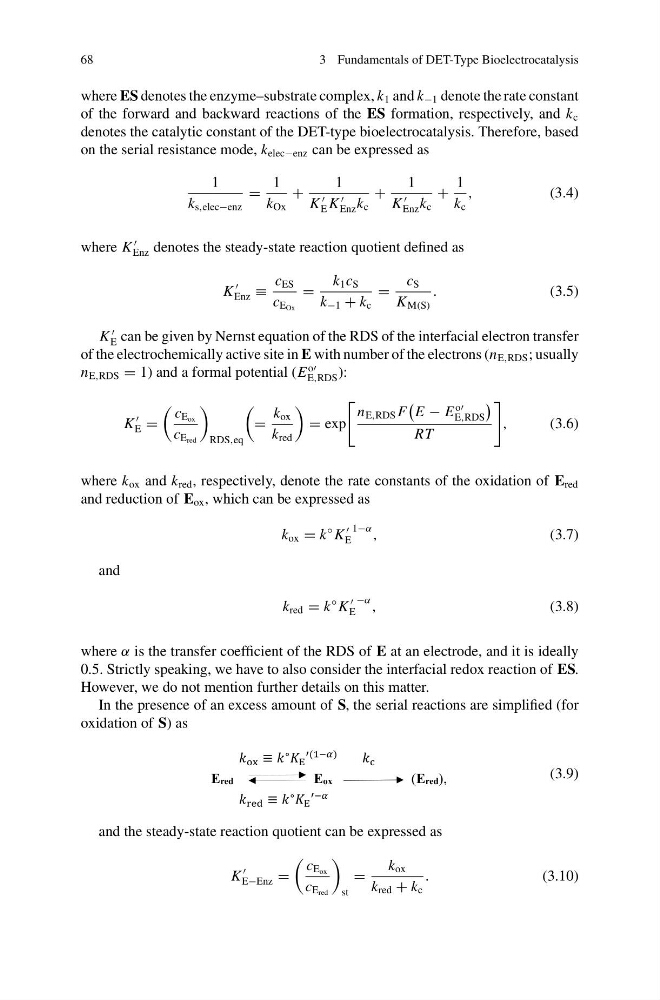
In the presence of an excess amount of S, the serial reactions are simplified (for
oxidation of S) as
Ered
Eox
(Ered),
(3.9)
and the steady-state reaction quotient can be expressed as
K
E−Enz =
c E ox
c E red
st
=
k ox
k red + k c
.
(3.10)
3 Fundamentals of DET-Type Bioelectrocatalysis
where ES denotes the enzyme–substrate complex, k 1 and k −1 denote the rate constant
of the forward and backward reactions of the ES formation, respectively, and k c
denotes the catalytic constant of the DET-type bioelectrocatalysis. Therefore, based
on the serial resistance mode, k elec−enz can be expressed as
1
k s,elec−enz
=
1
k Ox
+
1
K
E K
Enz k c
+
1
K
Enz k c
+
1
k c
,
(3.4)
where K
Enz denotes the steady-state reaction quotient defined as
K
Enz ≡
c ES
c E Ox
=
k 1 c S
k −1 + k c
=
c S
K M(S)
.
(3.5)
K
E can be given by Nernst equation of the RDS of the interfacial electron transfer
of the electrochemically active site in E with number of the electrons (n E,RDS ; usually
n E,RDS = 1) and a formal potential (E
o
E,RDS ):
K
E =
c E ox
c E red
RDS,eq
=
k ox
k red
= exp
n E,RDS F
E − E
o
E,RDS
RT
,
(3.6)
where k ox and k red , respectively, denote the rate constants of the oxidation of E red
and reduction of E ox , which can be expressed as
k ox = k
◦ K
E
1−α ,
(3.7)
and
k red = k
◦ K
E
−α ,
(3.8)
where α is the transfer coefficient of the RDS of E at an electrode, and it is ideally
0.5. Strictly speaking, we have to also consider the interfacial redox reaction of ES.
However, we do not mention further details on this matter.
In the presence of an excess amount of S, the serial reactions are simplified (for
oxidation of S) as
Ered
Eox
(Ered),
(3.9)
and the steady-state reaction quotient can be expressed as
K
E−Enz =
c E ox
c E red
st
=
k ox
k red + k c
.
(3.10)