

3.1 History of DET-Type Bioelectrocatalysis
67
Compound II. The E
⊕ values of ferric/Compound I and ferric/Compound II are +
0.50 V and +0.48 V, respectively [59–61]. Since E
⊕ value of H 2 O 2 /2H 2 O couple is
+1.36 V, the onset potential or half-wave potential of DET-type bioelectrocatalytic
waves of peroxidases should be close to E
⊕ of peroxidases (at pH 7), as reported in
several papers [16, 17, 62–65].
Contrary to the native function of peroxidases, there are numerous papers dealing
with a DET-type electrode reaction of the ferric/ferrous redox couple of peroxidases
(Fig. 3.3, gray color). Most of the authors in the papers on this issue also attempted to
show H 2 O 2 concentration dependence of the cathodic wave, though the voltammetric
waves of the ferric/ferrous redox couple show a peaked shape even in the presence of
H 2 O 2 . The extremely weak peroxidase-like activity is explained by the oxidation of
the ferrous form by H 2 O 2 to Compound II, which is reduced to the ferrous form via
the ferric form (Fig. 3.3, gray color) [66]. This catalytic cycle is completely different
from the native cycle of peroxidases.
3.2 Theory of Steady-State Catalytic Current
As a model of DET-type reaction, one may consider a set of series reaction involving
the steady-state mass transfer and the steady-state DET-type bioelectrocatalysis on
the electrode surface (electro-enzyme reaction), where the substrate S is transferred
to the electrode surface, and is transformed into the product P by a DET-type bioelectrocatalysis. Therefore, the steady-state catalytic current is given by the following
equation:
1
i s
=
1
i s,mt
+
1
i s,elec−enz
,
(3.1)
where i s,mt is given, for example, by Eqs. (2.32) and (2.33). The parameter i s,elec−enz
denotes the electro-enzyme reaction-controlled steady-state current, and can be
expressed as
i s,elec−enz = ±n S F Ak elec−enz E ,
(3.2)
where k elec−enz denotes the first-order steady-state rate constant of the enzyme E in
the DET-type bioelectrocatalysis.
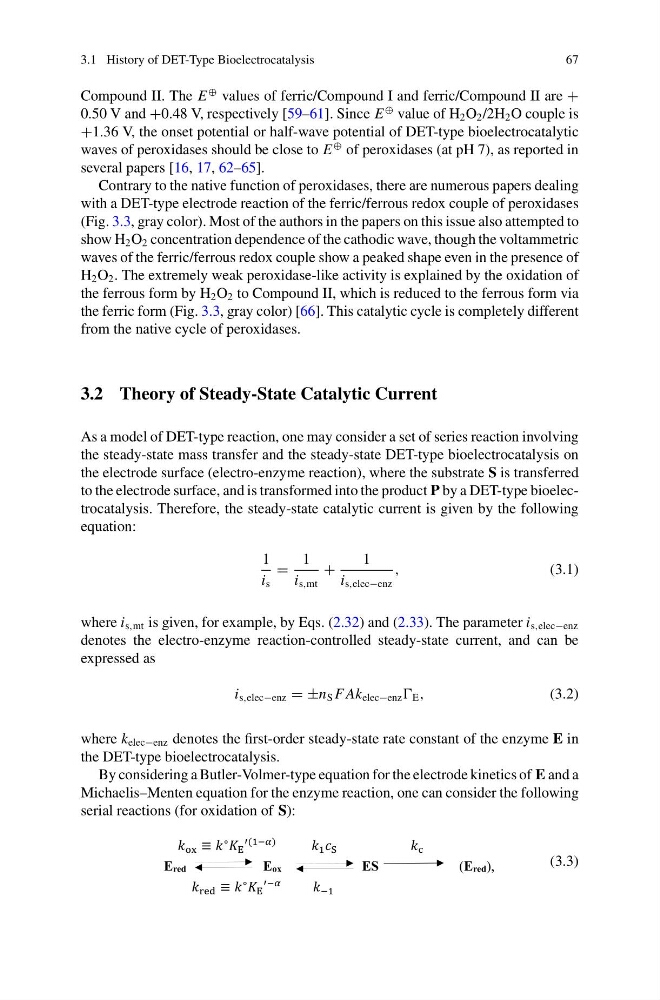
By considering a Butler-Volmer-type equation for the electrode kinetics of E and a
Michaelis–Menten equation for the enzyme reaction, one can consider the following
serial reactions (for oxidation of S):
Ered
Eox
ES
(Ered),
(3.3)
67
Compound II. The E
⊕ values of ferric/Compound I and ferric/Compound II are +
0.50 V and +0.48 V, respectively [59–61]. Since E
⊕ value of H 2 O 2 /2H 2 O couple is
+1.36 V, the onset potential or half-wave potential of DET-type bioelectrocatalytic
waves of peroxidases should be close to E
⊕ of peroxidases (at pH 7), as reported in
several papers [16, 17, 62–65].
Contrary to the native function of peroxidases, there are numerous papers dealing
with a DET-type electrode reaction of the ferric/ferrous redox couple of peroxidases
(Fig. 3.3, gray color). Most of the authors in the papers on this issue also attempted to
show H 2 O 2 concentration dependence of the cathodic wave, though the voltammetric
waves of the ferric/ferrous redox couple show a peaked shape even in the presence of
H 2 O 2 . The extremely weak peroxidase-like activity is explained by the oxidation of
the ferrous form by H 2 O 2 to Compound II, which is reduced to the ferrous form via
the ferric form (Fig. 3.3, gray color) [66]. This catalytic cycle is completely different
from the native cycle of peroxidases.
3.2 Theory of Steady-State Catalytic Current
As a model of DET-type reaction, one may consider a set of series reaction involving
the steady-state mass transfer and the steady-state DET-type bioelectrocatalysis on
the electrode surface (electro-enzyme reaction), where the substrate S is transferred
to the electrode surface, and is transformed into the product P by a DET-type bioelectrocatalysis. Therefore, the steady-state catalytic current is given by the following
equation:
1
i s
=
1
i s,mt
+
1
i s,elec−enz
,
(3.1)
where i s,mt is given, for example, by Eqs. (2.32) and (2.33). The parameter i s,elec−enz
denotes the electro-enzyme reaction-controlled steady-state current, and can be
expressed as
i s,elec−enz = ±n S F Ak elec−enz E ,
(3.2)
where k elec−enz denotes the first-order steady-state rate constant of the enzyme E in
the DET-type bioelectrocatalysis.
By considering a Butler-Volmer-type equation for the electrode kinetics of E and a
Michaelis–Menten equation for the enzyme reaction, one can consider the following
serial reactions (for oxidation of S):
Ered
Eox
ES
(Ered),
(3.3)