

3.2 Theory of Steady-State Catalytic Current
69
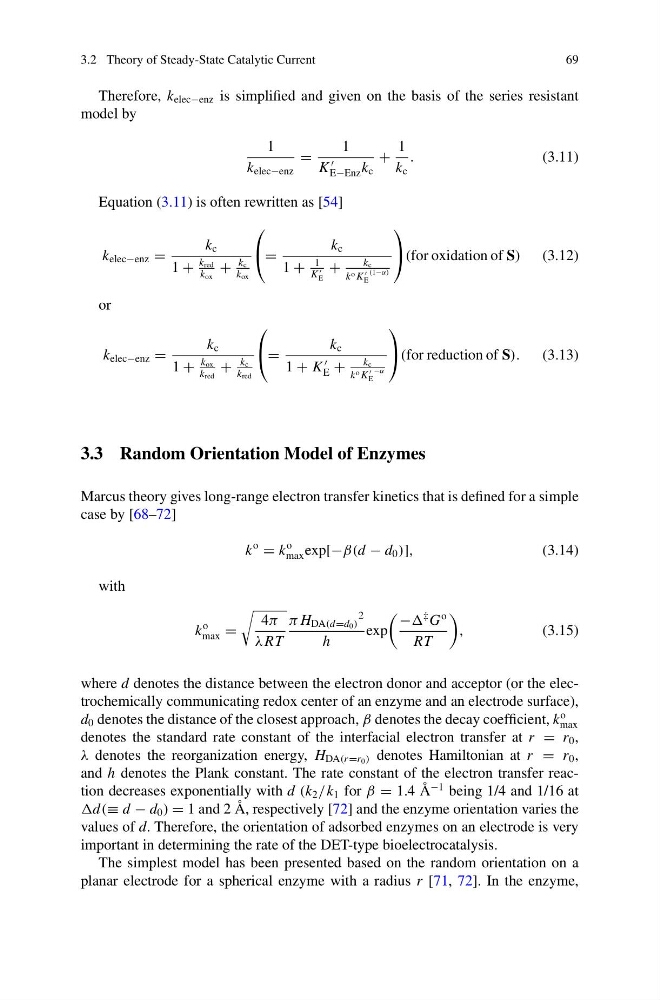
Therefore, k elec−enz is simplified and given on the basis of the series resistant
model by
1
k elec−enz
=
1
K
E−Enz k c
+
1
k c
.
(3.11)
Equation (3.11) is often rewritten as [54]
k elec−enz =
k c
1 +
k red
k ox
+
k c
k ox
⎛
⎝ =
k c
1 +
1
K
E
+
k c
k o K
E
(1−α)
⎞
⎠ (for oxidation of S) (3.12)
or
k elec−enz =
k c
1 +
k ox
k red
+
k c
k red
⎛
⎝ =
k c
1 + K
E +
k c
k o K
E
−α
⎞
⎠ (for reduction of S).
(3.13)
3.3 Random Orientation Model of Enzymes
Marcus theory gives long-range electron transfer kinetics that is defined for a simple
case by [68–72]
k
o
= k
o
max exp[−β(d − d 0 )],
(3.14)
with
k
o
max =
4π
λRT
π H DA(d=d 0 )
2
h
exp
−
‡ G
o
RT
,
(3.15)
where d denotes the distance between the electron donor and acceptor (or the electrochemically communicating redox center of an enzyme and an electrode surface),
d 0 denotes the distance of the closest approach, β denotes the decay coefficient, k
o
max
denotes the standard rate constant of the interfacial electron transfer at r = r 0 ,
λ denotes the reorganization energy, H DA(r =r 0 ) denotes Hamiltonian at r = r 0 ,
and h denotes the Plank constant. The rate constant of the electron transfer reaction decreases exponentially with d (k 2 /k 1 for β = 1.4 Å
−1 being 1/4 and 1/16 at
d(≡ d − d 0 ) = 1 and 2 Å, respectively [72] and the enzyme orientation varies the
values of d. Therefore, the orientation of adsorbed enzymes on an electrode is very
important in determining the rate of the DET-type bioelectrocatalysis.
The simplest model has been presented based on the random orientation on a
planar electrode for a spherical enzyme with a radius r [71, 72]. In the enzyme,
69
Therefore, k elec−enz is simplified and given on the basis of the series resistant
model by
1
k elec−enz
=
1
K
E−Enz k c
+
1
k c
.
(3.11)
Equation (3.11) is often rewritten as [54]
k elec−enz =
k c
1 +
k red
k ox
+
k c
k ox
⎛
⎝ =
k c
1 +
1
K
E
+
k c
k o K
E
(1−α)
⎞
⎠ (for oxidation of S) (3.12)
or
k elec−enz =
k c
1 +
k ox
k red
+
k c
k red
⎛
⎝ =
k c
1 + K
E +
k c
k o K
E
−α
⎞
⎠ (for reduction of S).
(3.13)
3.3 Random Orientation Model of Enzymes
Marcus theory gives long-range electron transfer kinetics that is defined for a simple
case by [68–72]
k
o
= k
o
max exp[−β(d − d 0 )],
(3.14)
with
k
o
max =
4π
λRT
π H DA(d=d 0 )
2
h
exp
−
‡ G
o
RT
,
(3.15)
where d denotes the distance between the electron donor and acceptor (or the electrochemically communicating redox center of an enzyme and an electrode surface),
d 0 denotes the distance of the closest approach, β denotes the decay coefficient, k
o
max
denotes the standard rate constant of the interfacial electron transfer at r = r 0 ,
λ denotes the reorganization energy, H DA(r =r 0 ) denotes Hamiltonian at r = r 0 ,
and h denotes the Plank constant. The rate constant of the electron transfer reaction decreases exponentially with d (k 2 /k 1 for β = 1.4 Å
−1 being 1/4 and 1/16 at
d(≡ d − d 0 ) = 1 and 2 Å, respectively [72] and the enzyme orientation varies the
values of d. Therefore, the orientation of adsorbed enzymes on an electrode is very
important in determining the rate of the DET-type bioelectrocatalysis.
The simplest model has been presented based on the random orientation on a
planar electrode for a spherical enzyme with a radius r [71, 72]. In the enzyme,