

32
2 MET-Type Bioelectrocatalysis
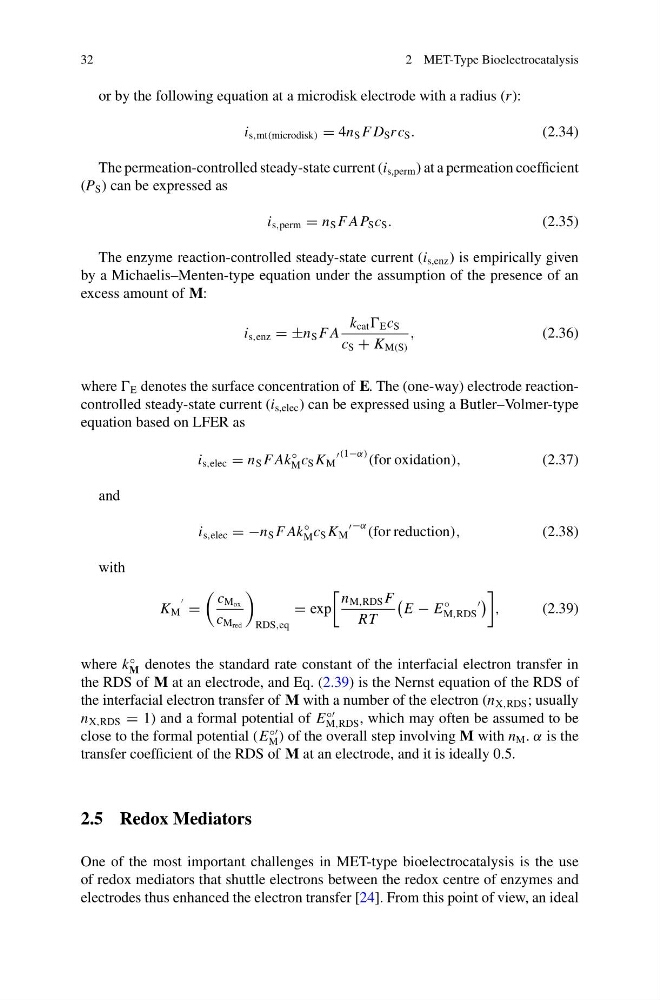
or by the following equation at a microdisk electrode with a radius (r):
i s,mt(microdisk) = 4n S F D S rc S .
(2.34)
The permeation-controlled steady-state current (i s,perm ) at a permeation coefficient
(P S ) can be expressed as
i s,perm = n S F AP S c S .
(2.35)
The enzyme reaction-controlled steady-state current (i s,enz ) is empirically given
by a Michaelis–Menten-type equation under the assumption of the presence of an
excess amount of M:
i s,enz = ±n S F A
k cat E c S
c S + K M(S)
,
(2.36)
where E denotes the surface concentration of E. The (one-way) electrode reactioncontrolled steady-state current (i s,elec ) can be expressed using a Butler–Volmer-type
equation based on LFER as
i s,elec = n S F Ak
◦
M c S K M
(1−α) (for oxidation),
(2.37)
and
i s,elec = −n S F Ak
◦
M c S K M
−α (for reduction),
(2.38)
with
K M
=
c M ox
c M red
RDS,eq
= exp
n M,RDS F
RT
E − E
◦
M,RDS
,
(2.39)
where k
◦
M denotes the standard rate constant of the interfacial electron transfer in
the RDS of M at an electrode, and Eq. (2.39) is the Nernst equation of the RDS of
the interfacial electron transfer of M with a number of the electron (n X,RDS ; usually
n X,RDS = 1) and a formal potential of E
◦◦
M,RDS , which may often be assumed to be
close to the formal potential (E
◦◦
M ) of the overall step involving M with n M . α is the
transfer coefficient of the RDS of M at an electrode, and it is ideally 0.5.
2.5 Redox Mediators
One of the most important challenges in MET-type bioelectrocatalysis is the use
of redox mediators that shuttle electrons between the redox centre of enzymes and
electrodes thus enhanced the electron transfer [24]. From this point of view, an ideal
2 MET-Type Bioelectrocatalysis
or by the following equation at a microdisk electrode with a radius (r):
i s,mt(microdisk) = 4n S F D S rc S .
(2.34)
The permeation-controlled steady-state current (i s,perm ) at a permeation coefficient
(P S ) can be expressed as
i s,perm = n S F AP S c S .
(2.35)
The enzyme reaction-controlled steady-state current (i s,enz ) is empirically given
by a Michaelis–Menten-type equation under the assumption of the presence of an
excess amount of M:
i s,enz = ±n S F A
k cat E c S
c S + K M(S)
,
(2.36)
where E denotes the surface concentration of E. The (one-way) electrode reactioncontrolled steady-state current (i s,elec ) can be expressed using a Butler–Volmer-type
equation based on LFER as
i s,elec = n S F Ak
◦
M c S K M
(1−α) (for oxidation),
(2.37)
and
i s,elec = −n S F Ak
◦
M c S K M
−α (for reduction),
(2.38)
with
K M
=
c M ox
c M red
RDS,eq
= exp
n M,RDS F
RT
E − E
◦
M,RDS
,
(2.39)
where k
◦
M denotes the standard rate constant of the interfacial electron transfer in
the RDS of M at an electrode, and Eq. (2.39) is the Nernst equation of the RDS of
the interfacial electron transfer of M with a number of the electron (n X,RDS ; usually
n X,RDS = 1) and a formal potential of E
◦◦
M,RDS , which may often be assumed to be
close to the formal potential (E
◦◦
M ) of the overall step involving M with n M . α is the
transfer coefficient of the RDS of M at an electrode, and it is ideally 0.5.
2.5 Redox Mediators
One of the most important challenges in MET-type bioelectrocatalysis is the use
of redox mediators that shuttle electrons between the redox centre of enzymes and
electrodes thus enhanced the electron transfer [24]. From this point of view, an ideal