

2.3 Mathematical Model in Immobilized Layers
31
A model of an actual MET-type glucose/O 2 biofuel cell composed of a cascade
of enzymes and redox mediators at the anode and cathode has also been reported
[22]. This model was used to describe a biofuel cell formerly reported by Sakai et al.
[23], in which both enzymatic systems were immobilized on porous carbon-fiber
electrodes. The simulated data agreed with the experimental results.
2.4 Serial Resistance Model for Steady-State Response
in MET-Type Bioelectrocatalysis
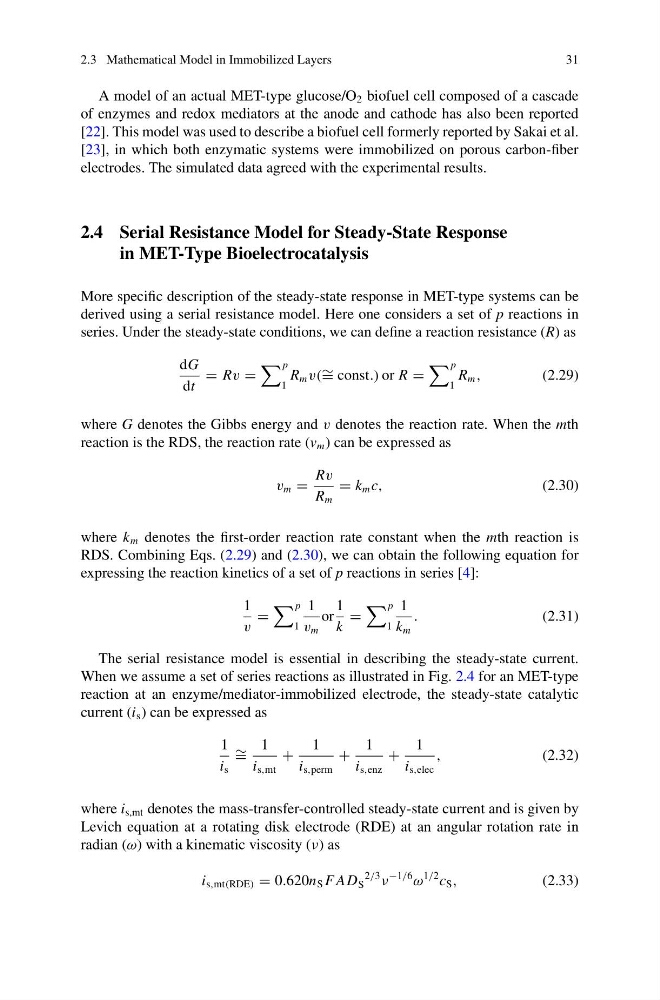
More specific description of the steady-state response in MET-type systems can be
derived using a serial resistance model. Here one considers a set of p reactions in
series. Under the steady-state conditions, we can define a reaction resistance (R) as
dG
dt
= Rv =
p
1
R m v( ∼ = const.) or R =
p
1
R m ,
(2.29)
where G denotes the Gibbs energy and v denotes the reaction rate. When the mth
reaction is the RDS, the reaction rate (v m ) can be expressed as
v m =
Rv
R m
= k m c,
(2.30)
where k m denotes the first-order reaction rate constant when the mth reaction is
RDS. Combining Eqs. (2.29) and (2.30), we can obtain the following equation for
expressing the reaction kinetics of a set of p reactions in series [4]:
1
v
=
p
1
1
v m
or
1
k
=
p
1
1
k m
.
(2.31)
The serial resistance model is essential in describing the steady-state current.
When we assume a set of series reactions as illustrated in Fig. 2.4 for an MET-type
reaction at an enzyme/mediator-immobilized electrode, the steady-state catalytic
current (i s ) can be expressed as
1
i s
∼ =
1
i s,mt
+
1
i s,perm
+
1
i s,enz
+
1
i s,elec
,
(2.32)
where i s,mt denotes the mass-transfer-controlled steady-state current and is given by
Levich equation at a rotating disk electrode (RDE) at an angular rotation rate in
radian (ω) with a kinematic viscosity (ν) as
i s,mt(RDE) = 0.620n S F AD S
2/3
ν
−1/6
ω
1/2 c S ,
(2.33)
31
A model of an actual MET-type glucose/O 2 biofuel cell composed of a cascade
of enzymes and redox mediators at the anode and cathode has also been reported
[22]. This model was used to describe a biofuel cell formerly reported by Sakai et al.
[23], in which both enzymatic systems were immobilized on porous carbon-fiber
electrodes. The simulated data agreed with the experimental results.
2.4 Serial Resistance Model for Steady-State Response
in MET-Type Bioelectrocatalysis
More specific description of the steady-state response in MET-type systems can be
derived using a serial resistance model. Here one considers a set of p reactions in
series. Under the steady-state conditions, we can define a reaction resistance (R) as
dG
dt
= Rv =
p
1
R m v( ∼ = const.) or R =
p
1
R m ,
(2.29)
where G denotes the Gibbs energy and v denotes the reaction rate. When the mth
reaction is the RDS, the reaction rate (v m ) can be expressed as
v m =
Rv
R m
= k m c,
(2.30)
where k m denotes the first-order reaction rate constant when the mth reaction is
RDS. Combining Eqs. (2.29) and (2.30), we can obtain the following equation for
expressing the reaction kinetics of a set of p reactions in series [4]:
1
v
=
p
1
1
v m
or
1
k
=
p
1
1
k m
.
(2.31)
The serial resistance model is essential in describing the steady-state current.
When we assume a set of series reactions as illustrated in Fig. 2.4 for an MET-type
reaction at an enzyme/mediator-immobilized electrode, the steady-state catalytic
current (i s ) can be expressed as
1
i s
∼ =
1
i s,mt
+
1
i s,perm
+
1
i s,enz
+
1
i s,elec
,
(2.32)
where i s,mt denotes the mass-transfer-controlled steady-state current and is given by
Levich equation at a rotating disk electrode (RDE) at an angular rotation rate in
radian (ω) with a kinematic viscosity (ν) as
i s,mt(RDE) = 0.620n S F AD S
2/3
ν
−1/6
ω
1/2 c S ,
(2.33)