

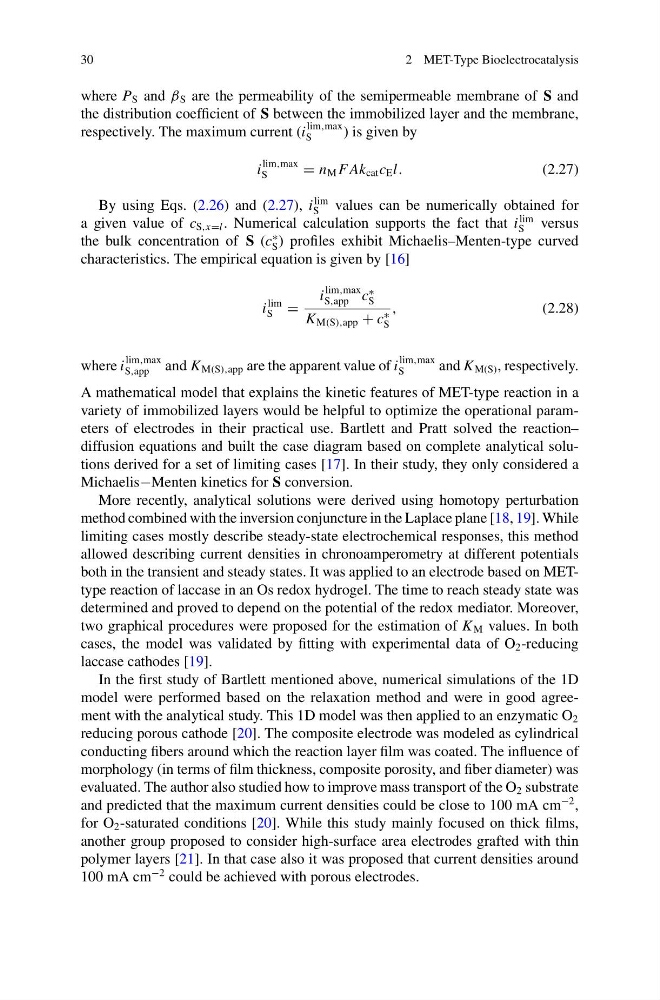
30
2 MET-Type Bioelectrocatalysis
where P S and β S are the permeability of the semipermeable membrane of S and
the distribution coefficient of S between the immobilized layer and the membrane,
respectively. The maximum current (i
lim,max
S
) is given by
i
lim,max
S
= n M F Ak cat c E l.
(2.27)
By using Eqs. (2.26) and (2.27), i
lim
S
values can be numerically obtained for
a given value of c S,x=l . Numerical calculation supports the fact that i
lim
S
versus
the bulk concentration of S (c
∗
S ) profiles exhibit Michaelis–Menten-type curved
characteristics. The empirical equation is given by [16]
i
lim
S =
i
lim,max
S,app c
∗
S
K M(S),app + c
∗
S
,
(2.28)
where i
lim,max
S,app
and K M(S),app are the apparent value of i
lim,max
S
and K M(S) , respectively.
A mathematical model that explains the kinetic features of MET-type reaction in a
variety of immobilized layers would be helpful to optimize the operational parameters of electrodes in their practical use. Bartlett and Pratt solved the reaction–
diffusion equations and built the case diagram based on complete analytical solutions derived for a set of limiting cases [17]. In their study, they only considered a
Michaelis−Menten kinetics for S conversion.
More recently, analytical solutions were derived using homotopy perturbation
method combined with the inversion conjuncture in the Laplace plane [18, 19]. While
limiting cases mostly describe steady-state electrochemical responses, this method
allowed describing current densities in chronoamperometry at different potentials
both in the transient and steady states. It was applied to an electrode based on METtype reaction of laccase in an Os redox hydrogel. The time to reach steady state was
determined and proved to depend on the potential of the redox mediator. Moreover,
two graphical procedures were proposed for the estimation of K M values. In both
cases, the model was validated by fitting with experimental data of O 2 -reducing
laccase cathodes [19].
In the first study of Bartlett mentioned above, numerical simulations of the 1D
model were performed based on the relaxation method and were in good agreement with the analytical study. This 1D model was then applied to an enzymatic O 2
reducing porous cathode [20]. The composite electrode was modeled as cylindrical
conducting fibers around which the reaction layer film was coated. The influence of
morphology (in terms of film thickness, composite porosity, and fiber diameter) was
evaluated. The author also studied how to improve mass transport of the O 2 substrate
and predicted that the maximum current densities could be close to 100 mA cm
−2 ,
for O 2 -saturated conditions [20]. While this study mainly focused on thick films,
another group proposed to consider high-surface area electrodes grafted with thin
polymer layers [21]. In that case also it was proposed that current densities around
100 mA cm
−2 could be achieved with porous electrodes.
2 MET-Type Bioelectrocatalysis
where P S and β S are the permeability of the semipermeable membrane of S and
the distribution coefficient of S between the immobilized layer and the membrane,
respectively. The maximum current (i
lim,max
S
) is given by
i
lim,max
S
= n M F Ak cat c E l.
(2.27)
By using Eqs. (2.26) and (2.27), i
lim
S
values can be numerically obtained for
a given value of c S,x=l . Numerical calculation supports the fact that i
lim
S
versus
the bulk concentration of S (c
∗
S ) profiles exhibit Michaelis–Menten-type curved
characteristics. The empirical equation is given by [16]
i
lim
S =
i
lim,max
S,app c
∗
S
K M(S),app + c
∗
S
,
(2.28)
where i
lim,max
S,app
and K M(S),app are the apparent value of i
lim,max
S
and K M(S) , respectively.
A mathematical model that explains the kinetic features of MET-type reaction in a
variety of immobilized layers would be helpful to optimize the operational parameters of electrodes in their practical use. Bartlett and Pratt solved the reaction–
diffusion equations and built the case diagram based on complete analytical solutions derived for a set of limiting cases [17]. In their study, they only considered a
Michaelis−Menten kinetics for S conversion.
More recently, analytical solutions were derived using homotopy perturbation
method combined with the inversion conjuncture in the Laplace plane [18, 19]. While
limiting cases mostly describe steady-state electrochemical responses, this method
allowed describing current densities in chronoamperometry at different potentials
both in the transient and steady states. It was applied to an electrode based on METtype reaction of laccase in an Os redox hydrogel. The time to reach steady state was
determined and proved to depend on the potential of the redox mediator. Moreover,
two graphical procedures were proposed for the estimation of K M values. In both
cases, the model was validated by fitting with experimental data of O 2 -reducing
laccase cathodes [19].
In the first study of Bartlett mentioned above, numerical simulations of the 1D
model were performed based on the relaxation method and were in good agreement with the analytical study. This 1D model was then applied to an enzymatic O 2
reducing porous cathode [20]. The composite electrode was modeled as cylindrical
conducting fibers around which the reaction layer film was coated. The influence of
morphology (in terms of film thickness, composite porosity, and fiber diameter) was
evaluated. The author also studied how to improve mass transport of the O 2 substrate
and predicted that the maximum current densities could be close to 100 mA cm
−2 ,
for O 2 -saturated conditions [20]. While this study mainly focused on thick films,
another group proposed to consider high-surface area electrodes grafted with thin
polymer layers [21]. In that case also it was proposed that current densities around
100 mA cm
−2 could be achieved with porous electrodes.