

2.3 Mathematical Model in Immobilized Layers
29
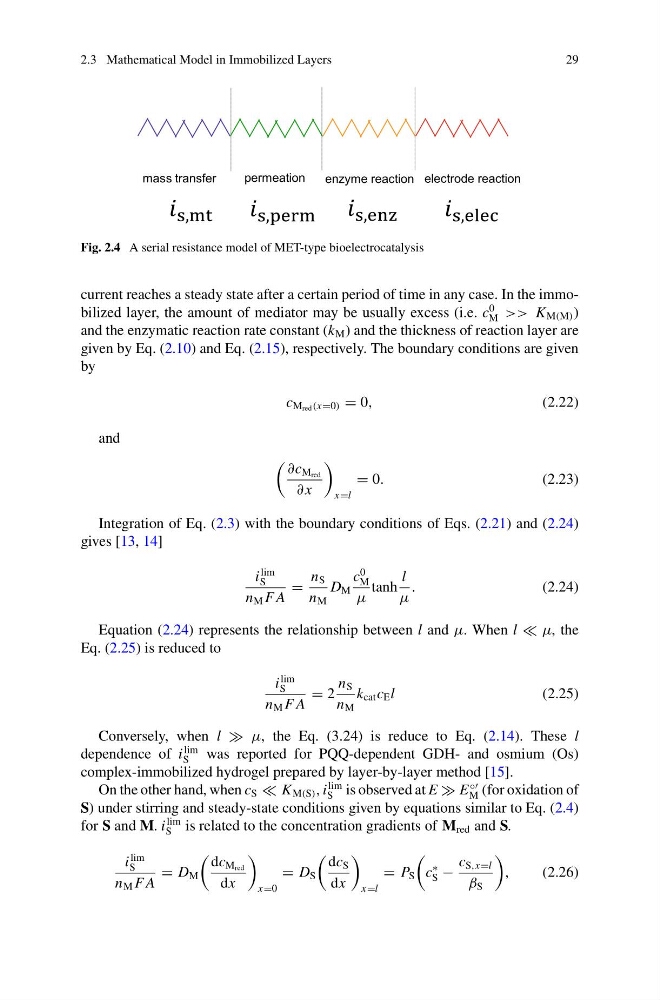
mass transfer
permeation
enzyme reaction electrode reaction
Fig. 2.4 A serial resistance model of MET-type bioelectrocatalysis
current reaches a steady state after a certain period of time in any case. In the immobilized layer, the amount of mediator may be usually excess (i.e. c
0
M >> K M(M) )
and the enzymatic reaction rate constant (k M ) and the thickness of reaction layer are
given by Eq. (2.10) and Eq. (2.15), respectively. The boundary conditions are given
by
c M red (x=0) = 0,
(2.22)
and
∂c M red
∂ x
x=l
= 0.
(2.23)
Integration of Eq. (2.3) with the boundary conditions of Eqs. (2.21) and (2.24)
gives [13, 14]
i
lim
S
n M F A
=
n S
n M
D M
c
0
M
μ
tanh
l
μ
.
(2.24)
Equation (2.24) represents the relationship between l and μ. When l μ, the
Eq. (2.25) is reduced to
i
lim
S
n M F A
= 2
n S
n M
k cat c E l
(2.25)
Conversely, when l μ, the Eq. (3.24) is reduce to Eq. (2.14). These l
dependence of i
lim
S
was reported for PQQ-dependent GDH- and osmium (Os)
complex-immobilized hydrogel prepared by layer-by-layer method [15].
On the other hand, when c S K M(S) , i
lim
S is observed at E E
◦◦
M (for oxidation of
S) under stirring and steady-state conditions given by equations similar to Eq. (2.4)
for S and M. i
lim
S is related to the concentration gradients of M red and S.
i
lim
S
n M F A
= D M
dc M red
dx
x=0
= D S
dc S
dx
x=l
= P S
c
∗
S −
c S,x=l
β S
,
(2.26)
29
mass transfer
permeation
enzyme reaction electrode reaction
Fig. 2.4 A serial resistance model of MET-type bioelectrocatalysis
current reaches a steady state after a certain period of time in any case. In the immobilized layer, the amount of mediator may be usually excess (i.e. c
0
M >> K M(M) )
and the enzymatic reaction rate constant (k M ) and the thickness of reaction layer are
given by Eq. (2.10) and Eq. (2.15), respectively. The boundary conditions are given
by
c M red (x=0) = 0,
(2.22)
and
∂c M red
∂ x
x=l
= 0.
(2.23)
Integration of Eq. (2.3) with the boundary conditions of Eqs. (2.21) and (2.24)
gives [13, 14]
i
lim
S
n M F A
=
n S
n M
D M
c
0
M
μ
tanh
l
μ
.
(2.24)
Equation (2.24) represents the relationship between l and μ. When l μ, the
Eq. (2.25) is reduced to
i
lim
S
n M F A
= 2
n S
n M
k cat c E l
(2.25)
Conversely, when l μ, the Eq. (3.24) is reduce to Eq. (2.14). These l
dependence of i
lim
S
was reported for PQQ-dependent GDH- and osmium (Os)
complex-immobilized hydrogel prepared by layer-by-layer method [15].
On the other hand, when c S K M(S) , i
lim
S is observed at E E
◦◦
M (for oxidation of
S) under stirring and steady-state conditions given by equations similar to Eq. (2.4)
for S and M. i
lim
S is related to the concentration gradients of M red and S.
i
lim
S
n M F A
= D M
dc M red
dx
x=0
= D S
dc S
dx
x=l
= P S
c
∗
S −
c S,x=l
β S
,
(2.26)