

28
2 MET-Type Bioelectrocatalysis
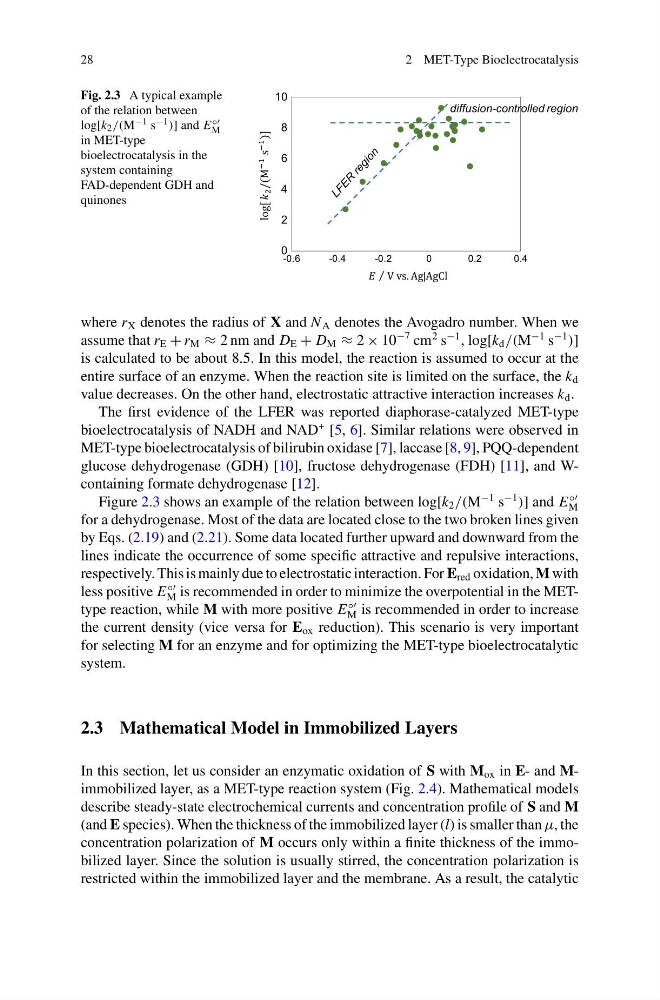
Fig. 2.3 A typical example
of the relation between
log[k 2 /(M −1 s −1 )] and E ◦◦
M
in MET-type
bioelectrocatalysis in the
system containing
FAD-dependent GDH and
quinones
0
2
4
6
8
10
-0.6
-0.4
-0.2
0
0.2
0.4
diffusion-controlled region
where r X denotes the radius of X and N A denotes the Avogadro number. When we
assume that r E + r M ≈ 2 nm and D E + D M ≈ 2 × 10
−7 cm
2 s
−1 , log[k d /(M
−1 s
−1
)]
is calculated to be about 8.5. In this model, the reaction is assumed to occur at the
entire surface of an enzyme. When the reaction site is limited on the surface, the k d
value decreases. On the other hand, electrostatic attractive interaction increases k d .
The first evidence of the LFER was reported diaphorase-catalyzed MET-type
bioelectrocatalysis of NADH and NAD
+ [5, 6]. Similar relations were observed in
MET-type bioelectrocatalysis of bilirubin oxidase [7], laccase [8, 9], PQQ-dependent
glucose dehydrogenase (GDH) [10], fructose dehydrogenase (FDH) [11], and Wcontaining formate dehydrogenase [12].
Figure 2.3 shows an example of the relation between log[k 2 /(M
−1 s
−1
)] and E
◦◦
M
for a dehydrogenase. Most of the data are located close to the two broken lines given
by Eqs. (2.19) and (2.21). Some data located further upward and downward from the
lines indicate the occurrence of some specific attractive and repulsive interactions,
respectively. This is mainly due to electrostatic interaction. For E red oxidation, M with
less positive E
◦◦
M is recommended in order to minimize the overpotential in the METtype reaction, while M with more positive E
◦◦
M is recommended in order to increase
the current density (vice versa for E ox reduction). This scenario is very important
for selecting M for an enzyme and for optimizing the MET-type bioelectrocatalytic
system.
2.3 Mathematical Model in Immobilized Layers
In this section, let us consider an enzymatic oxidation of S with M ox in E- and Mimmobilized layer, as a MET-type reaction system (Fig. 2.4). Mathematical models
describe steady-state electrochemical currents and concentration profile of S and M
(and E species). When the thickness of the immobilized layer (l) is smaller than μ, the
concentration polarization of M occurs only within a finite thickness of the immobilized layer. Since the solution is usually stirred, the concentration polarization is
restricted within the immobilized layer and the membrane. As a result, the catalytic
2 MET-Type Bioelectrocatalysis
Fig. 2.3 A typical example
of the relation between
log[k 2 /(M −1 s −1 )] and E ◦◦
M
in MET-type
bioelectrocatalysis in the
system containing
FAD-dependent GDH and
quinones
0
2
4
6
8
10
-0.6
-0.4
-0.2
0
0.2
0.4
diffusion-controlled region
where r X denotes the radius of X and N A denotes the Avogadro number. When we
assume that r E + r M ≈ 2 nm and D E + D M ≈ 2 × 10
−7 cm
2 s
−1 , log[k d /(M
−1 s
−1
)]
is calculated to be about 8.5. In this model, the reaction is assumed to occur at the
entire surface of an enzyme. When the reaction site is limited on the surface, the k d
value decreases. On the other hand, electrostatic attractive interaction increases k d .
The first evidence of the LFER was reported diaphorase-catalyzed MET-type
bioelectrocatalysis of NADH and NAD
+ [5, 6]. Similar relations were observed in
MET-type bioelectrocatalysis of bilirubin oxidase [7], laccase [8, 9], PQQ-dependent
glucose dehydrogenase (GDH) [10], fructose dehydrogenase (FDH) [11], and Wcontaining formate dehydrogenase [12].
Figure 2.3 shows an example of the relation between log[k 2 /(M
−1 s
−1
)] and E
◦◦
M
for a dehydrogenase. Most of the data are located close to the two broken lines given
by Eqs. (2.19) and (2.21). Some data located further upward and downward from the
lines indicate the occurrence of some specific attractive and repulsive interactions,
respectively. This is mainly due to electrostatic interaction. For E red oxidation, M with
less positive E
◦◦
M is recommended in order to minimize the overpotential in the METtype reaction, while M with more positive E
◦◦
M is recommended in order to increase
the current density (vice versa for E ox reduction). This scenario is very important
for selecting M for an enzyme and for optimizing the MET-type bioelectrocatalytic
system.
2.3 Mathematical Model in Immobilized Layers
In this section, let us consider an enzymatic oxidation of S with M ox in E- and Mimmobilized layer, as a MET-type reaction system (Fig. 2.4). Mathematical models
describe steady-state electrochemical currents and concentration profile of S and M
(and E species). When the thickness of the immobilized layer (l) is smaller than μ, the
concentration polarization of M occurs only within a finite thickness of the immobilized layer. Since the solution is usually stirred, the concentration polarization is
restricted within the immobilized layer and the membrane. As a result, the catalytic