

2.2 Selection of Mediators
27
2.2 Selection of Mediators
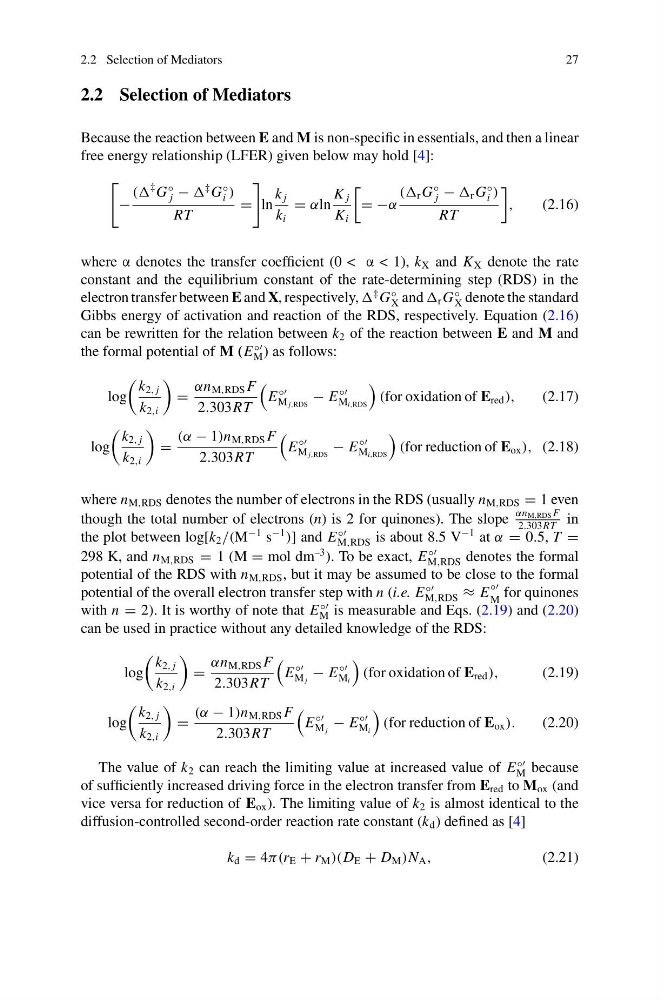
Because the reaction between E and M is non-specific in essentials, and then a linear
free energy relationship (LFER) given below may hold [4]:
−
((
‡ G
◦
j −
‡ G
◦
i )
RT
=
ln
k j
k i
= αln
K j
K i
= −α
(( r G
◦
j − r G
◦
i )
RT
,
(2.16)
where α denotes the transfer coefficient (0 < α < 1), k X and K X denote the rate
constant and the equilibrium constant of the rate-determining step (RDS) in the
electron transfer between E and X, respectively,
‡ G
◦
X and r G
◦
X denote the standard
Gibbs energy of activation and reaction of the RDS, respectively. Equation (2.16)
can be rewritten for the relation between k 2 of the reaction between E and M and
the formal potential of M (E
◦◦
M ) as follows:
log
k 2, j
k 2,i
=
αn M,RDS F
2.303RT
E
◦◦
M j,RDS
− E
◦◦
M i,RDS
(for oxidation of E red ),
(2.17)
log
k 2, j
k 2,i
=
(α − 1)n M,RDS F
2.303RT
E
◦◦
M j,RDS
− E
◦◦
M i,RDS
(for reduction of E ox ), (2.18)
where n M,RDS denotes the number of electrons in the RDS (usually n M,RDS = 1 even
though the total number of electrons (n) is 2 for quinones). The slope
αn M,RDS F
2.303RT
in
the plot between log[k 2 /(M
−1 s
−1
)] and E
◦◦
M,RDS is about 8.5 V
−1 at α = 0.5, T =
298 K, and n M,RDS = 1 (M = mol dm
–3 ). To be exact, E
◦◦
M,RDS denotes the formal
potential of the RDS with n M,RDS , but it may be assumed to be close to the formal
potential of the overall electron transfer step with n (i.e. E
◦◦
M,RDS ≈ E
◦◦
M
for quinones
with n = 2). It is worthy of note that E
◦◦
M is measurable and Eqs. (2.19) and (2.20)
can be used in practice without any detailed knowledge of the RDS:
log
k 2, j
k 2,i
=
αn M,RDS F
2.303RT
E
◦◦
M j
− E
◦◦
M i
(for oxidation of E red ),
(2.19)
log
k 2, j
k 2,i
=
(α − 1)n M,RDS F
2.303RT
E
◦◦
M j
− E
◦◦
M i
(for reduction of E ox ).
(2.20)
The value of k 2 can reach the limiting value at increased value of E
◦◦
M because
of sufficiently increased driving force in the electron transfer from E red to M ox (and
vice versa for reduction of E ox ). The limiting value of k 2 is almost identical to the
diffusion-controlled second-order reaction rate constant (k d ) defined as [4]
k d = 4π(r E + r M )(D E + D M )N A ,
(2.21)
27
2.2 Selection of Mediators
Because the reaction between E and M is non-specific in essentials, and then a linear
free energy relationship (LFER) given below may hold [4]:
−
((
‡ G
◦
j −
‡ G
◦
i )
RT
=
ln
k j
k i
= αln
K j
K i
= −α
(( r G
◦
j − r G
◦
i )
RT
,
(2.16)
where α denotes the transfer coefficient (0 < α < 1), k X and K X denote the rate
constant and the equilibrium constant of the rate-determining step (RDS) in the
electron transfer between E and X, respectively,
‡ G
◦
X and r G
◦
X denote the standard
Gibbs energy of activation and reaction of the RDS, respectively. Equation (2.16)
can be rewritten for the relation between k 2 of the reaction between E and M and
the formal potential of M (E
◦◦
M ) as follows:
log
k 2, j
k 2,i
=
αn M,RDS F
2.303RT
E
◦◦
M j,RDS
− E
◦◦
M i,RDS
(for oxidation of E red ),
(2.17)
log
k 2, j
k 2,i
=
(α − 1)n M,RDS F
2.303RT
E
◦◦
M j,RDS
− E
◦◦
M i,RDS
(for reduction of E ox ), (2.18)
where n M,RDS denotes the number of electrons in the RDS (usually n M,RDS = 1 even
though the total number of electrons (n) is 2 for quinones). The slope
αn M,RDS F
2.303RT
in
the plot between log[k 2 /(M
−1 s
−1
)] and E
◦◦
M,RDS is about 8.5 V
−1 at α = 0.5, T =
298 K, and n M,RDS = 1 (M = mol dm
–3 ). To be exact, E
◦◦
M,RDS denotes the formal
potential of the RDS with n M,RDS , but it may be assumed to be close to the formal
potential of the overall electron transfer step with n (i.e. E
◦◦
M,RDS ≈ E
◦◦
M
for quinones
with n = 2). It is worthy of note that E
◦◦
M is measurable and Eqs. (2.19) and (2.20)
can be used in practice without any detailed knowledge of the RDS:
log
k 2, j
k 2,i
=
αn M,RDS F
2.303RT
E
◦◦
M j
− E
◦◦
M i
(for oxidation of E red ),
(2.19)
log
k 2, j
k 2,i
=
(α − 1)n M,RDS F
2.303RT
E
◦◦
M j
− E
◦◦
M i
(for reduction of E ox ).
(2.20)
The value of k 2 can reach the limiting value at increased value of E
◦◦
M because
of sufficiently increased driving force in the electron transfer from E red to M ox (and
vice versa for reduction of E ox ). The limiting value of k 2 is almost identical to the
diffusion-controlled second-order reaction rate constant (k d ) defined as [4]
k d = 4π(r E + r M )(D E + D M )N A ,
(2.21)