

2.5 Redox Mediators
33
redox mediator should be able to react rapidly with enzymes and electrodes (i.e., as
fast heterogeneous and homogeneous electron transfer), be stable in both oxidized
and reduced forms under the working conditions, and do not participate in side reactions during the electron transfer [25]. On the other hand, as described above, E
◦◦
of redox mediators is another important consideration in the choice of mediators.
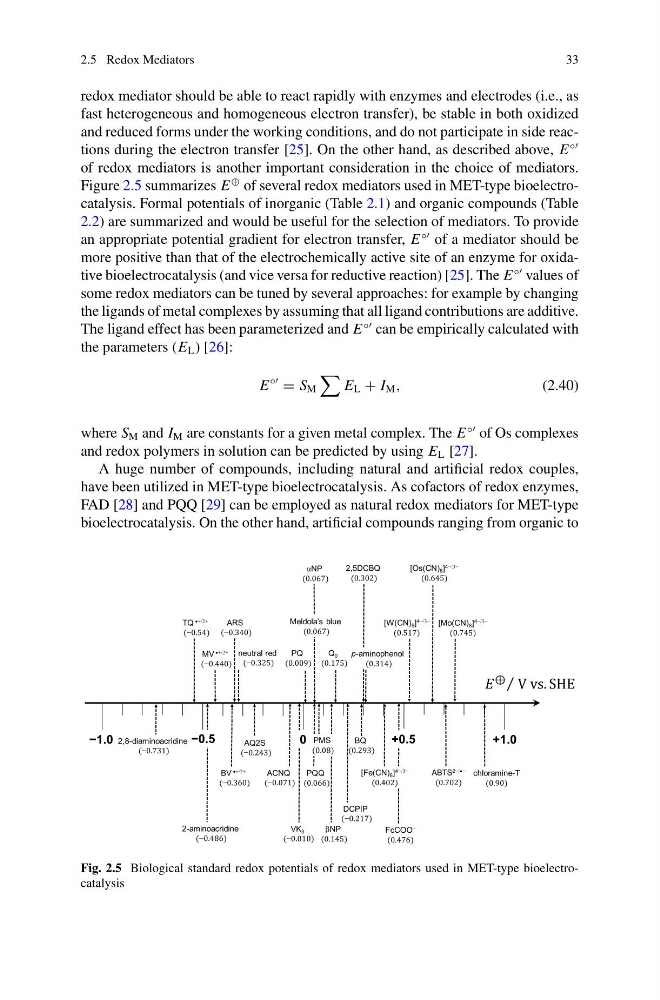
Figure 2.5 summarizes E
⊕ of several redox mediators used in MET-type bioelectrocatalysis. Formal potentials of inorganic (Table 2.1) and organic compounds (Table
2.2) are summarized and would be useful for the selection of mediators. To provide
an appropriate potential gradient for electron transfer, E
◦◦ of a mediator should be
more positive than that of the electrochemically active site of an enzyme for oxidative bioelectrocatalysis (and vice versa for reductive reaction) [25]. The E
◦◦ values of
some redox mediators can be tuned by several approaches: for example by changing
the ligands of metal complexes by assuming that all ligand contributions are additive.
The ligand effect has been parameterized and E
◦◦ can be empirically calculated with
the parameters (E L ) [26]:
E
◦◦
= S M
E L + I M ,
(2.40)
where S M and I M are constants for a given metal complex. The E
◦◦ of Os complexes
and redox polymers in solution can be predicted by using E L [27].
A huge number of compounds, including natural and artificial redox couples,
have been utilized in MET-type bioelectrocatalysis. As cofactors of redox enzymes,
FAD [28] and PQQ [29] can be employed as natural redox mediators for MET-type
bioelectrocatalysis. On the other hand, artificial compounds ranging from organic to
Fig. 2.5 Biological standard redox potentials of redox mediators used in MET-type bioelectrocatalysis
33
redox mediator should be able to react rapidly with enzymes and electrodes (i.e., as
fast heterogeneous and homogeneous electron transfer), be stable in both oxidized
and reduced forms under the working conditions, and do not participate in side reactions during the electron transfer [25]. On the other hand, as described above, E
◦◦
of redox mediators is another important consideration in the choice of mediators.
Figure 2.5 summarizes E
⊕ of several redox mediators used in MET-type bioelectrocatalysis. Formal potentials of inorganic (Table 2.1) and organic compounds (Table
2.2) are summarized and would be useful for the selection of mediators. To provide
an appropriate potential gradient for electron transfer, E
◦◦ of a mediator should be
more positive than that of the electrochemically active site of an enzyme for oxidative bioelectrocatalysis (and vice versa for reductive reaction) [25]. The E
◦◦ values of
some redox mediators can be tuned by several approaches: for example by changing
the ligands of metal complexes by assuming that all ligand contributions are additive.
The ligand effect has been parameterized and E
◦◦ can be empirically calculated with
the parameters (E L ) [26]:
E
◦◦
= S M
E L + I M ,
(2.40)
where S M and I M are constants for a given metal complex. The E
◦◦ of Os complexes
and redox polymers in solution can be predicted by using E L [27].
A huge number of compounds, including natural and artificial redox couples,
have been utilized in MET-type bioelectrocatalysis. As cofactors of redox enzymes,
FAD [28] and PQQ [29] can be employed as natural redox mediators for MET-type
bioelectrocatalysis. On the other hand, artificial compounds ranging from organic to
Fig. 2.5 Biological standard redox potentials of redox mediators used in MET-type bioelectrocatalysis