

8
1 Redox Proteins and Bioelectrocatalysis
1.2.3 Quinones [7, 12]
Quinones undergo sequential two-step single-electron transfer reduction coupled
with single- or two-proton transfer (that is, both electron and hydride ion transfers),
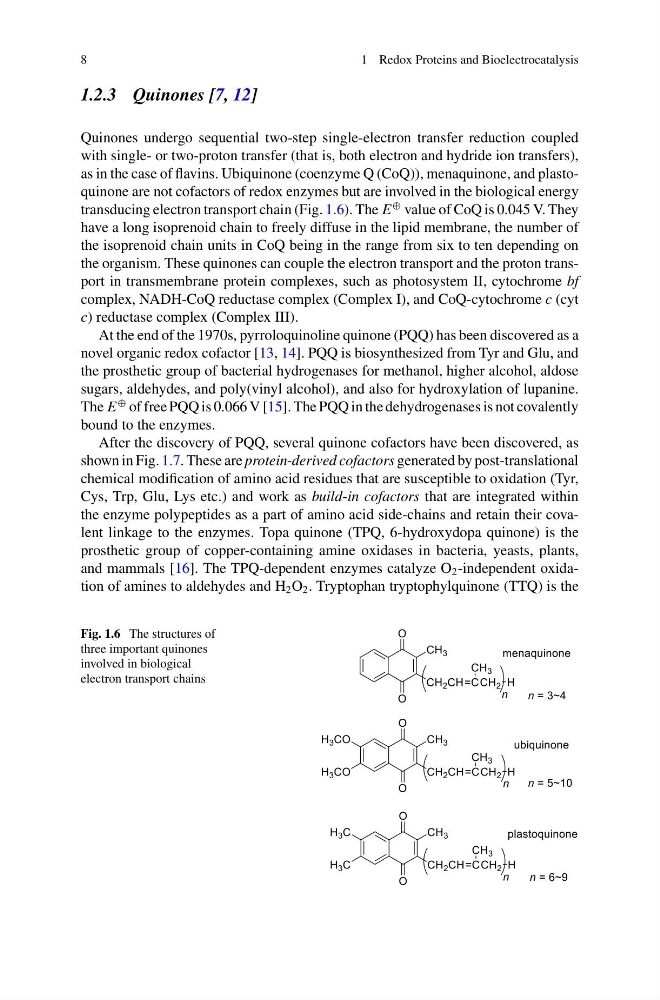
as in the case of flavins. Ubiquinone (coenzyme Q (CoQ)), menaquinone, and plastoquinone are not cofactors of redox enzymes but are involved in the biological energy
transducing electron transport chain (Fig. 1.6). The E
⊕ value of CoQ is 0.045 V. They
have a long isoprenoid chain to freely diffuse in the lipid membrane, the number of
the isoprenoid chain units in CoQ being in the range from six to ten depending on
the organism. These quinones can couple the electron transport and the proton transport in transmembrane protein complexes, such as photosystem II, cytochrome bf
complex, NADH-CoQ reductase complex (Complex I), and CoQ-cytochrome c (cyt
c) reductase complex (Complex III).
At the end of the 1970s, pyrroloquinoline quinone (PQQ) has been discovered as a
novel organic redox cofactor [13, 14]. PQQ is biosynthesized from Tyr and Glu, and
the prosthetic group of bacterial hydrogenases for methanol, higher alcohol, aldose
sugars, aldehydes, and poly(vinyl alcohol), and also for hydroxylation of lupanine.
The E
⊕ of free PQQ is 0.066 V [15]. The PQQ in the dehydrogenases is not covalently
bound to the enzymes.
After the discovery of PQQ, several quinone cofactors have been discovered, as
shown in Fig. 1.7. These are protein-derived cofactors generated by post-translational
chemical modification of amino acid residues that are susceptible to oxidation (Tyr,
Cys, Trp, Glu, Lys etc.) and work as build-in cofactors that are integrated within
the enzyme polypeptides as a part of amino acid side-chains and retain their covalent linkage to the enzymes. Topa quinone (TPQ, 6-hydroxydopa quinone) is the
prosthetic group of copper-containing amine oxidases in bacteria, yeasts, plants,
and mammals [16]. The TPQ-dependent enzymes catalyze O 2 -independent oxidation of amines to aldehydes and H 2 O 2 . Tryptophan tryptophylquinone (TTQ) is the
Fig. 1.6 The structures of
three important quinones
involved in biological
electron transport chains
1 Redox Proteins and Bioelectrocatalysis
1.2.3 Quinones [7, 12]
Quinones undergo sequential two-step single-electron transfer reduction coupled
with single- or two-proton transfer (that is, both electron and hydride ion transfers),
as in the case of flavins. Ubiquinone (coenzyme Q (CoQ)), menaquinone, and plastoquinone are not cofactors of redox enzymes but are involved in the biological energy
transducing electron transport chain (Fig. 1.6). The E
⊕ value of CoQ is 0.045 V. They
have a long isoprenoid chain to freely diffuse in the lipid membrane, the number of
the isoprenoid chain units in CoQ being in the range from six to ten depending on
the organism. These quinones can couple the electron transport and the proton transport in transmembrane protein complexes, such as photosystem II, cytochrome bf
complex, NADH-CoQ reductase complex (Complex I), and CoQ-cytochrome c (cyt
c) reductase complex (Complex III).
At the end of the 1970s, pyrroloquinoline quinone (PQQ) has been discovered as a
novel organic redox cofactor [13, 14]. PQQ is biosynthesized from Tyr and Glu, and
the prosthetic group of bacterial hydrogenases for methanol, higher alcohol, aldose
sugars, aldehydes, and poly(vinyl alcohol), and also for hydroxylation of lupanine.
The E
⊕ of free PQQ is 0.066 V [15]. The PQQ in the dehydrogenases is not covalently
bound to the enzymes.
After the discovery of PQQ, several quinone cofactors have been discovered, as
shown in Fig. 1.7. These are protein-derived cofactors generated by post-translational
chemical modification of amino acid residues that are susceptible to oxidation (Tyr,
Cys, Trp, Glu, Lys etc.) and work as build-in cofactors that are integrated within
the enzyme polypeptides as a part of amino acid side-chains and retain their covalent linkage to the enzymes. Topa quinone (TPQ, 6-hydroxydopa quinone) is the
prosthetic group of copper-containing amine oxidases in bacteria, yeasts, plants,
and mammals [16]. The TPQ-dependent enzymes catalyze O 2 -independent oxidation of amines to aldehydes and H 2 O 2 . Tryptophan tryptophylquinone (TTQ) is the
Fig. 1.6 The structures of
three important quinones
involved in biological
electron transport chains