

1.2 Redox Components
7
and
E = E
◦
2 +
RT
F
ln
a Sem
a Red
.
(1.9)
The Sem state is thermodynamically unstable (K S < 1) in aqueous solutions.
The third is that flavins can also undergo hydride transfers; flavins are able to
accept hydride at N5 of the flavin nucleus from NAD(P)H (Fig. 1.4c) and several
organic substances. The functions to catalyze both two-step single-electron transfer
and hydride ion transfer allow to link the electron transfer between several organic
substances including NAD(P)(H) and inorganic-redox centers in metal-containing
redox proteins.
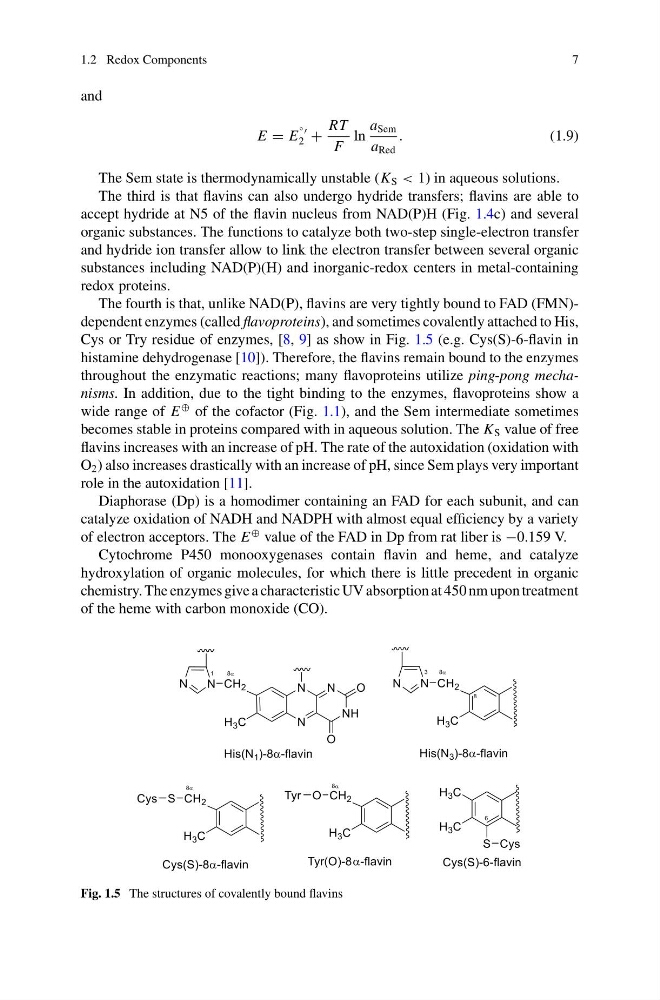
The fourth is that, unlike NAD(P), flavins are very tightly bound to FAD (FMN)dependent enzymes (called flavoproteins), and sometimes covalently attached to His,
Cys or Try residue of enzymes, [8, 9] as show in Fig. 1.5 (e.g. Cys(S)-6-flavin in
histamine dehydrogenase [10]). Therefore, the flavins remain bound to the enzymes
throughout the enzymatic reactions; many flavoproteins utilize ping-pong mechanisms. In addition, due to the tight binding to the enzymes, flavoproteins show a
wide range of E
⊕ of the cofactor (Fig. 1.1), and the Sem intermediate sometimes
becomes stable in proteins compared with in aqueous solution. The K S value of free
flavins increases with an increase of pH. The rate of the autoxidation (oxidation with
O 2 ) also increases drastically with an increase of pH, since Sem plays very important
role in the autoxidation [11].
Diaphorase (Dp) is a homodimer containing an FAD for each subunit, and can
catalyze oxidation of NADH and NADPH with almost equal efficiency by a variety
of electron acceptors. The E
⊕ value of the FAD in Dp from rat liber is −0.159 V.
Cytochrome P450 monooxygenases contain flavin and heme, and catalyze
hydroxylation of organic molecules, for which there is little precedent in organic
chemistry. The enzymes give a characteristic UV absorption at 450 nm upon treatment
of the heme with carbon monoxide (CO).
Fig. 1.5 The structures of covalently bound flavins
7
and
E = E
◦
2 +
RT
F
ln
a Sem
a Red
.
(1.9)
The Sem state is thermodynamically unstable (K S < 1) in aqueous solutions.
The third is that flavins can also undergo hydride transfers; flavins are able to
accept hydride at N5 of the flavin nucleus from NAD(P)H (Fig. 1.4c) and several
organic substances. The functions to catalyze both two-step single-electron transfer
and hydride ion transfer allow to link the electron transfer between several organic
substances including NAD(P)(H) and inorganic-redox centers in metal-containing
redox proteins.
The fourth is that, unlike NAD(P), flavins are very tightly bound to FAD (FMN)dependent enzymes (called flavoproteins), and sometimes covalently attached to His,
Cys or Try residue of enzymes, [8, 9] as show in Fig. 1.5 (e.g. Cys(S)-6-flavin in
histamine dehydrogenase [10]). Therefore, the flavins remain bound to the enzymes
throughout the enzymatic reactions; many flavoproteins utilize ping-pong mechanisms. In addition, due to the tight binding to the enzymes, flavoproteins show a
wide range of E
⊕ of the cofactor (Fig. 1.1), and the Sem intermediate sometimes
becomes stable in proteins compared with in aqueous solution. The K S value of free
flavins increases with an increase of pH. The rate of the autoxidation (oxidation with
O 2 ) also increases drastically with an increase of pH, since Sem plays very important
role in the autoxidation [11].
Diaphorase (Dp) is a homodimer containing an FAD for each subunit, and can
catalyze oxidation of NADH and NADPH with almost equal efficiency by a variety
of electron acceptors. The E
⊕ value of the FAD in Dp from rat liber is −0.159 V.
Cytochrome P450 monooxygenases contain flavin and heme, and catalyze
hydroxylation of organic molecules, for which there is little precedent in organic
chemistry. The enzymes give a characteristic UV absorption at 450 nm upon treatment
of the heme with carbon monoxide (CO).
Fig. 1.5 The structures of covalently bound flavins