

6
1 Redox Proteins and Bioelectrocatalysis
NAD +
NADP +
A
B
C
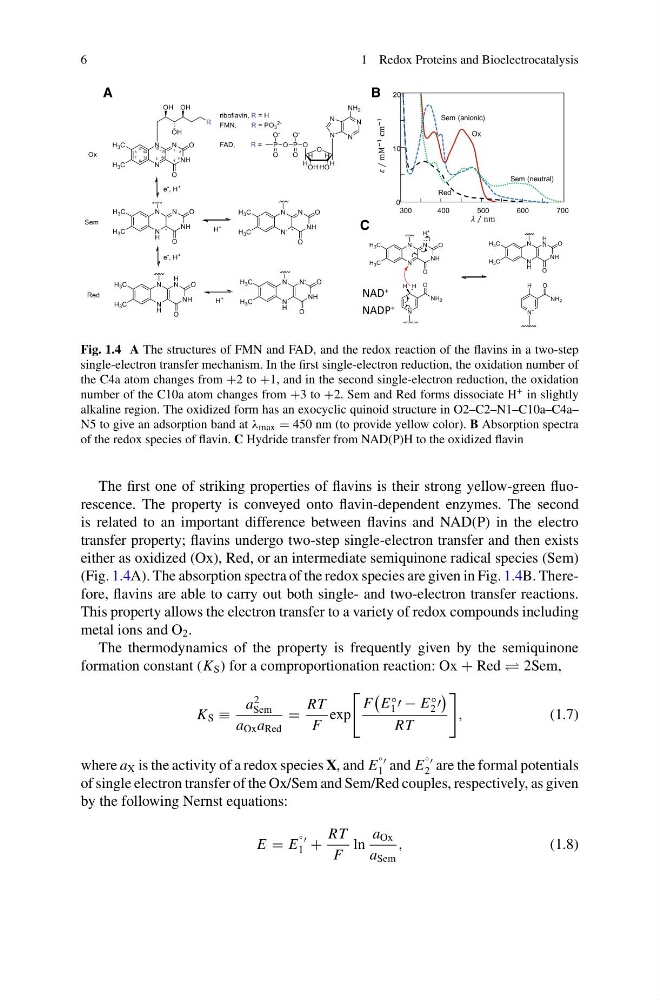
Fig. 1.4 A The structures of FMN and FAD, and the redox reaction of the flavins in a two-step
single-electron transfer mechanism. In the first single-electron reduction, the oxidation number of
the C4a atom changes from +2 to +1, and in the second single-electron reduction, the oxidation
number of the C10a atom changes from +3 to +2. Sem and Red forms dissociate H + in slightly
alkaline region. The oxidized form has an exocyclic quinoid structure in O2–C2–N1–C10a–C4a–
N5 to give an adsorption band at λ max = 450 nm (to provide yellow color). B Absorption spectra
of the redox species of flavin. C Hydride transfer from NAD(P)H to the oxidized flavin
The first one of striking properties of flavins is their strong yellow-green fluorescence. The property is conveyed onto flavin-dependent enzymes. The second
is related to an important difference between flavins and NAD(P) in the electro
transfer property; flavins undergo two-step single-electron transfer and then exists
either as oxidized (Ox), Red, or an intermediate semiquinone radical species (Sem)
(Fig. 1.4A). The absorption spectra of the redox species are given in Fig. 1.4B. Therefore, flavins are able to carry out both single- and two-electron transfer reactions.
This property allows the electron transfer to a variety of redox compounds including
metal ions and O 2 .
The thermodynamics of the property is frequently given by the semiquinone
formation constant (K S ) for a comproportionation reaction: Ox + Red 2Sem,
K S ≡
a
2
Sem
a Ox a Red
=
RT
F
exp
F
E
◦
1 − E
◦
2
RT
,
(1.7)
where a X is the activity of a redox species X, and E
◦
1 and E
◦
2 are the formal potentials
of single electron transfer of the Ox/Sem and Sem/Red couples, respectively, as given
by the following Nernst equations:
E = E
◦
1 +
RT
F
ln
a Ox
a Sem
,
(1.8)
1 Redox Proteins and Bioelectrocatalysis
NAD +
NADP +
A
B
C
Fig. 1.4 A The structures of FMN and FAD, and the redox reaction of the flavins in a two-step
single-electron transfer mechanism. In the first single-electron reduction, the oxidation number of
the C4a atom changes from +2 to +1, and in the second single-electron reduction, the oxidation
number of the C10a atom changes from +3 to +2. Sem and Red forms dissociate H + in slightly
alkaline region. The oxidized form has an exocyclic quinoid structure in O2–C2–N1–C10a–C4a–
N5 to give an adsorption band at λ max = 450 nm (to provide yellow color). B Absorption spectra
of the redox species of flavin. C Hydride transfer from NAD(P)H to the oxidized flavin
The first one of striking properties of flavins is their strong yellow-green fluorescence. The property is conveyed onto flavin-dependent enzymes. The second
is related to an important difference between flavins and NAD(P) in the electro
transfer property; flavins undergo two-step single-electron transfer and then exists
either as oxidized (Ox), Red, or an intermediate semiquinone radical species (Sem)
(Fig. 1.4A). The absorption spectra of the redox species are given in Fig. 1.4B. Therefore, flavins are able to carry out both single- and two-electron transfer reactions.
This property allows the electron transfer to a variety of redox compounds including
metal ions and O 2 .
The thermodynamics of the property is frequently given by the semiquinone
formation constant (K S ) for a comproportionation reaction: Ox + Red 2Sem,
K S ≡
a
2
Sem
a Ox a Red
=
RT
F
exp
F
E
◦
1 − E
◦
2
RT
,
(1.7)
where a X is the activity of a redox species X, and E
◦
1 and E
◦
2 are the formal potentials
of single electron transfer of the Ox/Sem and Sem/Red couples, respectively, as given
by the following Nernst equations:
E = E
◦
1 +
RT
F
ln
a Ox
a Sem
,
(1.8)