

1.2 Redox Components
5
NAD +
NADP +
A
B
C
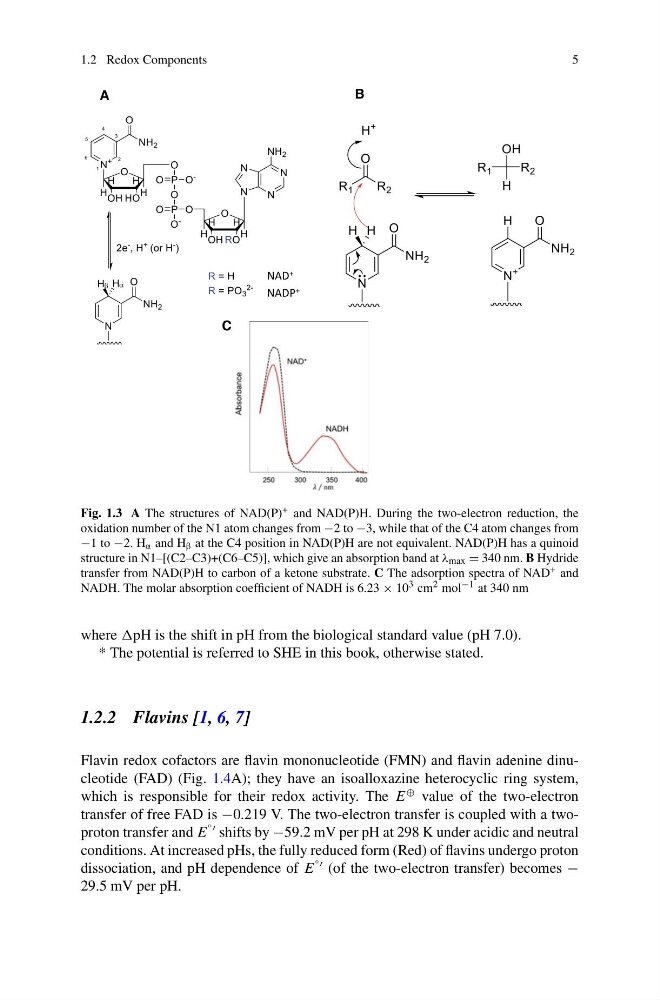
Fig. 1.3 A The structures of NAD(P) + and NAD(P)H. During the two-electron reduction, the
oxidation number of the N1 atom changes from −2 to −3, while that of the C4 atom changes from
−1 to −2. H α and H β at the C4 position in NAD(P)H are not equivalent. NAD(P)H has a quinoid
structure in N1–[(C2–C3)+(C6–C5)], which give an absorption band at λ max = 340 nm. B Hydride
transfer from NAD(P)H to carbon of a ketone substrate. C The adsorption spectra of NAD + and
NADH. The molar absorption coefficient of NADH is 6.23 × 10 3 cm 2 mol −1 at 340 nm
where pH is the shift in pH from the biological standard value (pH 7.0).
* The potential is referred to SHE in this book, otherwise stated.
1.2.2 Flavins [1, 6, 7]
Flavin redox cofactors are flavin mononucleotide (FMN) and flavin adenine dinucleotide (FAD) (Fig. 1.4A); they have an isoalloxazine heterocyclic ring system,
which is responsible for their redox activity. The E
⊕ value of the two-electron
transfer of free FAD is −0.219 V. The two-electron transfer is coupled with a twoproton transfer and E
◦ shifts by −59.2 mV per pH at 298 K under acidic and neutral
conditions. At increased pHs, the fully reduced form (Red) of flavins undergo proton
dissociation, and pH dependence of E
◦ (of the two-electron transfer) becomes −
29.5 mV per pH.
5
NAD +
NADP +
A
B
C
Fig. 1.3 A The structures of NAD(P) + and NAD(P)H. During the two-electron reduction, the
oxidation number of the N1 atom changes from −2 to −3, while that of the C4 atom changes from
−1 to −2. H α and H β at the C4 position in NAD(P)H are not equivalent. NAD(P)H has a quinoid
structure in N1–[(C2–C3)+(C6–C5)], which give an absorption band at λ max = 340 nm. B Hydride
transfer from NAD(P)H to carbon of a ketone substrate. C The adsorption spectra of NAD + and
NADH. The molar absorption coefficient of NADH is 6.23 × 10 3 cm 2 mol −1 at 340 nm
where pH is the shift in pH from the biological standard value (pH 7.0).
* The potential is referred to SHE in this book, otherwise stated.
1.2.2 Flavins [1, 6, 7]
Flavin redox cofactors are flavin mononucleotide (FMN) and flavin adenine dinucleotide (FAD) (Fig. 1.4A); they have an isoalloxazine heterocyclic ring system,
which is responsible for their redox activity. The E
⊕ value of the two-electron
transfer of free FAD is −0.219 V. The two-electron transfer is coupled with a twoproton transfer and E
◦ shifts by −59.2 mV per pH at 298 K under acidic and neutral
conditions. At increased pHs, the fully reduced form (Red) of flavins undergo proton
dissociation, and pH dependence of E
◦ (of the two-electron transfer) becomes −
29.5 mV per pH.