

1.2 Redox Components
9
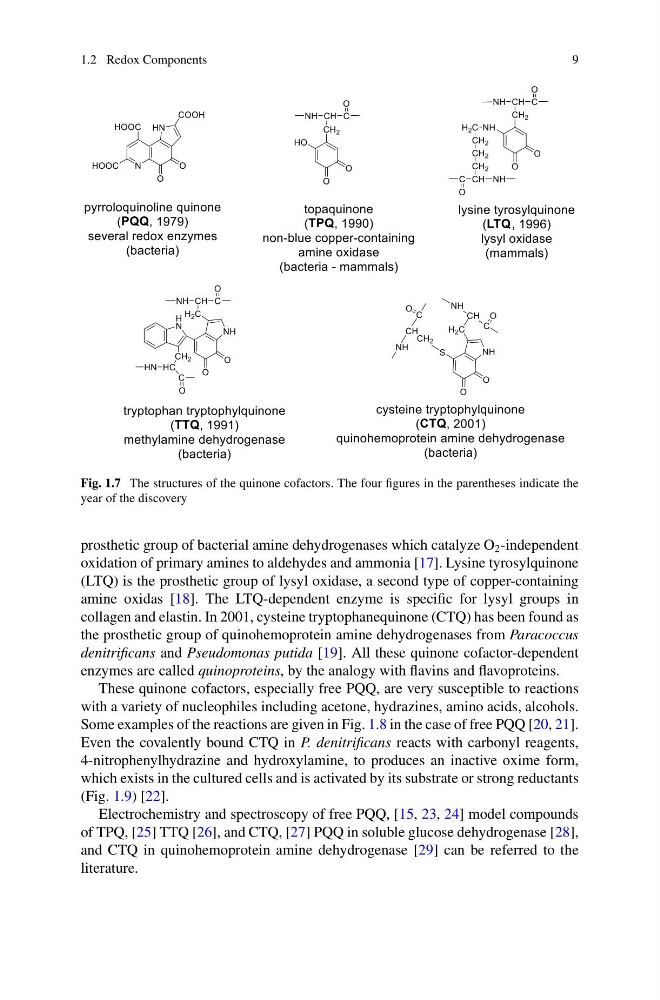
Fig. 1.7 The structures of the quinone cofactors. The four figures in the parentheses indicate the
year of the discovery
prosthetic group of bacterial amine dehydrogenases which catalyze O 2 -independent
oxidation of primary amines to aldehydes and ammonia [17]. Lysine tyrosylquinone
(LTQ) is the prosthetic group of lysyl oxidase, a second type of copper-containing
amine oxidas [18]. The LTQ-dependent enzyme is specific for lysyl groups in
collagen and elastin. In 2001, cysteine tryptophanequinone (CTQ) has been found as
the prosthetic group of quinohemoprotein amine dehydrogenases from Paracoccus
denitrificans and Pseudomonas putida [19]. All these quinone cofactor-dependent
enzymes are called quinoproteins, by the analogy with flavins and flavoproteins.
These quinone cofactors, especially free PQQ, are very susceptible to reactions
with a variety of nucleophiles including acetone, hydrazines, amino acids, alcohols.
Some examples of the reactions are given in Fig. 1.8 in the case of free PQQ [20, 21].
Even the covalently bound CTQ in P. denitrificans reacts with carbonyl reagents,
4-nitrophenylhydrazine and hydroxylamine, to produces an inactive oxime form,
which exists in the cultured cells and is activated by its substrate or strong reductants
(Fig. 1.9) [22].
Electrochemistry and spectroscopy of free PQQ, [15, 23, 24] model compounds
of TPQ, [25] TTQ [26], and CTQ, [27] PQQ in soluble glucose dehydrogenase [28],
and CTQ in quinohemoprotein amine dehydrogenase [29] can be referred to the
literature.
9
Fig. 1.7 The structures of the quinone cofactors. The four figures in the parentheses indicate the
year of the discovery
prosthetic group of bacterial amine dehydrogenases which catalyze O 2 -independent
oxidation of primary amines to aldehydes and ammonia [17]. Lysine tyrosylquinone
(LTQ) is the prosthetic group of lysyl oxidase, a second type of copper-containing
amine oxidas [18]. The LTQ-dependent enzyme is specific for lysyl groups in
collagen and elastin. In 2001, cysteine tryptophanequinone (CTQ) has been found as
the prosthetic group of quinohemoprotein amine dehydrogenases from Paracoccus
denitrificans and Pseudomonas putida [19]. All these quinone cofactor-dependent
enzymes are called quinoproteins, by the analogy with flavins and flavoproteins.
These quinone cofactors, especially free PQQ, are very susceptible to reactions
with a variety of nucleophiles including acetone, hydrazines, amino acids, alcohols.
Some examples of the reactions are given in Fig. 1.8 in the case of free PQQ [20, 21].
Even the covalently bound CTQ in P. denitrificans reacts with carbonyl reagents,
4-nitrophenylhydrazine and hydroxylamine, to produces an inactive oxime form,
which exists in the cultured cells and is activated by its substrate or strong reductants
(Fig. 1.9) [22].
Electrochemistry and spectroscopy of free PQQ, [15, 23, 24] model compounds
of TPQ, [25] TTQ [26], and CTQ, [27] PQQ in soluble glucose dehydrogenase [28],
and CTQ in quinohemoprotein amine dehydrogenase [29] can be referred to the
literature.