

112
6 Applications to Biosensors
n S F N S = Q S =
t 2
t 1
idt =
E M,f
−∞
i
v
dE =
n M
2 F
2 A M,t
RT
E M,f
−∞
K M,f
(1 + K M,f )
2
dE
=
n M F A M,t
K M,f
ln
1 + K M,f
+
1
1 + K M,f
.
(6.8)
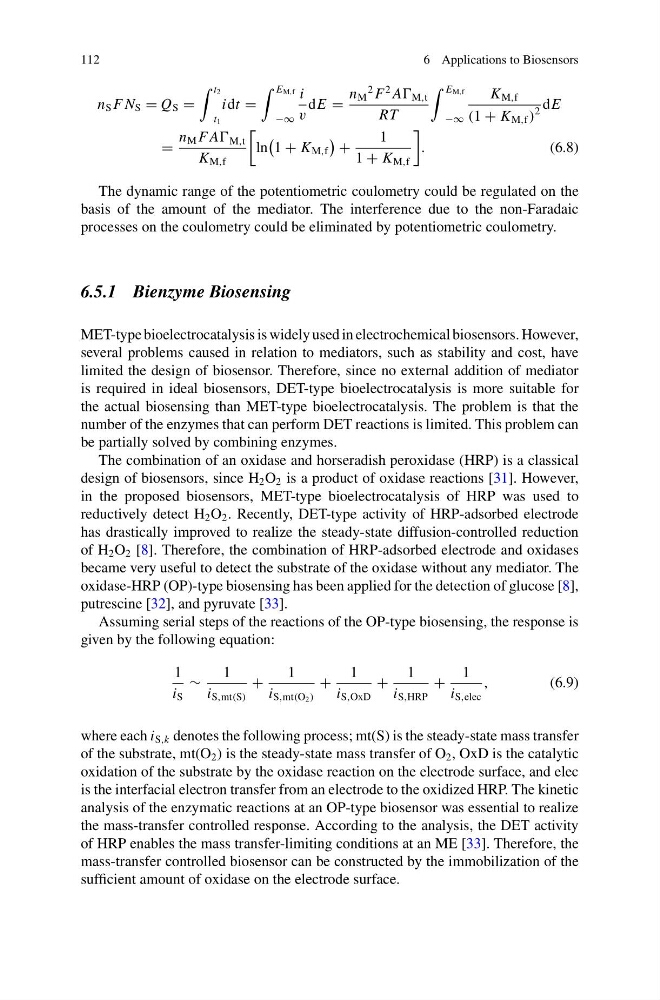
The dynamic range of the potentiometric coulometry could be regulated on the
basis of the amount of the mediator. The interference due to the non-Faradaic
processes on the coulometry could be eliminated by potentiometric coulometry.
6.5.1 Bienzyme Biosensing
MET-type bioelectrocatalysis is widely used in electrochemical biosensors. However,
several problems caused in relation to mediators, such as stability and cost, have
limited the design of biosensor. Therefore, since no external addition of mediator
is required in ideal biosensors, DET-type bioelectrocatalysis is more suitable for
the actual biosensing than MET-type bioelectrocatalysis. The problem is that the
number of the enzymes that can perform DET reactions is limited. This problem can
be partially solved by combining enzymes.
The combination of an oxidase and horseradish peroxidase (HRP) is a classical
design of biosensors, since H 2 O 2 is a product of oxidase reactions [31]. However,
in the proposed biosensors, MET-type bioelectrocatalysis of HRP was used to
reductively detect H 2 O 2 . Recently, DET-type activity of HRP-adsorbed electrode
has drastically improved to realize the steady-state diffusion-controlled reduction
of H 2 O 2 [8]. Therefore, the combination of HRP-adsorbed electrode and oxidases
became very useful to detect the substrate of the oxidase without any mediator. The
oxidase-HRP (OP)-type biosensing has been applied for the detection of glucose [8],
putrescine [32], and pyruvate [33].
Assuming serial steps of the reactions of the OP-type biosensing, the response is
given by the following equation:
1
i S
∼
1
i S,mt(S)
+
1
i S,mt(O 2 )
+
1
i S,OxD
+
1
i S,HRP
+
1
i S,elec
,
(6.9)
where each i S,k denotes the following process; mt(S) is the steady-state mass transfer
of the substrate, mt(O 2 ) is the steady-state mass transfer of O 2 , OxD is the catalytic
oxidation of the substrate by the oxidase reaction on the electrode surface, and elec
is the interfacial electron transfer from an electrode to the oxidized HRP. The kinetic
analysis of the enzymatic reactions at an OP-type biosensor was essential to realize
the mass-transfer controlled response. According to the analysis, the DET activity
of HRP enables the mass transfer-limiting conditions at an ME [33]. Therefore, the
mass-transfer controlled biosensor can be constructed by the immobilization of the
sufficient amount of oxidase on the electrode surface.
6 Applications to Biosensors
n S F N S = Q S =
t 2
t 1
idt =
E M,f
−∞
i
v
dE =
n M
2 F
2 A M,t
RT
E M,f
−∞
K M,f
(1 + K M,f )
2
dE
=
n M F A M,t
K M,f
ln
1 + K M,f
+
1
1 + K M,f
.
(6.8)
The dynamic range of the potentiometric coulometry could be regulated on the
basis of the amount of the mediator. The interference due to the non-Faradaic
processes on the coulometry could be eliminated by potentiometric coulometry.
6.5.1 Bienzyme Biosensing
MET-type bioelectrocatalysis is widely used in electrochemical biosensors. However,
several problems caused in relation to mediators, such as stability and cost, have
limited the design of biosensor. Therefore, since no external addition of mediator
is required in ideal biosensors, DET-type bioelectrocatalysis is more suitable for
the actual biosensing than MET-type bioelectrocatalysis. The problem is that the
number of the enzymes that can perform DET reactions is limited. This problem can
be partially solved by combining enzymes.
The combination of an oxidase and horseradish peroxidase (HRP) is a classical
design of biosensors, since H 2 O 2 is a product of oxidase reactions [31]. However,
in the proposed biosensors, MET-type bioelectrocatalysis of HRP was used to
reductively detect H 2 O 2 . Recently, DET-type activity of HRP-adsorbed electrode
has drastically improved to realize the steady-state diffusion-controlled reduction
of H 2 O 2 [8]. Therefore, the combination of HRP-adsorbed electrode and oxidases
became very useful to detect the substrate of the oxidase without any mediator. The
oxidase-HRP (OP)-type biosensing has been applied for the detection of glucose [8],
putrescine [32], and pyruvate [33].
Assuming serial steps of the reactions of the OP-type biosensing, the response is
given by the following equation:
1
i S
∼
1
i S,mt(S)
+
1
i S,mt(O 2 )
+
1
i S,OxD
+
1
i S,HRP
+
1
i S,elec
,
(6.9)
where each i S,k denotes the following process; mt(S) is the steady-state mass transfer
of the substrate, mt(O 2 ) is the steady-state mass transfer of O 2 , OxD is the catalytic
oxidation of the substrate by the oxidase reaction on the electrode surface, and elec
is the interfacial electron transfer from an electrode to the oxidized HRP. The kinetic
analysis of the enzymatic reactions at an OP-type biosensor was essential to realize
the mass-transfer controlled response. According to the analysis, the DET activity
of HRP enables the mass transfer-limiting conditions at an ME [33]. Therefore, the
mass-transfer controlled biosensor can be constructed by the immobilization of the
sufficient amount of oxidase on the electrode surface.