

6.5 Potentiometric Coulometry
111
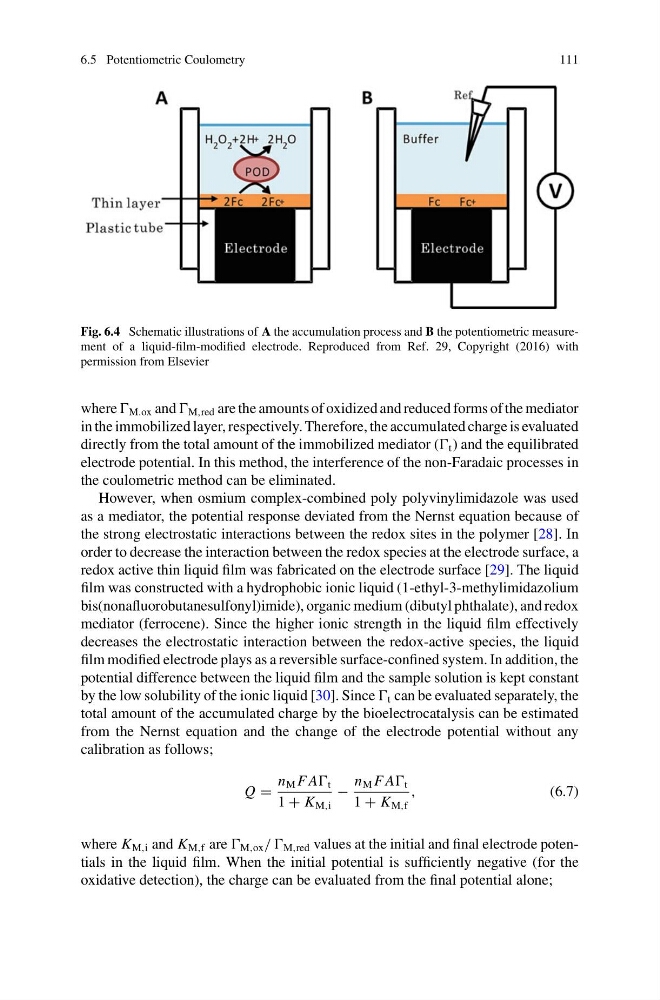
Fig. 6.4 Schematic illustrations of A the accumulation process and B the potentiometric measurement of a liquid-film-modified electrode. Reproduced from Ref. 29, Copyright (2016) with
permission from Elsevier
where M.ox and M,red are the amounts of oxidized and reduced forms of the mediator
in the immobilized layer, respectively. Therefore, the accumulated charge is evaluated
directly from the total amount of the immobilized mediator ( t ) and the equilibrated
electrode potential. In this method, the interference of the non-Faradaic processes in
the coulometric method can be eliminated.
However, when osmium complex-combined poly polyvinylimidazole was used
as a mediator, the potential response deviated from the Nernst equation because of
the strong electrostatic interactions between the redox sites in the polymer [28]. In
order to decrease the interaction between the redox species at the electrode surface, a
redox active thin liquid film was fabricated on the electrode surface [29]. The liquid
film was constructed with a hydrophobic ionic liquid (1-ethyl-3-methylimidazolium
bis(nonafluorobutanesulfonyl)imide), organic medium (dibutyl phthalate), and redox
mediator (ferrocene). Since the higher ionic strength in the liquid film effectively
decreases the electrostatic interaction between the redox-active species, the liquid
film modified electrode plays as a reversible surface-confined system. In addition, the
potential difference between the liquid film and the sample solution is kept constant
by the low solubility of the ionic liquid [30]. Since t can be evaluated separately, the
total amount of the accumulated charge by the bioelectrocatalysis can be estimated
from the Nernst equation and the change of the electrode potential without any
calibration as follows;
Q =
n M F A t
1 + K M,i
−
n M F A t
1 + K M,f
,
(6.7)
where K M,i and K M,f are M,ox / / M,red values at the initial and final electrode potentials in the liquid film. When the initial potential is sufficiently negative (for the
oxidative detection), the charge can be evaluated from the final potential alone;
111
Fig. 6.4 Schematic illustrations of A the accumulation process and B the potentiometric measurement of a liquid-film-modified electrode. Reproduced from Ref. 29, Copyright (2016) with
permission from Elsevier
where M.ox and M,red are the amounts of oxidized and reduced forms of the mediator
in the immobilized layer, respectively. Therefore, the accumulated charge is evaluated
directly from the total amount of the immobilized mediator ( t ) and the equilibrated
electrode potential. In this method, the interference of the non-Faradaic processes in
the coulometric method can be eliminated.
However, when osmium complex-combined poly polyvinylimidazole was used
as a mediator, the potential response deviated from the Nernst equation because of
the strong electrostatic interactions between the redox sites in the polymer [28]. In
order to decrease the interaction between the redox species at the electrode surface, a
redox active thin liquid film was fabricated on the electrode surface [29]. The liquid
film was constructed with a hydrophobic ionic liquid (1-ethyl-3-methylimidazolium
bis(nonafluorobutanesulfonyl)imide), organic medium (dibutyl phthalate), and redox
mediator (ferrocene). Since the higher ionic strength in the liquid film effectively
decreases the electrostatic interaction between the redox-active species, the liquid
film modified electrode plays as a reversible surface-confined system. In addition, the
potential difference between the liquid film and the sample solution is kept constant
by the low solubility of the ionic liquid [30]. Since t can be evaluated separately, the
total amount of the accumulated charge by the bioelectrocatalysis can be estimated
from the Nernst equation and the change of the electrode potential without any
calibration as follows;
Q =
n M F A t
1 + K M,i
−
n M F A t
1 + K M,f
,
(6.7)
where K M,i and K M,f are M,ox / / M,red values at the initial and final electrode potentials in the liquid film. When the initial potential is sufficiently negative (for the
oxidative detection), the charge can be evaluated from the final potential alone;