

110
6 Applications to Biosensors
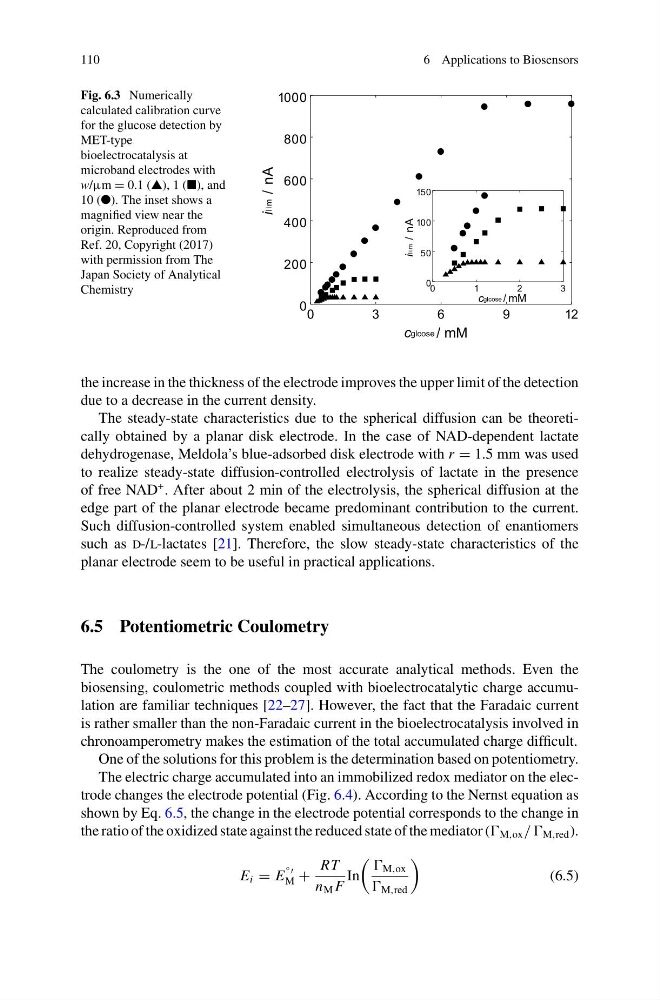
Fig. 6.3 Numerically
calculated calibration curve
for the glucose detection by
MET-type
bioelectrocatalysis at
microband electrodes with
w/µm = 0.1 (▲), 1 (), and
10 (●). The inset shows a
magnified view near the
origin. Reproduced from
Ref. 20, Copyright (2017)
with permission from The
Japan Society of Analytical
Chemistry
0
1
2
3
0
50
100
150
0
3
6
9
1 2
0
200
400
600
800
1000
cglcose / mM
ilim
/ nA
cglcose / mM
ilim
/ nA
the increase in the thickness of the electrode improves the upper limit of the detection
due to a decrease in the current density.
The steady-state characteristics due to the spherical diffusion can be theoretically obtained by a planar disk electrode. In the case of NAD-dependent lactate
dehydrogenase, Meldola’s blue-adsorbed disk electrode with r = 1.5 mm was used
to realize steady-state diffusion-controlled electrolysis of lactate in the presence
of free NAD
+ . After about 2 min of the electrolysis, the spherical diffusion at the
edge part of the planar electrode became predominant contribution to the current.
Such diffusion-controlled system enabled simultaneous detection of enantiomers
such as d-/l-lactates [21]. Therefore, the slow steady-state characteristics of the
planar electrode seem to be useful in practical applications.
6.5 Potentiometric Coulometry
The coulometry is the one of the most accurate analytical methods. Even the
biosensing, coulometric methods coupled with bioelectrocatalytic charge accumulation are familiar techniques [22–27]. However, the fact that the Faradaic current
is rather smaller than the non-Faradaic current in the bioelectrocatalysis involved in
chronoamperometry makes the estimation of the total accumulated charge difficult.
One of the solutions for this problem is the determination based on potentiometry.
The electric charge accumulated into an immobilized redox mediator on the electrode changes the electrode potential (Fig. 6.4). According to the Nernst equation as
shown by Eq. 6.5, the change in the electrode potential corresponds to the change in
the ratio of the oxidized state against the reduced state of the mediator ( M,ox / / M,red ).
E i = E
◦
M +
RT
n M F
In
M,ox
M,red
(6.5)
6 Applications to Biosensors
Fig. 6.3 Numerically
calculated calibration curve
for the glucose detection by
MET-type
bioelectrocatalysis at
microband electrodes with
w/µm = 0.1 (▲), 1 (), and
10 (●). The inset shows a
magnified view near the
origin. Reproduced from
Ref. 20, Copyright (2017)
with permission from The
Japan Society of Analytical
Chemistry
0
1
2
3
0
50
100
150
0
3
6
9
1 2
0
200
400
600
800
1000
cglcose / mM
ilim
/ nA
cglcose / mM
ilim
/ nA
the increase in the thickness of the electrode improves the upper limit of the detection
due to a decrease in the current density.
The steady-state characteristics due to the spherical diffusion can be theoretically obtained by a planar disk electrode. In the case of NAD-dependent lactate
dehydrogenase, Meldola’s blue-adsorbed disk electrode with r = 1.5 mm was used
to realize steady-state diffusion-controlled electrolysis of lactate in the presence
of free NAD
+ . After about 2 min of the electrolysis, the spherical diffusion at the
edge part of the planar electrode became predominant contribution to the current.
Such diffusion-controlled system enabled simultaneous detection of enantiomers
such as d-/l-lactates [21]. Therefore, the slow steady-state characteristics of the
planar electrode seem to be useful in practical applications.
6.5 Potentiometric Coulometry
The coulometry is the one of the most accurate analytical methods. Even the
biosensing, coulometric methods coupled with bioelectrocatalytic charge accumulation are familiar techniques [22–27]. However, the fact that the Faradaic current
is rather smaller than the non-Faradaic current in the bioelectrocatalysis involved in
chronoamperometry makes the estimation of the total accumulated charge difficult.
One of the solutions for this problem is the determination based on potentiometry.
The electric charge accumulated into an immobilized redox mediator on the electrode changes the electrode potential (Fig. 6.4). According to the Nernst equation as
shown by Eq. 6.5, the change in the electrode potential corresponds to the change in
the ratio of the oxidized state against the reduced state of the mediator ( M,ox / / M,red ).
E i = E
◦
M +
RT
n M F
In
M,ox
M,red
(6.5)